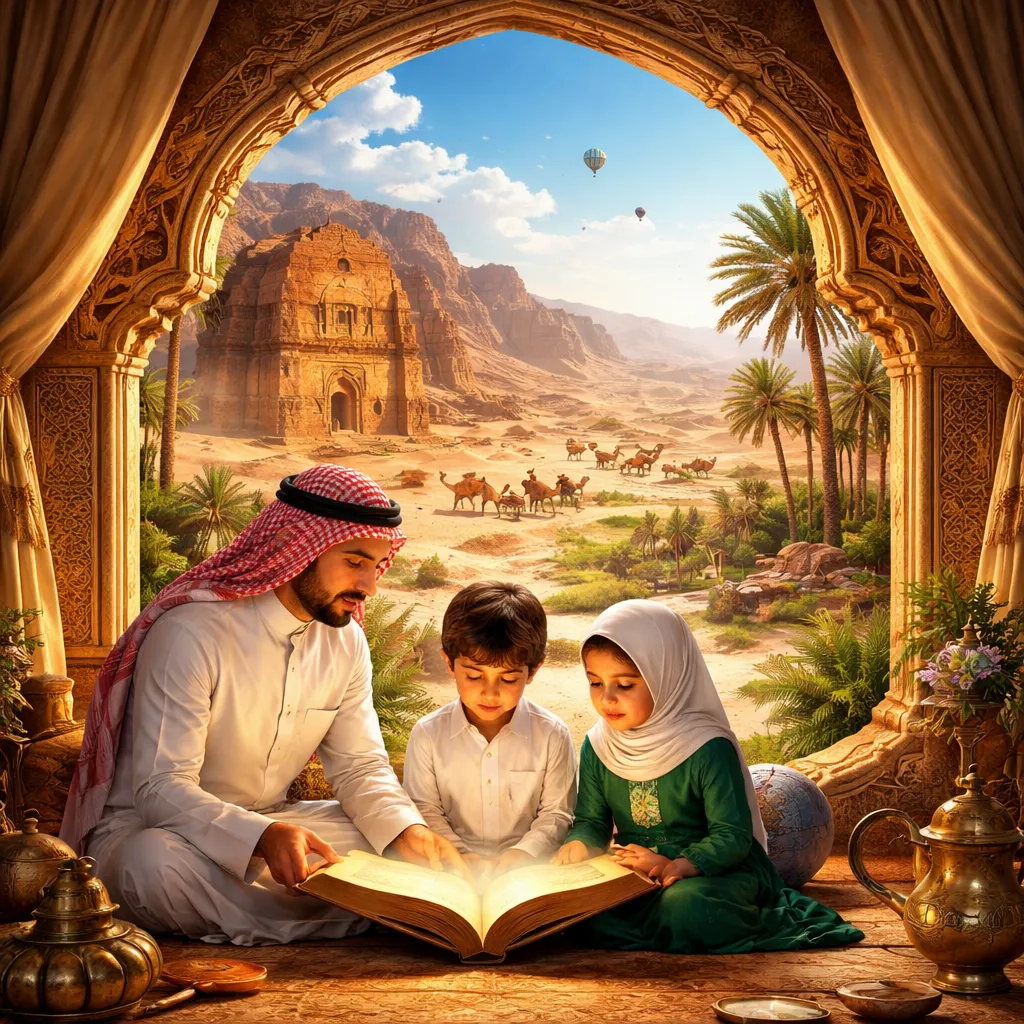

Introduction to Saudi Arabia Saudi Arabia is a very large country on the Arabian Peninsula. Most of its land is desert. Children there learn Arabic as their first language. They also study English in school. Learning reading: Saudi Arabia offers a chance to explore a land of sand, sun, and ancient history. Kids in this country read stories about camels and oases. They also learn about trading goods like spices and perfumes. Reading about Saudi Arabia feels like crossing a golden sea of sand. Your child can visit this desert kingdom from your living room. Each new word becomes a grain of sand in an hourglass. Let us turn that hourglass together.
Where Is Saudi Arabia? Saudi Arabia sits in Southwest Asia. This region is called the Middle East. The country touches the Red Sea on its west side. It touches the Arabian Gulf on its east side. Jordan and Iraq lie to the north. Kuwait and Qatar lie to the northeast. The United Arab Emirates and Oman lie to the east. Yemen lies to the south. The capital city is Riyadh. Riyadh sits in the center of the country. Saudi Arabia is very large. It covers 2.15 million square kilometers. That is about one-third the size of the United States. Learning reading: Saudi Arabia becomes real when you look at a map of Asia. Find the large peninsula that looks like a boot. That is the Arabian Peninsula. Saudi Arabia takes up most of that boot. Point to the capital Riyadh. Trace the long coastlines on the Red Sea and the Arabian Gulf. Say the name. "Sau-di A-ra-bi-a." You just found one of the largest countries in Asia.
Interesting Facts About Saudi Arabia Saudi Arabia has many amazing facts. First, it has no rivers that flow all year. Water comes from underground wells and desalination plants. Second, the country has the largest sand desert in the world. It is called the Empty Quarter or Rub' al Khali. Third, Saudi Arabia grows dates on palm trees. Date farms appear like green dots in the desert. Fourth, the country has very old rock art. People carved pictures of animals into stone thousands of years ago. Fifth, Saudi Arabia is home to Mecca and Medina. These are the two holiest cities in Islam. Sixth, the country has huge oil reserves. Oil makes the country wealthy. Learning reading: Saudi Arabia teaches words like "desert," "oasis," "date," and "camel." Each fact gives your child a new picture. Imagine a sea of sand with no water anywhere. Imagine green palm trees growing in the middle of that sand. Imagine a camel walking slowly across golden dunes. These pictures make words stay in your mind. Parents can ask: "Would you like to ride a camel across the desert?" "What does a date taste like?" Your child will feel curious about this dry but fascinating land.
Key Vocabulary About Saudi Arabia Let us learn six important words from Saudi Arabia.
First is "desert." A desert is a dry place with very little rain. Most of Saudi Arabia is desert.
Second is "oasis." An oasis is a green spot in the desert with water and plants.
Third is "camel." A camel is a large animal with a hump. Camels carry people across the desert.
Fourth is "date." A date is a sweet fruit that grows on palm trees. People eat them fresh or dried.
Fifth is "oil." Oil is a thick black liquid found underground. Saudi Arabia sells oil to other countries.
Sixth is "dune." A dune is a hill of sand shaped by the wind.
Learning reading: Saudi Arabia gives you these six words. Make a movement for each word. For desert, wipe your forehead like you are hot. For oasis, cup your hands and pretend to drink water. For camel, bend your back like a hump and walk slowly. For date, pretend to pick a fruit from a tall tree. For oil, make a pumping motion with your arm. For dune, make a wave shape with your hand. Say each word while you make the movement. Your child will learn faster when their body joins the lesson. Practice these movements while standing in line. Practice them while waiting for a video to load. Soon your child will say "camel" and bend their back without thinking.
The Famous People About Saudi Arabia Saudi Arabia has produced many famous people. One is King Salman bin Abdulaziz. He became the king of Saudi Arabia in 2015. Another famous person is Mohammed bin Salman. He is the crown prince and leads many changes in the country. There is also a famous astronaut named Sultan bin Salman Al Saud. He flew on a space shuttle in 1985. He was the first Arab astronaut in space. Another important person is Hatoon Al Fassi. She is a historian and writer. She studies women's history in Saudi Arabia. There is also a famous architect named Abdulaziz Al Fadhl. He designs beautiful buildings. These people show that Saudi Arabia has leaders, explorers, and thinkers. Learning reading: Saudi Arabia becomes inspiring through these names. Say each name. "King Sal-man bin Ab-dul-a-ziz." "Mo-ham-med bin Sal-man." "Sul-tan bin Sal-man Al Saud." "Ha-toon Al Fas-si." "Ab-dul-a-ziz Al Fadhl." Talk about what each person did. "What does the king do?" "He leads the country." "What did Sultan do?" "He flew to space." "What does Hatoon do?" "She writes history." Your child can imagine flying in a rocket or designing a building. These famous people prove that Saudi Arabia reaches for the stars.
Simple Sentences for Reading Practice Here are easy sentences about Saudi Arabia. Read each one aloud.
Saudi Arabia is a large country with many deserts.
The capital city Riyadh sits in the center of the country.
Camels walk across the sand dunes in the Empty Quarter.
An oasis provides water and shade for tired travelers.
Dates grow on tall palm trees in green valleys.
Saudi Arabia has no permanent rivers that flow all year.
Oil lies deep underground and makes the country rich.
The Red Sea touches the west side of Saudi Arabia.
Sultan bin Salman flew to space on a shuttle mission.
Hatoon Al Fassi writes books about women in Saudi history.
Learning reading: Saudi Arabia makes these sentences easy to practice. Read a sentence. Then ask your child to make the movement they learned. For sentence three, walk like a camel. For sentence four, pretend to drink from a cup. For sentence five, reach up like you are picking dates. For sentence seven, make a pumping motion for oil. The movement locks the sentence into memory. You can also play a whisper game. Whisper a sentence into your child's ear. They whisper it to the next person. The last person says the sentence out loud. See if it stays the same. This game builds listening and speaking at the same time.
Short Reading Passage About Saudi Arabia Read this passage together. It uses all the words we learned.
Saudi Arabia is a vast land of golden sand. The desert covers most of the country. Wind shapes the sand into tall dunes that move slowly over time. In the Empty Quarter, dunes stretch farther than the eye can see. No rivers flow through this desert. But water hides underground. Where water reaches the surface, an oasis appears. Green palm trees grow around the water. They produce sweet fruits called dates. People have eaten dates for thousands of years. Camels walk across the hot sand. Their wide feet do not sink. Their humps store fat for long journeys. Deep under the desert, oil waits to be pumped. Oil makes Saudi Arabia a wealthy nation. The Red Sea glitters on the west coast. Fish and coral fill its warm waters. The capital Riyadh rises from the desert like a modern oasis. Famous people from Saudi Arabia include an astronaut who flew in space and a historian who writes books. Learning reading: Saudi Arabia invites you to cross a desert in your mind. You feel the hot sun on your face. You see a camel walking ahead. You spot a green oasis in the distance. Now close your eyes. Imagine you ride on a camel. The animal sways gently. You see sand everywhere. Then you see palm trees. What do you do when you reach the oasis? Do you drink the water? Do you eat a sweet date?
This passage has 200 words. Read it slowly. Stop after each sentence. Ask your child to touch their nose when they hear a vocabulary word. Touch nose for "desert." Touch nose for "oasis." Touch nose for "camel." This keeps them listening. After the passage, ask your child to draw their favorite scene. Maybe they draw a camel. Maybe they draw an oasis. Maybe they draw the astronaut floating in space. Hang the drawing on the wall. You have just made Saudi Arabia part of your home.
Fun Questions About Saudi Arabia Use these questions to talk about this desert kingdom.
Would you rather ride a camel or walk across the desert? Why?
What would you pack for a trip to a very hot desert?
Why do you think dates grow so well in the desert?
How does an oasis help animals and people survive?
Would you like to climb a sand dune and roll down? Why or why not?
What does oil look like? Why is it so valuable?
Would you want to visit the Red Sea? What would you do there?
If you met Sultan bin Salman the astronaut, what would you ask him?
Why do you think people carved pictures on rocks thousands of years ago?
What would you name a new oasis you discovered in the desert?
Learning reading: Saudi Arabia turns every question into a journey. Parents answer first. "I would pack a lot of water and a hat to protect my head from the sun." Then your child answers. Let them be creative. If they say "I would pack a snow machine," say "That would feel wonderful in the hot desert. How would you carry it on a camel?" Keep the conversation flowing. You can also act out the answers. Pretend to ride a camel. Pretend to climb a dune. Pretend to pick dates from a tall tree. Ask one question during a walk. Ask another question while getting ready for bed. Saudi Arabia will become a familiar friend.
Tips for Learning English with This Topic Now let us bring Saudi Arabia into your home. First, eat some dates. Find them at a grocery store. Taste the sweet fruit. Say "date" with each bite. Second, build a sand dune in a small box. Use sand or brown sugar. Shape it with your hands. Say "dune" as you shape. Third, draw a camel. Give it one hump or two. Say "camel" when you finish. Fourth, pretend to pump oil. Make a pumping motion with your arm. Say "oil, oil, oil" as you pump. Fifth, find the Red Sea on a map. Trace the coastline. Say "Red Sea" as you trace. Sixth, watch a short video about the Empty Quarter. See the endless sand. Say "desert" when you see the big dunes. Learning reading: Saudi Arabia gives you these six tips. Do one tip each day. Do not worry about doing them perfectly. Just try. The taste of a date. The feel of sand. The sight of a camel. These experiences build stronger memories than worksheets. Learning English is like crossing a desert. You take one step at a time. You rest at oases. You keep going. So keep going. One word. One tip. One day at a time.
Your child will remember Saudi Arabia. They will remember the camels and the dates and the endless sand. But most of all, they will remember reading with you. That quiet time together builds a bridge between your home and the wider world. So keep this article on your phone. Keep it on your table. Read one sentence tonight. Ask one question tomorrow. Try one tip this weekend. Saudi Arabia is not a faraway mystery. It is right here every time you learn a new word together. Say one now. "Camel." Wonderful. Say another. "Oasis." Beautiful. You are already crossing the desert. Keep walking. The journey is full of wonders.