
Opening Introduction
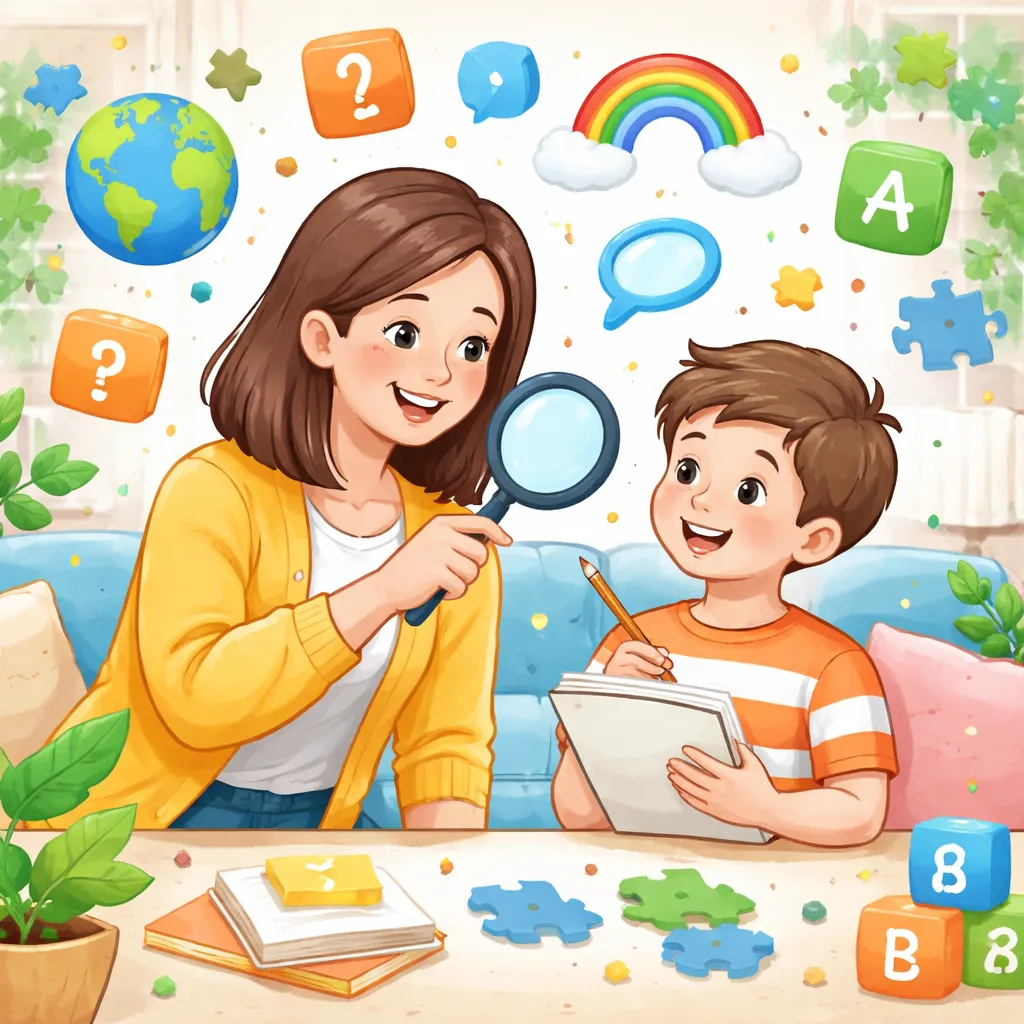
Leo*s mom is looking at a big box of English books. There are easy books and hard books. She wants to pick the best one for Leo. But how does she know which one is just right? She asks Leo, "How do you feel about your English?" Leo thinks. "I am okay," he says. But that does not help much. Mom has an idea. "Let's play some games," she says. "These games will help us be detectives. We will be assessing your child's English level at home. It is not a test. It is a fun way to see all the wonderful words you know." Leo likes the sound of that. Being a detective sounds cool. Let's start the investigation.
Core Knowledge Explanation
What does "assessing" mean? Assessing means checking. It is like a doctor checking your height and weight. It shows how you are growing. Assessing your English level is checking how your English is growing. Why do we do it? We do it to celebrate what you know. We also do it to see what you can learn next. It helps your parents and teachers help you better. But assessing your child's English level at home is not about grades or scores. It is about observation. Observation means watching and listening carefully.
How do we do it? We look at four main areas: listening, speaking, reading, and writing. First, listening. Can you understand simple English? Can you follow a one-step direction? "Please bring me the red cup." Can you follow a two-step direction? "Pick up your toy and put it in the box." Second, speaking. Can you say your name? Can you name common objects? Can you ask for what you want? "Can I have water, please?" Can you tell a simple story about your day? These are clues to your speaking level.
Third, reading. Do you know the letters? Can you read simple words? Can you read a short sentence? Do you understand what you read? Fourth, writing. Can you write your name? Can you copy words? Can you write a word you hear? Can you write a sentence about a picture? These are clues for reading and writing. The key is to do this during normal, fun activities. It should not feel like a quiz. It should feel like play. This is the secret to assessing your child's English level at home. You are playing games that give you information.
Remember, every child is different. Some are great at speaking but find reading hard. Some love reading but are shy to speak. That is okay. The goal is to get a full picture. A picture of all the amazing things you can do. And a picture of what you are ready to learn next. This helps your parents choose the right books, the right games, and the right way to talk with you. It makes learning English more fun and more effective.
Fun Interactive Learning
Let's play some detective games. These games are for assessing your child's English level at home. First, the "Listening Mission" game. Ask your parent to give you silly directions. "Touch your nose and then hop like a bunny." "Find something blue and bring it to me." See if you can do it. This checks your listening skills. Make it fun. Your parent can wear a detective hat. You can wear one too.
Second, the "Picture Story" game. Look at a picture from a storybook. Do not read the words. Just look at the picture. Tell a story about what you see. "The dog is running. The sun is shining. The boy is happy." This checks your speaking skills and your imagination. Your parent can write down the words you say. This is your story.
Third, the "Word Hunt" game. Get a simple book. Can you find the word "the" on a page? Can you point to a word that starts with "B"? Can you read the title? This checks your reading skills. Fourth, the "Secret Message" game. Your parent can say a simple word, like "cat". Can you write it? Or, they can show you a picture of a cat. Can you write the word? This checks your writing. If you can only write "c", that is great. If you can write the whole word, that is great too. Every step is a clue.
Play these games for a few minutes each week. Keep a "Detective Notebook". Draw a smiley face for each skill you try. Do not worry about right or wrong. The goal is to see what you can do. This is the fun way of assessing your child's English level at home. You are collecting clues about your own superpowers.
Expanded Learning
All over the world, teachers assess their students. In schools, they have tests. But the best teachers also watch their students every day. They listen to them talk. They watch them read. Your parents can be like teachers at home. Long ago, there were no formal tests. Parents knew what their children knew by living and working with them. Today, we have many tools. But the idea is the same. Knowing your level helps you grow.
In some countries, children learn many languages. Their parents might speak one language, and school is in another. They are always assessing their child's English level at home and in other languages too. It is a way to make sure the child is comfortable in both worlds. It is a way to celebrate being bilingual. Bilingual means knowing two languages. That is a special superpower.
Let's sing a detective song. Sing this to the tune of "Are You Sleeping?"
We're assessing, we're assessing, English skills, English skills! Listening and speaking, reading, writing, growing brains, growing brains! We are detectives, we are detectives, having fun, having fun! We are assessing, we are assessing, everyone, everyone!
What You Will Learn
You are learning about self-awareness and growth. You are learning new words: assessing, observation, direction, imagination, detective, formal, bilingual. You are learning about the four language skills.
You are learning helpful sentences. You can say, "Let's play a listening game." You can ask, "Can I try to read this word?" You can explain, "This game helps assess my English." You are using English to talk about your own learning journey. This is a smart thing to do.
You are building important skills. You are building metacognition. That means thinking about your own thinking. You are building communication. You talk about your skills. You are building confidence. You see what you can do. You are building a partnership with your parents. You work together to learn.
You are forming a reflective habit. The habit of noticing your progress. You learn that growth is a journey. You can be proud of every step. The process of assessing your child's English level at home teaches you to be an active participant in your own learning. You are not just a student. You are a detective on your own case.
Using What You Learned in Life
Use these detective games often. Ask your parent, "Can we do a listening mission today?" It can be a fun break. After you learn something new, like a new word, add it to your detective notebook. "Today I learned the word 'enormous'." This shows your growth. When you choose a new book, use your detective skills. Is it too easy? Too hard? Just right? You are now the expert on your own level.
At school, you can tell your teacher about the games you play. Your teacher will be impressed. You can even teach a friend the detective games. You can help assess each other in a fun way. Remember, the goal is not to label yourself as "good" or "bad". The goal is to map your journey. Every time you play, you are taking a snapshot of your amazing, growing brain. The habit of assessing your child's English level at home turns learning into a lifelong adventure of discovery.
Closing Encouragement
You are a fantastic language detective. You are a curious learner. You are a brave explorer of your own mind. I am so proud of you. Playing these assessment games shows you are smart and in charge of your learning.
Keep your detective notebook. Celebrate every clue. Enjoy the games. You are learning and having fun at the same time. That is the best way.
Remember, you are growing every day. Every word you learn is a new tool. Every sentence you speak is a new bridge. You are capable, you are observant, and you are on a wonderful path. Great work, my amazing language detective.