
Opening Introduction
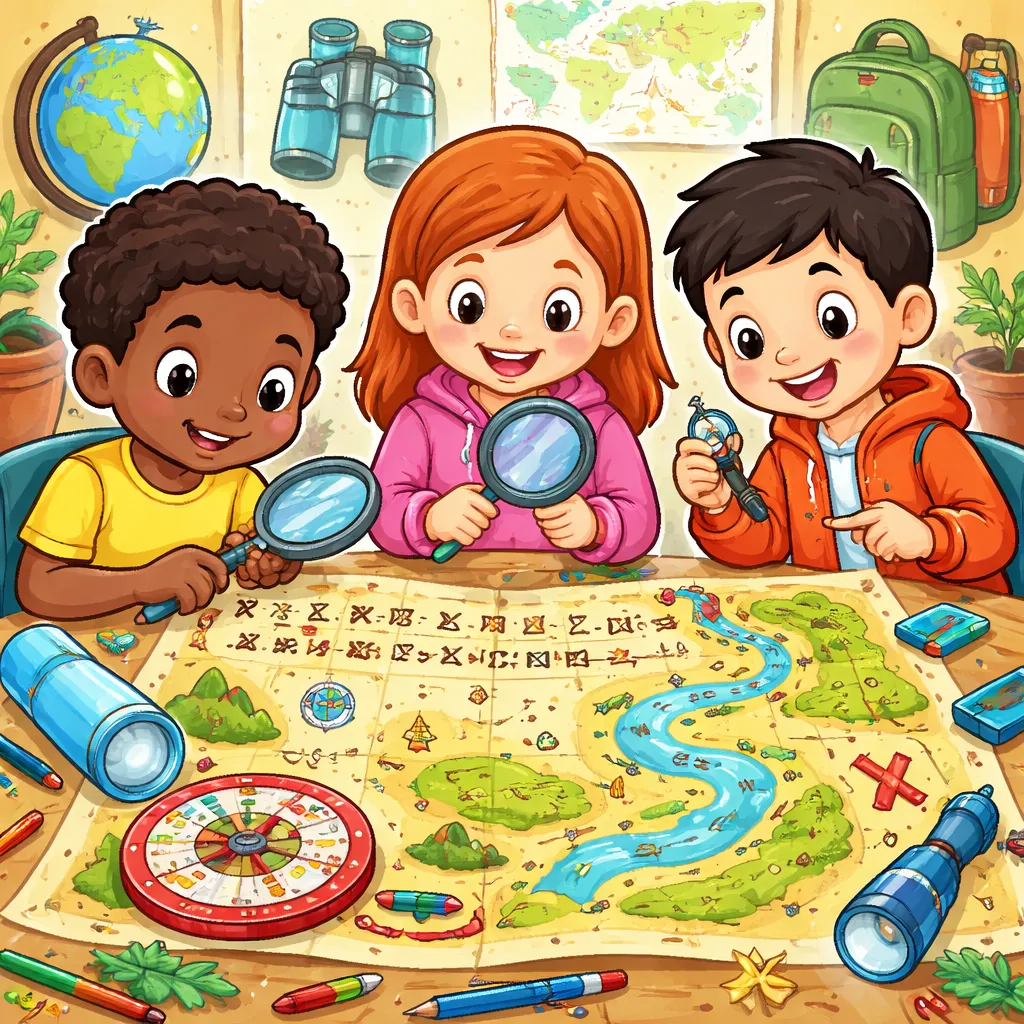
Leo and Mia were on a family hike. Their dad handed them a colorful, folded paper. "This is a trail map," he said. "It shows the whole park. See this squiggly blue line? That's the river. The green parts are forests. And this star is where we are right now!" Mia pointed to a triangle. "What's that?" "That's a mountain," said Dad. "Maps are like secret pictures of a place. But to read the secret, you need to know the code words. Let's learn the map skills vocabulary for elementary. Then, you can be the navigator on our next adventure!" Leo unfolded the map carefully. A secret picture with a code? This was the best kind of puzzle. Let's learn the code together.
Core Knowledge Explanation
A map is a flat drawing of a place. It can be a city, a country, or even the whole world. A globe is a round map of the world. To read a map, you need to know special words. This map skills vocabulary for elementary is your key. The first word is title. The title tells you what the map shows. "Map of Central Park" or "Map of Canada." Always look at the title first. The second word is compass rose. The compass rose is a drawing on the map that shows directions. It has four main points: north, south, east, and west. North is usually at the top of the map. Knowing north helps you know which way you are going.
The third word is symbol. A map is too small to draw real trees and buildings. So, it uses symbols. A symbol is a small picture that stands for something real. A black dot might be a city. A star might be a capital city. A blue line is a river. The fourth word is legend or key. The legend is a box that lists all the symbols on the map. It is the decoder for the secret picture. You look at the symbol in the legend to see what it means. This is a very important part of map skills vocabulary for elementary.
The fifth word is scale. The scale shows how distances on the map relate to real life. It might say, "One inch equals one mile." This means one inch on the map is one mile in the real world. The scale helps you understand how far apart places are. The sixth word is grid. Some maps have a grid of lines. The lines are labeled with letters and numbers. This helps you find places quickly. "The museum is in square B-4." These are the main tools. Now, let's learn words for what you see on maps. Landforms are natural features. Mountain, hill, valley, river, lake, ocean. Political features are human-made. City, road, border, country, capital. Learning this map skills vocabulary for elementary turns a confusing paper into a helpful guide.
Fun Interactive Learning
Let's make a map of your room! This is the best way to practice. Take a big piece of paper. This is your map. First, decide on a title. "Map of My Room." Draw a compass rose in the corner. Now, choose symbols. Will a square be your bed? Will a circle be your lamp? Draw a legend box and put your symbols there. Now, draw the room. Where is the door? Where is the window? Use your symbols. This activity uses all the map skills vocabulary for elementary in a personal way. You are the cartographer, the person who makes maps.
Another fun game is "Treasure Hunt with a Grid." Draw a simple map of your backyard or living room. Draw a grid over it with letters on one side and numbers on the other. Hide a small treasure. Mark the spot on your map with an X. Write the grid coordinates for a friend. "The treasure is at C-2." Your friend must use the map and the grid to find it. Then switch. This game teaches you to use a grid and follow a map. You can also play "Symbol Match." On cards, draw map symbols: a blue wavy line, a green triangle, a black dot. On other cards, write what they mean: river, mountain, city. Mix them up and match them. This helps you learn the symbol language.
Expanded Learning
People have been making maps for thousands of years. The oldest maps were carved on stone or clay. Today, we have digital maps on phones. But the map skills vocabulary for elementary is the same. In different countries, map symbols can be a little different, but the idea is the same. A blue line is almost always water. Maps are used by pilots, ship captains, hikers, and even delivery drivers. When you learn these words, you are learning a skill used by explorers and adventurers everywhere.
Maps can show many things. A weather map shows rain and sun. A population map shows where many people live. A topographic map shows how high the land is. The basic vocabulary helps you read all of them. Knowing how to read a map is also a safety skill. If you are ever lost, a map can help you find your way. Let's make a map skills chant. Chants are fun and easy to remember.
Title, compass, scale, and key, these are the tools for you and me! Symbols are the secret code, on any busy road! North and south and east and west, the compass rose points to the best! Grids and lines will help you look, in your favorite storybook! Read a map and you will see, the whole wide world for free!
What You Will Learn
You are learning about geography, representation, and navigation. You are learning essential map skills vocabulary for elementary: map, globe, title, compass rose, cardinal directions (north, south, east, west), symbol, legend/key, scale, grid. You are also learning landform and political words like mountain, river, city, and border.
You are learning to describe and interpret visual information. You can say, "The legend shows that a star is the capital." You can explain, "The scale means one centimeter equals one kilometer." You can locate, "The park is in grid square D-3." You are using English to decode and discuss spatial representations. This builds critical thinking and communication skills.
You are building foundational geographical skills. You are building symbolic thinking. You understand that pictures can stand for real things. You are building spatial orientation. You can relate a map to the real world. You are building measurement skills. You use scale to estimate distance. You are building research skills. You can use a map to find information. You are building confidence. You can navigate using a paper map.
Using What You Learned in Life
Use your new skills on family trips. Be the map reader in the car. Look at a road map or the map in a zoo. "The elephant exhibit is to the north, near the blue lake symbol." When you visit a new place, pick up a tourist map. Use the legend to find the bathroom or the gift shop. Plan a walk in your neighborhood and sketch a simple map. Mark your friend's house and the park. This uses your map skills vocabulary for elementary in real life.
At school, you can use maps in social studies and science. When you learn about a country, look at its map. Find the capital, the rivers, the borders. You can make a map for a book report, showing where the story took place. Teach a younger student how to use the legend. The more you practice, the better you will get. You are becoming a skilled navigator and a knowledgeable global citizen.
Closing Encouragement
You are a map decoder. You are a legend reader. You are a curious and sharp-eyed explorer. I am so proud of you. Learning all this map skills vocabulary shows you have a mind for discovery and a love for the world.
May you always find your way and enjoy the journey, with a map in your hand and adventure in your heart. Remember, every map is an invitation to explore. You are learning the language of exploration, and that is a language of endless possibility.
You are knowledgeable, you are observant, and you are ready to chart your own course. Great work, my wonderful cartographer.