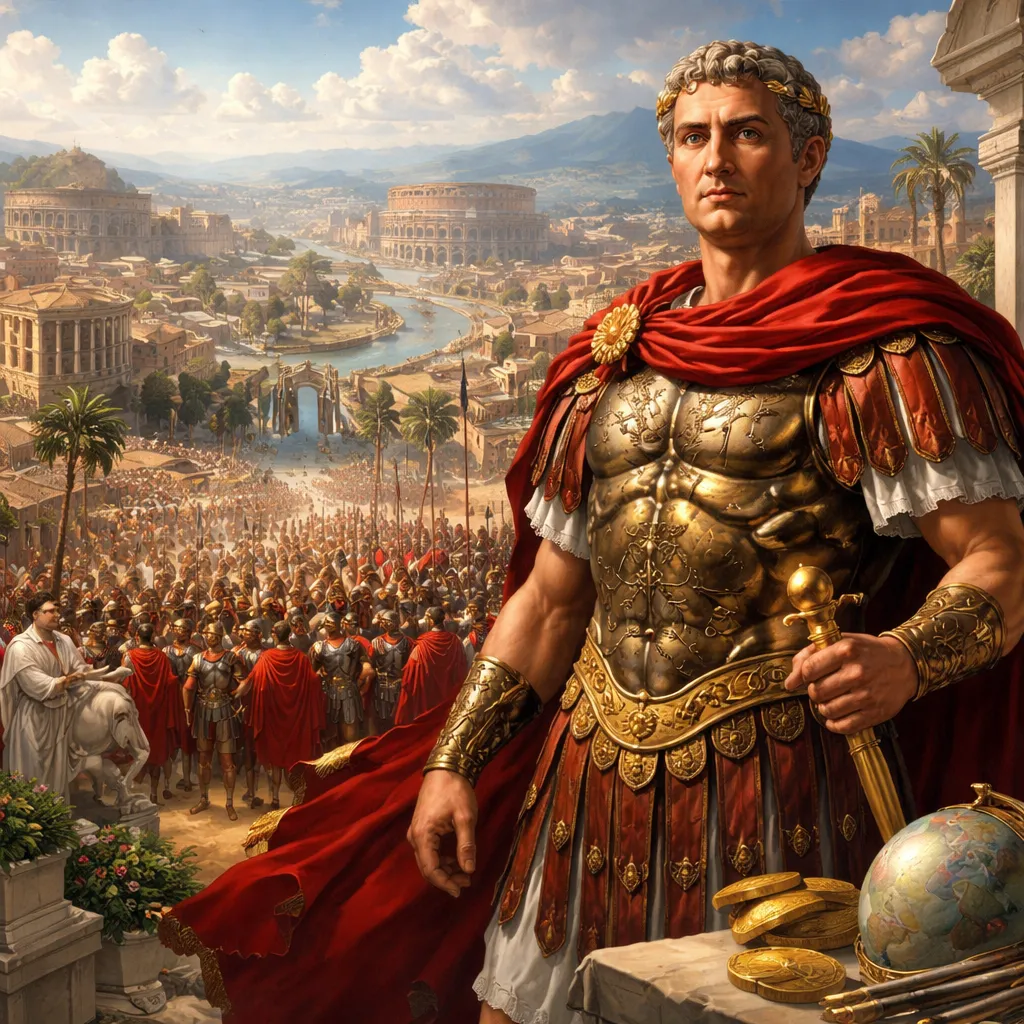

Introduction to Julius Caesar
Julius Caesar, born on July 12, 100 BCE in Rome, was a Roman general, statesman, and one of the most significant figures in Western history. His rise to power, military conquests, and eventual role as dictator made him a legendary figure whose influence continues to resonate today. Julius Caesar’s leadership and decisions had far-reaching consequences for the Roman Republic, and his legacy lives on in both history and modern political thought.
Why is Julius Caesar worth learning about? His story is not just one of conquest but of leadership, strategic brilliance, and vision. His impact on Rome was profound, and his influence extended beyond the empire, shaping politics and military tactics for centuries. For children and parents alike, studying Caesar’s life offers valuable lessons on courage, innovation, and the consequences of power.
Early Life and Background
Julius Caesar was born into a patrician family, the Julii, in a time of political turmoil in Rome. Though his family was part of the Roman elite, they were not particularly wealthy, and Caesar’s early years were marked by both privilege and struggle. His father, Gaius Julius Caesar, was a politician and a general, but he died when Julius was only 16 years old.
Growing up in Rome, Caesar was surrounded by political intrigue, and he was exposed to the world of Roman governance from a young age. He received an excellent education, studying rhetoric, philosophy, and law. His academic pursuits helped shape his understanding of power and leadership. Caesar’s early life was also marked by personal struggles. At the age of 18, he faced a severe threat to his life when he was captured by pirates during a journey to the eastern Mediterranean. After his release, he returned to Rome with a fierce resolve to seek political power.
Caesar’s youth was also influenced by the volatile political climate of Rome, where the republic was increasingly divided between powerful factions. These early experiences, combined with his education, shaped his ambitions and made him keenly aware of the importance of political alliances.
Career Highlights and Achievements
Julius Caesar’s career was defined by his military prowess and his skill in navigating the complex political landscape of Rome. His early career began in the military, where he quickly demonstrated his talent as a leader. His service in Asia Minor and his role as a quaestor (a Roman official) helped him gain recognition in the military and political spheres.
One of Caesar’s first major military achievements was his conquest of Gaul (modern-day France), which lasted from 58 BCE to 50 BCE. His campaigns in Gaul were not only successful but also strategically brilliant. Caesar’s ability to outmaneuver larger enemy forces and his innovative use of tactics earned him the loyalty of his soldiers and the admiration of Rome. His conquest of Gaul significantly expanded the Roman Republic, and his commentaries on the Gallic Wars, known as "Commentarii de Bello Gallico," are still studied today for their insight into military strategy and leadership.
By 49 BCE, Caesar’s power in Rome had grown, leading to political conflict with Pompey the Great and the Senate. In a dramatic moment in Roman history, Caesar crossed the Rubicon River with his army, effectively declaring war on Rome. This act, which led to the Roman Civil War, was a decisive moment in Caesar’s career. It culminated in his victory over Pompey and the Senate’s forces, after which Caesar became the unrivaled leader of Rome.
In 46 BCE, Julius Caesar was named dictator for ten years, and in 44 BCE, he was declared dictator for life. During this time, he implemented numerous reforms aimed at stabilizing Rome, including restructuring the Senate, reforming the calendar (creating the Julian calendar), and providing land to veterans. Caesar also enacted social and economic reforms that improved the lives of many Roman citizens.
However, his increasing power and reforms began to create tensions with many in the Senate, who feared his growing influence. His assassination on the Ides of March in 44 BCE, carried out by a group of senators, marked the tragic end of his rule. Although his death led to the eventual fall of the Roman Republic, Caesar’s legacy lived on through his adopted heir, Octavian (later Augustus), who became the first emperor of Rome.
Famous Works or Performances
While Julius Caesar was not an artist or a performer in the traditional sense, his greatest "works" were his military campaigns and the lasting impact he had on Roman governance. His writings, particularly "Commentarii de Bello Gallico," are considered some of his most significant contributions to literature and history. These commentaries provided a detailed account of his military campaigns in Gaul, showcasing his skills as both a strategist and a writer.
The "Gallic Wars" was not just a military record; it also served as propaganda. By writing about his own victories, Caesar was able to shape public perception of his leadership and military genius. The work was widely read and helped cement his image as a heroic leader who brought prosperity and glory to Rome.
Beyond his writings, Caesar’s reforms also marked significant milestones in Roman history. The Julian calendar, introduced in 45 BCE, was one of his most important legacies, providing a more accurate system for measuring the year and influencing the calendar systems used around the world to this day.
Personal Life and Fun Facts
Julius Caesar’s personal life was just as colorful as his political career. He was married three times: first to Cornelia, then to Pompeia, and finally to Calpurnia. His marriage to Cornelia was significant, as she came from a prominent family, and their union helped solidify his political alliances.
Caesar also had numerous lovers, the most famous of whom was Cleopatra, the Queen of Egypt. Their relationship was politically strategic as well as romantic, and they had a child together named Caesarion. His relationship with Cleopatra and his role in the political intrigues of Egypt further cemented his reputation as a master of diplomacy.
Despite his many personal relationships and political maneuverings, Caesar was known for his intelligence, discipline, and ambition. He was a highly educated man who spoke several languages, and his love of knowledge extended to his military campaigns, where he often relied on detailed maps and strategic planning.
An interesting fact about Julius Caesar is his role in shaping Roman architecture. He commissioned the construction of new buildings, including the Forum of Caesar, which became a center for political activity in Rome. This not only reinforced his power but also demonstrated his vision for Rome’s future.
Legacy and Influence
Julius Caesar’s legacy is immense, and it has shaped much of Western history. His role in transforming the Roman Republic into the Roman Empire set the stage for the imperial system that would dominate Europe for centuries. Caesar’s political reforms, including the expansion of citizenship and the reorganization of the Senate, laid the groundwork for the Roman Empire’s future governance.
His military achievements also had a lasting impact on military strategy. Caesar’s ability to lead his armies with discipline, his use of speed and surprise in battle, and his innovative tactics made him one of the most successful generals in history. His campaigns in Gaul are still studied in military academies around the world.
Furthermore, Caesar’s assassination marked a pivotal moment in Roman history, triggering the eventual downfall of the Roman Republic and the rise of the Roman Empire under Augustus. His legacy as a leader and military tactician continues to inspire political and military leaders to this day.
Quotes or Famous Sayings
Julius Caesar is remembered for several famous sayings, some of which capture his strategic mindset and leadership philosophy. One of his most famous quotes is:
“Veni, vidi, vici” (I came, I saw, I conquered), which he reportedly said after his swift victory at the Battle of Zela in 47 BCE.
Other famous quotes attributed to Caesar include:
“The die is cast,” said as he crossed the Rubicon River, signaling his decision to march on Rome. “Cowards die many times before their deaths; the valiant never taste of death but once,” reflecting his fearless nature in battle.
These quotes reflect Caesar’s decisiveness, confidence, and belief in his destiny as a leader of Rome.
How to Learn from Julius Caesar
Julius Caesar’s life offers valuable lessons for young readers, especially in the areas of leadership, resilience, and strategic thinking. His ability to adapt to different challenges, whether in the battlefield or in the Senate, teaches the importance of being flexible and wise in decision-making.
One key lesson from Caesar’s life is the importance of education and preparation. Despite his military focus, Caesar was a highly educated individual who understood the value of knowledge and critical thinking. His love for learning and strategic planning helped him become a successful leader.
Another important lesson is the power of ambition. Caesar’s rise to power was driven by a clear sense of purpose and an unrelenting pursuit of his goals. However, his story also serves as a cautionary tale about the dangers of unchecked ambition. It teaches young readers the importance of balancing ambition with wisdom and humility.
Julius Caesar’s life offers inspiration for anyone who aspires to make a difference, whether in leadership, creativity, or perseverance. His story demonstrates that success comes from a combination of skill, knowledge, and the courage to face challenges head-on.