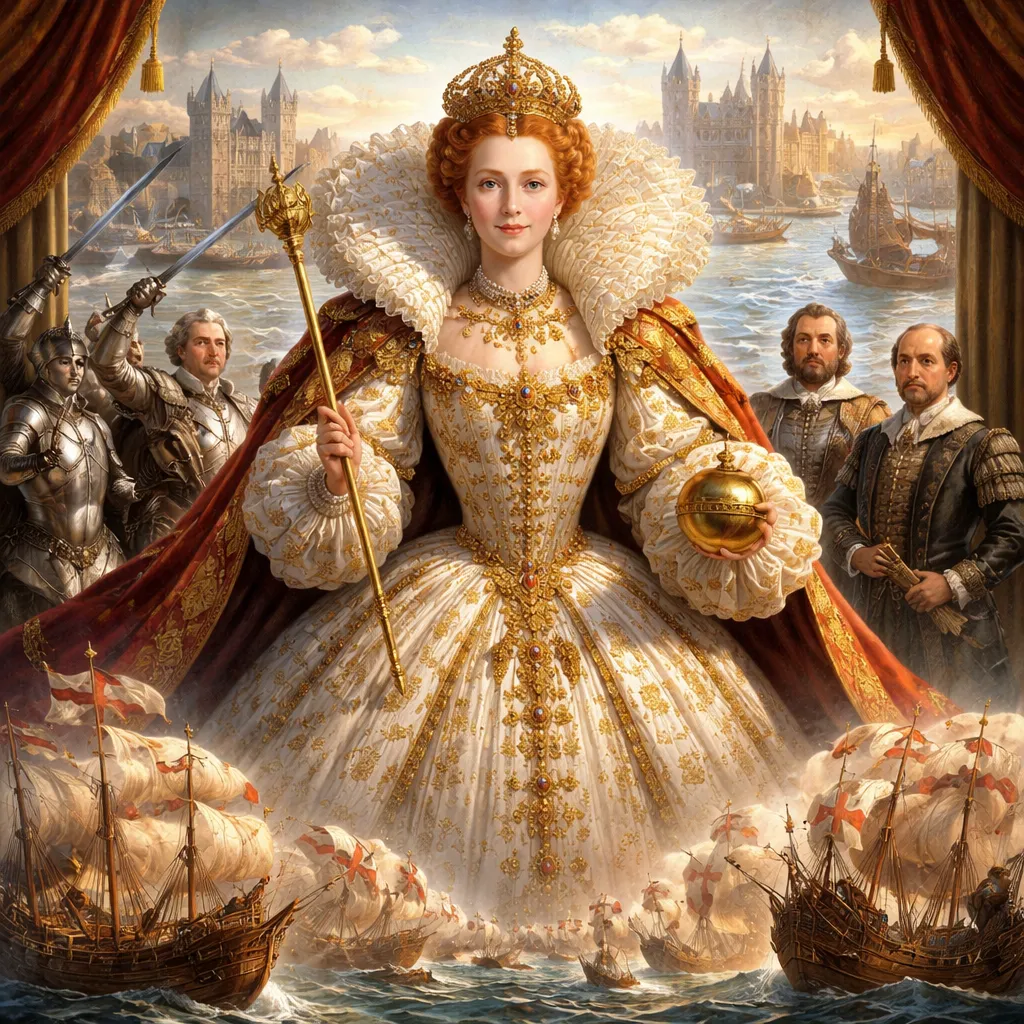

Introduction to Queen Elizabeth I
Queen Elizabeth I, also known as the Virgin Queen or Gloriana, was one of the most remarkable monarchs in English history. Born in 1533, she became the Queen of England and Ireland in 1558 after the death of her sister, Queen Mary I. Elizabeth’s reign, lasting 45 years, is often referred to as the Elizabethan Era, a time of great cultural, political, and military achievements.
Elizabeth I was not just a monarch; she was a symbol of strength, intelligence, and resilience. Her leadership helped shape the future of England, guiding the country through religious turmoil, foreign invasions, and internal challenges. She was instrumental in making England one of the most powerful nations in Europe.
Her reign is widely regarded as one of the most successful in British history, marked by peace, prosperity, and a flourishing of the arts. Elizabeth’s ability to rule with authority, yet compassion, earned her a lasting place in history. Understanding her life and achievements can teach valuable lessons in leadership, determination, and the importance of standing firm in one’s convictions.
Early Life and Background
Elizabeth was born on September 7, 1533, at the Palace of Placentia in Greenwich, London. She was the daughter of King Henry VIII and Anne Boleyn. Her birth was a significant event, as her father, Henry VIII, had hoped for a male heir to secure the Tudor dynasty. However, Elizabeth was his second daughter, and her birth led to political and religious upheaval in England.
Elizabeth’s mother, Anne Boleyn, was executed when Elizabeth was just two years old. As a result, she was declared illegitimate for a time, and her childhood was marked by political instability. Despite these early setbacks, Elizabeth received an excellent education, particularly in languages, history, and the arts. Her tutors included some of the finest scholars of the time, and she became fluent in several languages, including Latin, French, and Italian.
Elizabeth's early life was not without its challenges. As a young girl, she was often at the mercy of her father’s whims, and she faced periods of isolation from the royal court. However, Elizabeth’s intelligence, determination, and ability to navigate the treacherous politics of the Tudor court allowed her to emerge as a strong and capable future ruler.
By the time Elizabeth ascended to the throne in 1558, she had already gained a reputation for her sharp mind and her ability to manage delicate political situations. Her early life, filled with adversity, helped shape her into the monarch who would become one of England’s greatest leaders.
Career Highlights and Achievements
Elizabeth I’s reign is considered one of the most successful in English history. She inherited a divided and unstable kingdom, but under her leadership, England emerged as a dominant power in Europe. Her reign is often associated with the flourishing of English culture, the defeat of the Spanish Armada, and the establishment of Protestantism as the national religion.
One of Elizabeth’s greatest achievements was her handling of the religious conflict in England. The country had been torn apart by the Protestant Reformation, and the Catholic Church had been a source of great division. Elizabeth navigated this complex issue with remarkable skill. She established the Elizabethan Religious Settlement, which helped solidify Protestantism in England while allowing some degree of religious tolerance. This balance brought stability to a country that had previously been plagued by religious strife.
In 1588, Elizabeth’s leadership was put to the test when the Spanish Armada, a massive fleet sent by King Philip II of Spain, attempted to invade England. Elizabeth’s navy, aided by a powerful storm, decisively defeated the Armada, marking a turning point in European politics. This victory boosted England’s national pride and established it as a formidable naval power.
Elizabeth also presided over a cultural renaissance in England, known as the Elizabethan Golden Age. The arts, literature, and theater flourished during her reign, with figures like William Shakespeare, Christopher Marlowe, and Sir Francis Drake contributing to England’s cultural legacy. Elizabeth’s patronage of the arts helped establish England as a cultural center of Europe, and her reign is often seen as the height of the English Renaissance.
Famous Works or Performances
While Elizabeth I was not a creator of artistic works herself, she played a significant role in fostering an environment where creativity could thrive. The period known as the Elizabethan Golden Age saw the creation of some of the greatest literary and theatrical works in English history.
One of the most famous cultural achievements of Elizabeth’s reign was the flourishing of English theater, particularly the works of William Shakespeare. Shakespeare’s plays, such as Romeo and Juliet, Hamlet, and Macbeth, are still performed around the world today. Elizabeth’s support of the arts helped make the Elizabethan theater a vibrant and influential part of English culture.
In addition to theater, Elizabeth’s reign saw advancements in music, painting, and literature. Elizabeth was herself an accomplished musician and a patron of the arts. Her court was a center for musicians and poets, and she was known to play the lute and sing.
Elizabeth’s reign also saw the rise of English exploration and expansion. Figures like Sir Francis Drake and Sir Walter Raleigh led expeditions that helped expand England’s influence overseas. These explorations laid the foundation for the British Empire, which would later become one of the most powerful empires in the world.
Personal Life and Fun Facts
Elizabeth I was known for her intelligence, beauty, and strong personality. She was also known for her famous image as the "Virgin Queen" – a symbol of her dedication to her country rather than to marriage. Despite numerous suitors and offers of marriage, Elizabeth chose to remain single throughout her life. This decision was strategic, as it allowed her to maintain complete control over the monarchy and avoid the complications that a marriage could bring.
One of the most famous aspects of Elizabeth’s personal life was her relationship with the courtier Robert Dudley. The two were close throughout her reign, and rumors of a romantic relationship circulated for many years. However, Elizabeth never married Dudley or anyone else, and her reasons for remaining single remain a subject of historical speculation.
Elizabeth was also known for her sharp wit, sense of humor, and ability to engage with those around her. She had a charismatic presence and was a master of political diplomacy. Her speeches, such as the famous Speech to the Troops at Tilbury in 1588, are still studied for their rhetorical brilliance and effectiveness.
Legacy and Influence
Queen Elizabeth I’s legacy is immense, and her influence extends far beyond her time. She transformed England from a divided, troubled kingdom into a major European power. Her success in balancing political, religious, and social issues made her one of the most admired monarchs in history.
Elizabeth’s leadership helped shape the future of the British monarchy. Her reign set a precedent for future rulers, and her ability to govern effectively without marrying helped establish the idea of a powerful, independent monarch. She was able to secure her country’s position as a leading European power through diplomacy, military victories, and cultural achievements.
Her support of the arts laid the foundation for English literature and theater, making her reign one of the most culturally significant periods in history. The works created during her time, particularly those of Shakespeare, continue to influence literature and theater today.
Elizabeth’s legacy also had a lasting impact on the role of women in leadership. She showed that a woman could rule effectively and command respect on the world stage, a message that resonates today as more women continue to rise to positions of power and influence.
Quotes or Famous Sayings
Queen Elizabeth I was known for her eloquent speeches and insightful words. One of her most famous quotes is:
"I have the heart and stomach of a king, and of a king of England too."
This declaration was made during her Speech to the Troops at Tilbury in 1588, where she inspired her soldiers to fight against the Spanish Armada. It exemplifies Elizabeth’s confidence and unwavering commitment to her country.
Another memorable quote from Elizabeth is:
"I will have here but one mistress and no master."
This statement reflects Elizabeth’s strong desire for independence and her refusal to marry, even though many suitors sought her hand in marriage.
How to Learn from Queen Elizabeth I
Queen Elizabeth I’s life teaches us many valuable lessons. Her ability to lead with intelligence, courage, and dignity is an example of the power of self-confidence and determination. Despite the challenges she faced, she remained resolute in her beliefs and was dedicated to her country.
Her success as a female monarch in a male-dominated world also provides inspiration for young people, especially girls, showing that gender is no barrier to leadership. Elizabeth’s ability to balance her personal desires with her responsibility to her country is a powerful reminder that sometimes sacrifices must be made for the greater good.
Through her reign, Elizabeth demonstrated the importance of diplomacy, education, and the arts in shaping a nation’s future. Her legacy continues to inspire leaders, artists, and individuals around the world who seek to make a positive impact on society.
Elizabeth I’s story reminds us that leadership is not about power alone but about integrity, wisdom, and the courage to follow one’s convictions.