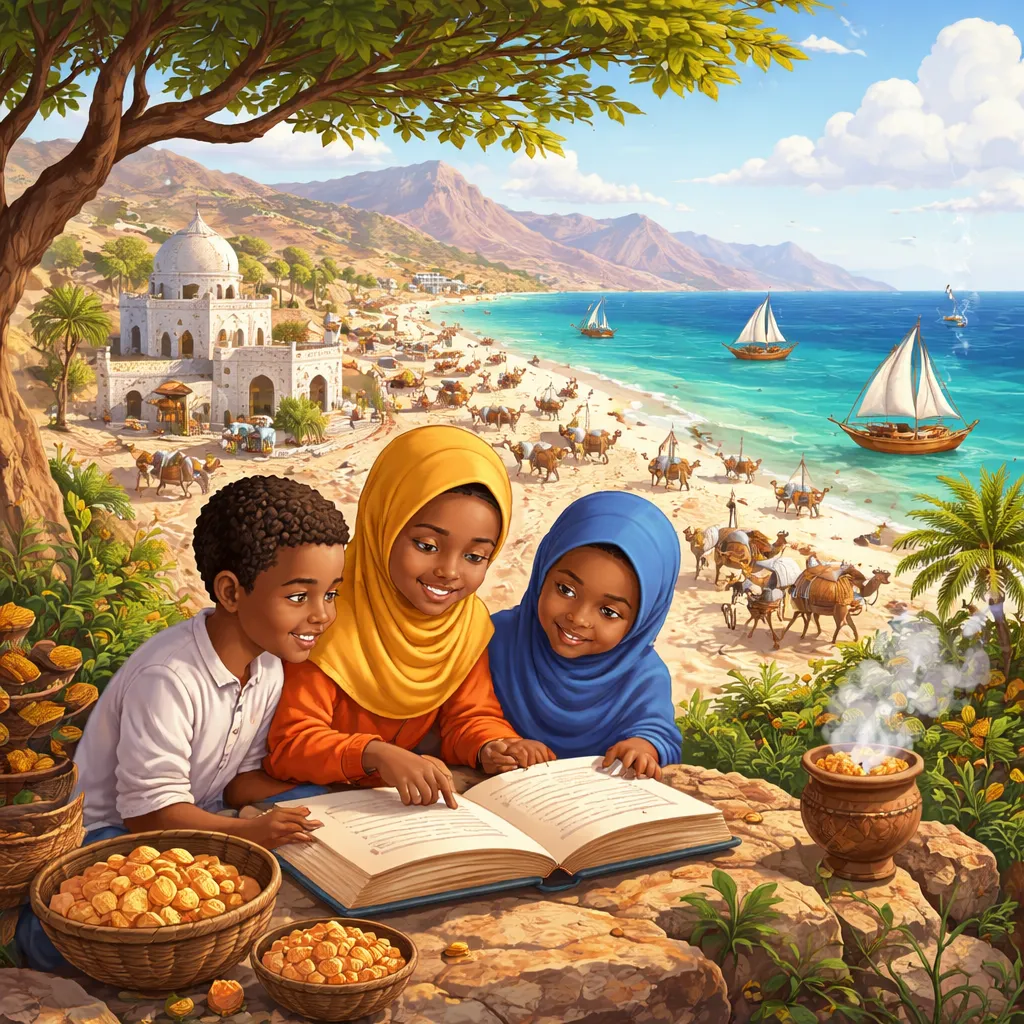

Introduction to Somalia Somalia is a country on the eastern tip of Africa. It has a very long coastline along the Indian Ocean. Children there learn Somali as their first language. They also learn Arabic and sometimes English. Learning reading: Somalia offers a window into a land of desert plains, ancient ports, and camel caravans. Kids in this country read stories about frankincense trees and sailing ships. They also learn about poets who memorize long poems. Reading about Somalia feels like traveling to the edge of a vast continent. Your child can explore this historic land from your reading corner. Each new word becomes a grain of sand on a long beach. Let us walk along that beach together.
Where Is Somalia? Somalia sits in the Horn of Africa. This is the easternmost part of the African continent. The country has a very long shape. It curves out into the Indian Ocean like a rhino horn. The Gulf of Aden lies to the north. The Indian Ocean lies to the east. Djibouti lies to the northwest. Ethiopia lies to the west. Kenya lies to the southwest. The capital city is Mogadishu. Mogadishu sits on the coast of the Indian Ocean. The whole country covers 637,600 square kilometers. That is about the size of Texas. Somalia has deserts, mountains, and a long coastline. The Shebelle and Juba rivers flow through the south. Learning reading: Somalia becomes real when you look at a map of Africa. Find the eastern bulge that sticks out into the Indian Ocean. That is the Horn of Africa. Somalia takes up most of that horn. Point to Mogadishu on the coast. Say the name. "So-ma-li-a." You just found a country shaped by the ocean and the desert.
Interesting Facts About Somalia Somalia has many fascinating facts. First, the country has more camels per person than any other nation. Camels provide milk, meat, and transport. Second, Somalia was once called the Land of Punt. Ancient Egyptians traded with Punt for frankincense and myrrh. Third, the country has a very old cave painting at Laas Geel. The paintings show cows with long horns. They are over 5,000 years old. Fourth, Somalia has frankincense trees. People cut the bark to get a sweet-smelling sap. Fifth, the country has a fruit called the hima apple. It tastes sweet and sour. Sixth, Somali people love poetry. Poets are very respected. Long poems tell stories of history and love. Learning reading: Somalia teaches words like "camel," "frankincense," "desert," and "coastline." Each fact gives your child a new picture. Imagine a line of camels walking across red sand. Imagine a tree bleeding sweet-smelling tears. Imagine a cave painting made by people thousands of years ago. These pictures make words stay in your mind. Parents can ask: "Would you like to ride a camel?" "What does frankincense smell like?" Your child will feel curious about this ancient land.
Key Vocabulary About Somalia Let us learn six important words from Somalia.
First is "camel." A camel is a large animal with one or two humps. Somalia has many camels.
Second is "frankincense." Frankincense is a sweet-smelling sap from a tree. People burn it for its scent.
Third is "desert." A desert is a dry place with very little rain. Most of Somalia is desert.
Fourth is "coastline." A coastline is the edge of the land where it meets the ocean. Somalia has a very long coastline.
Fifth is "nomad." A nomad is a person who moves from place to place with their animals.
Sixth is "poet." A poet is a person who writes or speaks beautiful words in poems.
Learning reading: Somalia gives you these six words. Make a movement for each word. For camel, bend your arm like a hump and walk slowly. For frankincense, pretend to smell something wonderful. For desert, wipe your forehead like you are hot. For coastline, make a long wavy line with your hand. For nomad, pretend to pack a bag and walk. For poet, put your hand on your heart and speak dramatically. Say each word while you make the movement. Your child will learn faster when their body joins the lesson. Practice these movements during breakfast. Practice them on a walk. Soon your child will say "camel" and make a hump without thinking.
The Famous People About Somalia Somalia has produced many famous people. One is Iman. She is a supermodel and actress. She also started a charity to help children. Another famous person is Mo Farah. He is a long-distance runner. He won four Olympic gold medals for Great Britain. His parents came from Somalia. There is also a writer named Nuruddin Farah. He writes novels about Somalia. People around the world read his books. Another important person is K'naan. He is a singer and rapper. His song "Wavin' Flag" became very famous. It was played during the World Cup. There is also a former prime minister named Mohamed Abdullahi Mohamed. He also worked for the United Nations. These people show that Somalia has models, runners, writers, singers, and leaders. Learning reading: Somalia becomes inspiring through these names. Say each name. "I-man." "Mo Fa-rah." "Nu-rud-din Fa-rah." "K'naan." "Mo-ha-med Ab-dul-la-hi Mo-ha-med." Talk about what each person did. "What does Iman do?" "She models and helps children." "What does Mo do?" "He runs very fast." "What does Nuruddin do?" "He writes books." "What does K'naan do?" "He sings." Your child can imagine running a race or writing a novel. These famous people prove that Somalia reaches far beyond its shores.
Simple Sentences for Reading Practice Here are easy sentences about Somalia. Read each one aloud.
Somalia sits on the Horn of Africa with a long coastline on the Indian Ocean.
The capital city Mogadishu has been a trading port for hundreds of years.
Somalia has more camels per person than any other country in the world.
Frankincense trees grow in the dry hills and produce sweet-smelling sap.
Most of Somalia is desert with hot sun and very little rain.
Nomads move across the land with their camels and goats.
Ancient cave paintings at Laas Geel show cows with long horns.
The Shebelle River flows through the southern part of the country.
Mo Farah won four Olympic gold medals for long-distance running.
K'naan wrote the song "Wavin' Flag" that people sang around the world.
Learning reading: Somalia makes these sentences easy to practice. Read a sentence. Then ask your child to close their eyes and imagine it. For sentence three, imagine a hundred camels. For sentence four, imagine smelling something sweet. For sentence seven, imagine painting on a cave wall. For sentence nine, imagine running very fast. After the picture is clear, read the sentence again. You can also make a rhythm game. Clap the syllables of each important word. Ca-mel (two claps). Fran-kin-cense (three claps). No-mad (two claps). Po-et (two claps). Clapping builds a sense of how words sound.
Short Reading Passage About Somalia Read this passage together. It uses all the words we learned.
Somalia stretches along the Indian Ocean like a long, sandy finger. The coastline runs for over 3,000 kilometers. Waves crash on white beaches. Behind the beaches, the desert begins. Red sand and thorny bushes cover the land. Camels walk in single file across the dry ground. Their long legs carry them for miles. Nomad families follow the camels. They move when the water runs out. In the northern hills, frankincense trees grow. People cut the bark carefully. Sweet-smelling sap drips out like tears. The sap hardens into golden drops. People have traded frankincense for thousands of years. Near the capital Mogadishu, the Laas Geel caves hide ancient paintings. Cows with long horns dance across the rock walls. Famous Somalis include Mo Farah, who ran faster than almost anyone, and K'naan, whose song made people wave flags. Learning reading: Somalia invites you to a land of camels and frankincense. A land of nomads and ancient caves. Now close your eyes. Imagine you stand on the Somali coast. The Indian Ocean stretches to the horizon. Behind you, a camel walks slowly. You smell something sweet in the dry air. It is frankincense. What do you see on the water? What do you want to explore first?
This passage has 190 words. Read it slowly. After each sentence, ask your child to give a thumbs up if they can see it in their mind. Thumbs sideways if they need help. This check-in helps you know which words need more time. After the passage, ask your child to name three things from Somalia. "Camels, desert, frankincense." Celebrate each one. "Yes, camels! Yes, desert! Yes, frankincense! You learned so much."
Fun Questions About Somalia Use these questions to talk about this Horn of Africa nation.
Would you rather ride a camel across the desert or sail along the long coastline? Why?
What do you think frankincense smells like? Have you ever smelled anything similar?
Why do you think nomads move from place to place instead of staying in one home?
Would you like to see the 5,000-year-old cave paintings at Laas Geel? Why?
What would you name a new camel you owned?
How do you think people traded frankincense thousands of years ago?
Would you rather run like Mo Farah or sing like K'naan? Why?
What would you write a poem about if you were a Somali poet?
Why do you think Somalia has so many camels compared to other countries?
What would you bring with you if you lived as a nomad in the desert?
Learning reading: Somalia turns every question into a desert journey. Parents answer first. "I would sail along the coastline because I want to see the water and the desert meeting." Then your child answers. Let them be creative. If they say "I would name my camel Sparkle Toes," say "That is a wonderful name. What color is Sparkle Toes?" Keep asking. Keep imagining. You can also act out the answers. Pretend to ride a camel. Pretend to smell frankincense. Pretend to run like Mo Farah. Ask one question during a car ride. Ask another question before bed. Somalia will become a familiar place in your home.
Tips for Learning English with This Topic Now let us bring Somalia into your home. First, draw a camel. Give it one hump or two. Say "camel" as you draw. Second, smell something sweet. Perfume, a flower, or a candle works. Say "frankincense" as you smell. Third, build a desert in a box. Use sand or rice. Add small sticks for bushes. Say "desert" as you play. Fourth, draw a long coastline. Make blue water on one side and sand on the other. Say "coastline" when you finish. Fifth, pretend to be a nomad. Pack a small bag. Walk from one room to another. Say "nomad" as you move. Sixth, listen to K'naan's song "Wavin' Flag." Dance and wave your hand like a flag. Say "poet" and "singer" as you dance. Learning reading: Somalia gives you these six tips. Do one tip each day. Do not worry about doing them perfectly. Just try. Learning English is like crossing a desert. You take one step at a time. The sun is hot. But you keep going. Each step brings you closer to the oasis. So take your steps. One word. One tip. One desert step at a time.
Your child will remember Somalia. They will remember the camels and the frankincense and the long coastline. But most of all, they will remember reading with you. That quiet time together builds an oasis of its own. An oasis of love and learning. So keep this article on your fridge. Read one sentence tonight. Ask one question tomorrow. Try one tip this weekend. Somalia is not a faraway mystery. It is right here every time you learn a new word together. Say one now. "Camel." Wonderful. Say another. "Frankincense." Beautiful. You are already walking across the red sand. Keep walking. The ocean is ahead.