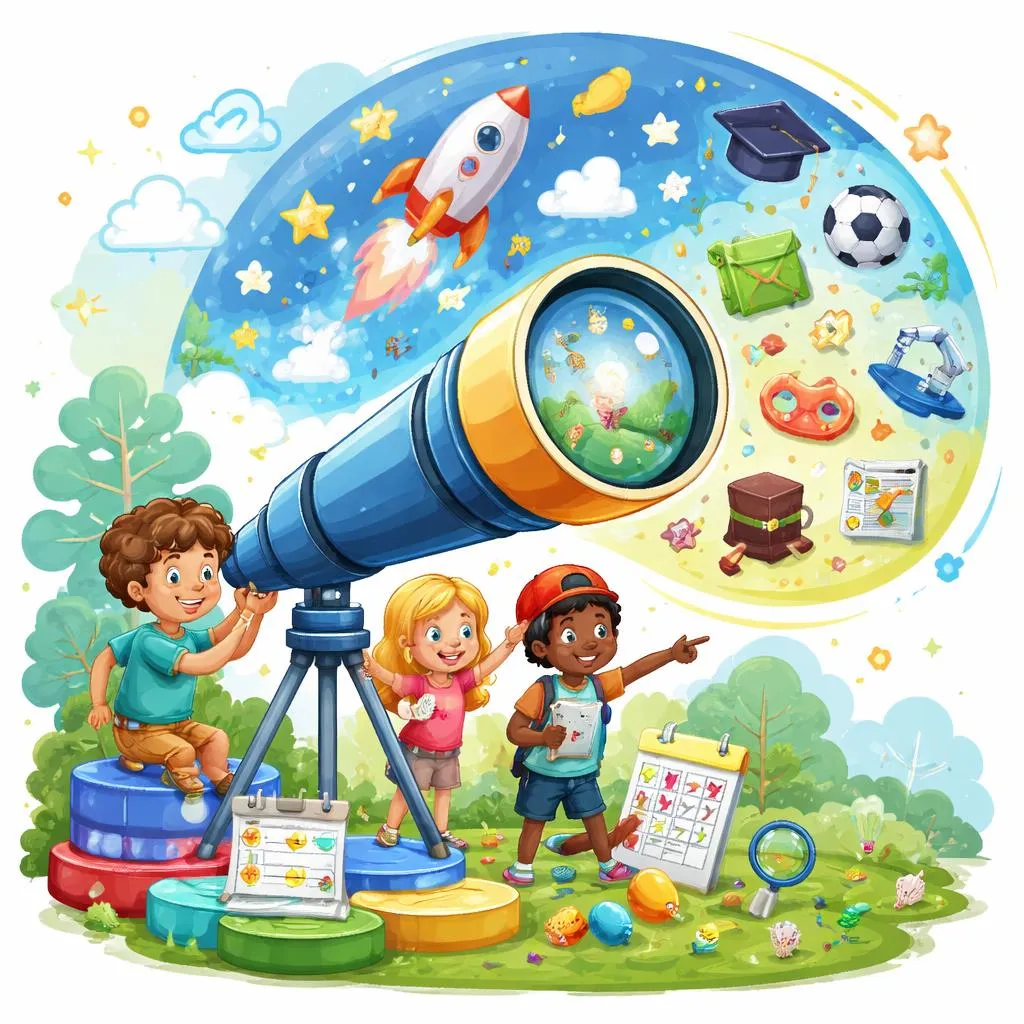

Hello, word explorer! Do you have a telescope? You can look through it. You can see far away. You can see what is coming! Your words have a telescope too. It is called the simple future tense. The simple future tense talks about things that have not happened yet. It is about what will happen or what is going to happen. Today, we will look at eighty wonderful future plans! Our guide is Finn the Future Fox. Finn loves to look ahead! He will show us the simple future tense at home, the playground, school, and in the forest. Let's peer into the future!
What Is the Simple Future Tense? The simple future tense is your word telescope. It is a verb form. It tells us about actions that are still to come. They have not happened yet. We use it to talk about plans, predictions, and promises. At home, you say "I will help you clean up." The words "will help" are in the simple future. It is a promise for later. You also say "I am going to visit Grandma tomorrow." This is a plan. At the playground, you say "We will play a new game." At school, you say "I am going to learn a new song." In nature, Finn says "The sun will rise tomorrow. Spring is going to come." "Finn's telescope reveals his eighty must-master simple future verbs." Learning this tense helps you talk about your exciting tomorrows.
Why Do We Use the Word Telescope? The simple future tense is your planning tool! It helps your ears listen. You can understand what someone plans to do or what they think will happen. It helps your mouth speak. You can make promises and tell people your plans. "I will share my toy with you." It helps your eyes read. You will see it in stories about adventures and dreams. It helps your hand write. You can write about your hopes and what you intend to do. Looking through your word telescope makes you a great planner and dreamer.
What Do We See in the Telescope? We have two main ways to talk about the future. Both are simple future.
Using "Will": We use "will" for quick decisions, promises, offers, and predictions. "I think I will have the apple." (Quick decision). "I will be your friend." (Promise). Using "Going to": We use "going to" for plans and intentions. Things you have already decided. "I am going to have a party on Saturday."
The formula for "will" is easy: Subject + will + base verb. I will go. You will see. He will run. The formula for "going to" is: Subject + am/is/are + going to + base verb. I am going to eat. She is going to read. We are going to play.
How Can You Spot a Future Plan? Spotting the simple future tense is a fun game. Use these clues.
First, look for the word will. It is a very clear clue.
Second, look for the phrase going to. Remember, it is three words together.
Third, listen for time words that point to the future. Words like tomorrow, next week, later, soon, in an hour.
Look through Finn's telescope. "Tomorrow, I will dig a new den. My brother is going to help me. I think it will rain soon." You can spot "will" and "going to".
How Do We Use Our Telescope Correctly? Using the simple future is about choosing the right helper. Remember the formulas.
For "will": Subject + will + base verb. "I will call you. She will laugh. They will jump." The verb after "will" never changes. For "going to": I + am + going to + base verb. He/She/It + is + going to + base verb. You/We/They + are + going to + base verb. "I am going to sleep. He is going to watch. We are going to sing."
To make a negative, add "not". "I will not (won't) go. She is not (isn't) going to cry." To ask a question with "will", put "will" first. "Will you come?" For "going to", put "am/is/are" first. "Are you going to play?"
Finn shows us. "I will see you later. I am going to find some berries. Will you join me? No, I won't. I am going to take a nap."
Let's Fix Some Blurry Views. Sometimes our telescope view gets blurry. Let's fix that.
A common blur is using "will" for a firm plan. "I will go to the dentist on Tuesday" is okay. But "I am going to go to the dentist on Tuesday" sounds more like a set plan.
Another is using "to" twice. "I am going to to play" is wrong. After "going to", use the base verb: "I am going to play."
Also, mixing "will" and "going to" in the same phrase. "I will going to eat" is wrong. Choose one: "I will eat" or "I am going to eat."
Can You Be a Future Scout? You are a great scout! Let's play the "Will or Going To?" game. I will say a sentence. You tell me which helper it uses. "I will draw a picture." You say: "Will!" "She is going to read a book." You say: "Going to!" "They will be here soon." You say: "Will!" Great! Here is a harder challenge. Think of two plans for next weekend. Say one with "will" and one with "going to".
Your Telescope Log of 80 Must-Master Plans. Ready to look into the log? Here are eighty wonderful simple future sentences. Finn the Fox sees them all. They are grouped by the scene. Each group has twenty examples. We use both "will" and "going to".
Home Future Plans (20). I will help my mom later. Dad will cook pasta tonight. We are going to visit Grandma. I will play with my new toy. My sister is going to watch a movie. I will drink all my milk. Mom is going to bake cookies. I will brush my teeth before bed. Dad will read me a story. I am going to clean my room tomorrow. Our dog will bark at the mailman. I am going to call my friend. We will eat dinner at six. I will find my lost sock. The baby is going to sleep soon. I am going to draw a picture for you. We will have a family game night. I will be kind to my brother. Home will be cozy tonight. I am going to have sweet dreams.
Playground Future Plans (20). I will swing very high. My friend is going to climb the tree. We will play tag together. She is going to run in the race. He will jump over the puddle. They are going to build a fort. The sun will shine tomorrow. Children will laugh and play. I am going to throw the ball. We will have lots of fun. The coach is going to teach us. I will try to reach the top. My friend is going to push me on the swing. Birds will sing in the morning. We are going to share our snacks. The game will be exciting. I am going to learn a new trick. Everyone will get tired. Fun is going to happen all day. I will be a good sport.
School Future Plans (20). I will learn new things tomorrow. The teacher is going to read a story. We will write in our journals. She is going to answer the question. He will color a big picture. Our class is going to sing a song. I will listen carefully. The bell will ring at three o'clock. We are going to line up quietly. My friend will help me. I am going to think hard. We will plant more seeds. She is going to study for the test. The clock will tick all day. We are going to listen to the teacher. I will draw a map of the world. Our seeds are going to grow tall. Learning will be fun. I am going to try my best. The class will be great.
Nature and Animal Future Plans (20). The sun will rise in the morning. It is going to rain this afternoon. The river will flow to the sea. The wind is going to blow the leaves. Flowers will bloom in the spring. Leaves are going to fall in autumn. A bird will build a nest. The spider is going to spin a new web. Winter will be cold. Night is going to fall later. The caterpillar will become a butterfly. Bees are going to make honey. The snow will melt in the sun. The days are going to get longer. I will walk in the park tomorrow. We are going to watch the stars. The seasons will change. Nature is going to be beautiful. The forest will grow for many years. Life will continue its amazing cycle.
Planning Your Bright Future. You did it! You are now a simple future tense expert. You know the simple future is your word telescope. It uses "will" and "going to" to talk about what's ahead. You can spot it and use it to make plans and promises. Finn the Future Fox is proud of your scouting. Now you can talk about all your exciting plans for tomorrow. Your words will be full of hope and intention.
Here is what you can learn from our telescope adventure. You will know what the simple future tense is. You will understand the difference between "will" and "going to". You can form simple future sentences correctly. You can identify the simple future in sentences. You have a telescope log of eighty must-master simple future sentences.
Now, let's do some life practice! Your mission is today. Be a word scout. Tell someone two things you will do tomorrow. Use both "will" and "going to". Say: "Tomorrow, I will help set the table. I am going to read my new book." You just used your word telescope! Keep planning and dreaming with your words every day. Have fun, little explorer!