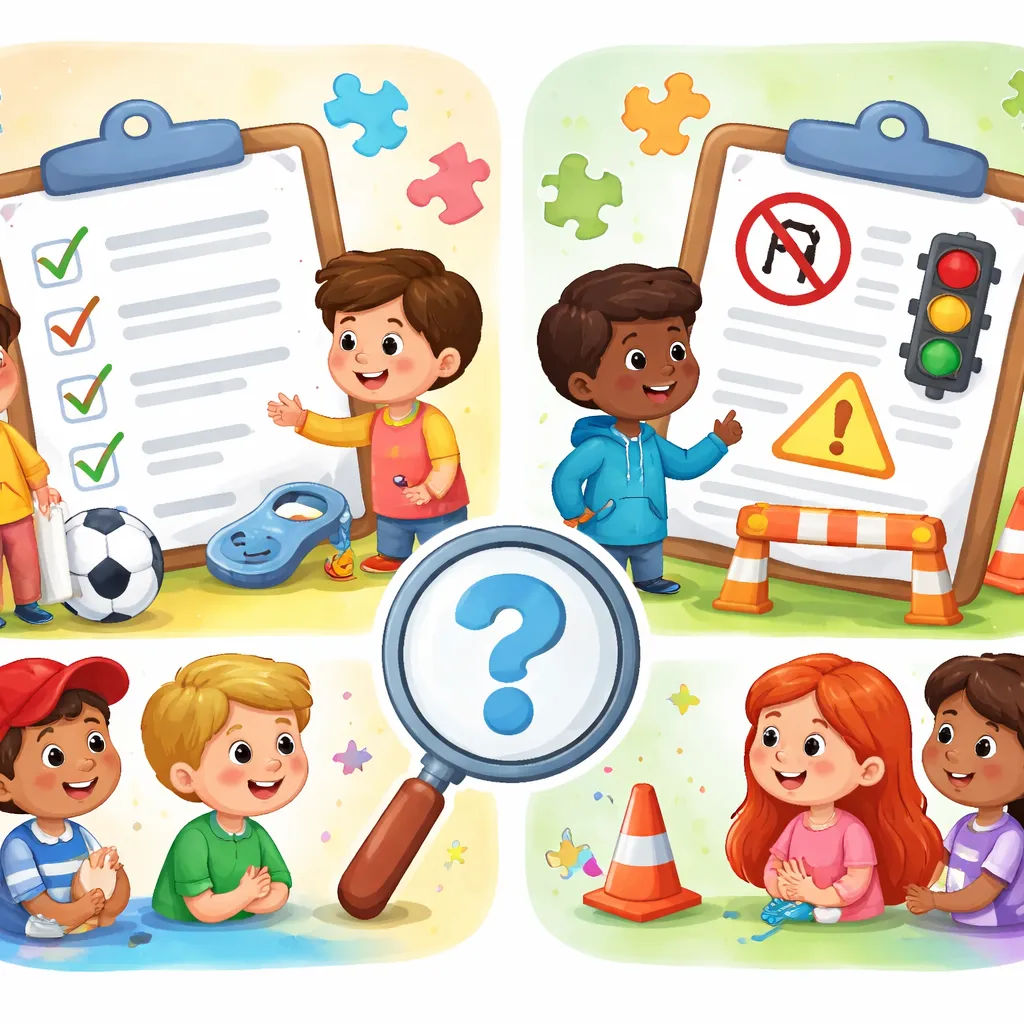

Rule and Regulation: What’s the Difference?
In learning English, children often encounter words that seem similar but have distinct meanings and uses. Rule and regulation are two such words. Both refer to guidelines or instructions that people must follow, but they are used in different contexts. Understanding the differences between rule and regulation can help children use these terms correctly, both in speech and writing.
In this article, we will explore the meanings of rule and regulation, looking at their similarities and differences. By the end, children and parents will have a clearer understanding of when to use each word.
Are Similar Words Really Interchangeable?
Words that appear to have the same meaning are not always interchangeable. While rule and regulation both involve guidelines or standards that must be followed, they are not used in exactly the same way.
A rule is often seen as a simple guideline that applies to a specific situation or group. It is commonly used in everyday life, including in games, classrooms, or home settings. For example, a teacher may set rules in the classroom to make sure students behave well.
On the other hand, a regulation is a more formal term. It refers to rules created by an authority, such as a government or organization, to regulate behavior in a broader context. For example, there are regulations about how businesses should operate or how products should be manufactured to ensure safety and fairness.
Although both words suggest the need for compliance, regulation is often more formal, complex, and official, while rule tends to be simpler and more immediate.
Set 1: Rule vs Regulation — Which One Is More Common?
In everyday conversation, rule is used more frequently than regulation. Most people, including children, encounter rules in their daily lives — whether it's at home, in school, or during games. Rules are practical and apply to situations where behavior or actions are being guided.
For example:
“You must follow the rules of the game.” “There’s a rule that says we can’t talk during the test.”
Regulation, however, is more formal and typically used in contexts that require more structure and authority, such as law, business, or government. Children are less likely to come across the word regulation in their daily lives unless they are discussing something official.
For example:
“The government passed new regulations for air quality.” “The company follows strict safety regulations.”
So, while both words have similar meanings, rule is more common in everyday speech, especially among children.
Set 2: Rule vs Regulation — Same Meaning, Different Contexts
Although rule and regulation have similar meanings, they are used in different contexts.
A rule often refers to guidelines that apply in specific situations or settings. It can be seen as a tool for maintaining order and ensuring fairness. Rules are typically set by individuals, groups, or organizations to control actions or behavior in specific situations.
For example:
At school, students must follow rules set by the teacher. In a game, the referee enforces the rules to ensure everyone plays fairly.
A regulation, on the other hand, is typically a formal or legal rule that is created by an authority, such as the government, to regulate certain activities on a larger scale. Regulations tend to be more detailed and carry greater consequences if they are not followed.
For example:
The regulation requires all vehicles to pass a safety inspection before they can be sold. There are regulations that companies must follow to ensure fair treatment of workers.
While both words deal with guidelines or standards, rule is more likely to be used in informal, everyday situations, and regulation is used in formal, legal, or organizational contexts.
Set 3: Rule vs Regulation — Which Word Is “Bigger” or More Emphatic?
In terms of formality and importance, regulation is generally seen as “bigger” or more significant than rule. While both terms represent a set of guidelines or standards, regulations are usually official and are enforced by law or authority.
For example, a regulation might govern how a company should treat its employees or how a government agency controls pollution, both of which can have serious consequences if violated.
On the other hand, a rule is often used in smaller, everyday settings where the consequences for breaking them are less severe. For example, if a child breaks a rule in a game, they might be asked to sit out for a round, but there are no major consequences beyond the game itself.
So, while both terms carry the idea of control, regulation is typically associated with larger systems and more significant authority.
Set 4: Rule vs Regulation — Concrete vs Abstract
Both rule and regulation are abstract concepts. They refer to ideas or guidelines that govern behavior, but they are not physical objects that you can touch. However, regulation can often be seen as more abstract and formal, relating to a broader system or structure, while rule tends to be more concrete, applying to specific situations or actions.
For example:
A rule might say, “You can’t speak without raising your hand.” A regulation might say, “Companies must ensure their products meet safety standards before they can be sold.”
In this sense, while both terms involve guidelines for behavior, regulation is more about formal structures, and rule is more about immediate actions and expectations.
Set 5: Rule vs Regulation — Verb or Noun? First Understand the Role
Both rule and regulation are most commonly used as nouns. They both refer to guidelines or standards. However, rule can sometimes be used as a verb, while regulation is not typically used in this way.
Rule as a noun: “The teacher made a new rule for the class.” “It’s important to follow the rules.” Rule as a verb: “The referee rules on all fouls during the match.” “The judge ruled in favor of the defendant.” Regulation as a noun: “The company must follow government regulations.” “There are strict regulations regarding employee safety.”
As you can see, while both words serve as nouns, rule is more flexible in its use as a verb, while regulation is strictly a noun.
Set 6: Rule vs Regulation — American English vs British English
The words rule and regulation are used similarly in both American and British English. However, there can be slight differences in their frequency and the contexts in which they appear.
In American English, regulation tends to be used more in formal, legal contexts, while rule is more common in everyday situations. For example, people in the U.S. might talk about “safety regulations” in the workplace but “classroom rules” when discussing a school setting.
In British English, both rule and regulation are used in similar contexts, but rule is more commonly applied to social or informal settings, while regulation is reserved for more official or legal situations.
Set 7: Rule vs Regulation — Which Fits Formal Situations?
Regulation is more commonly used in formal situations, especially in legal, business, and governmental contexts. It’s the term used for official rules that are created and enforced by authorities, such as the government or regulatory bodies.
For example:
“There are regulations about how businesses must handle customer complaints.” “The regulation ensures that all products meet safety standards.”
Rule, on the other hand, is more likely to be used in informal settings. It is often associated with smaller, everyday situations, such as games, classrooms, or family life.
For example:
“The rule of the game is to take turns.” “There’s a rule that we must clean up after ourselves.” Set 8: Rule vs Regulation — Which One Is Easier for Kids to Remember?
For children, rule is the easier word to remember. It is simple and often used in their daily lives. Whether it’s the rules of a game, the classroom rules, or the rules at home, children are familiar with the concept of rules and can relate to them more easily.
Regulation, on the other hand, is more formal and abstract. It is a word that children may not encounter as frequently in their daily lives unless they are involved in a more complex or structured environment, like a sports team or a competition. As a result, rule is the more intuitive and accessible word for kids.
Mini Exercise: Can You Spot the Differences Between These Similar Words?
Let’s practice what we’ve learned. Choose the correct word for each sentence:
“The company must follow the ____ about environmental safety.” a) Rule b) Regulation “There is a ____ that says we must wear uniforms at school.” a) Rule b) Regulation “The ____ for this game are simple: no running.” a) Rule b) Regulation “The ____ for the competition are strict and must be followed by all participants.” a) Rule b) Regulation Parent Tips: How to Help Kids Learn and Remember Similar Words
Here are a few tips to help children learn and remember the difference between rule and regulation:
Use real-life examples: When discussing rules at home or school, explain how these rules help everyone stay safe and follow guidelines. Compare situations: Discuss the difference between everyday rules (like “no running inside”) and more formal regulations (like “safety regulations at work”). Practice with stories: Share stories or books that include characters following rules or dealing with regulations. This helps children see how these words are used in context.
By practicing these strategies, children will develop a clear understanding of rule and regulation and how to use these words in different situations.