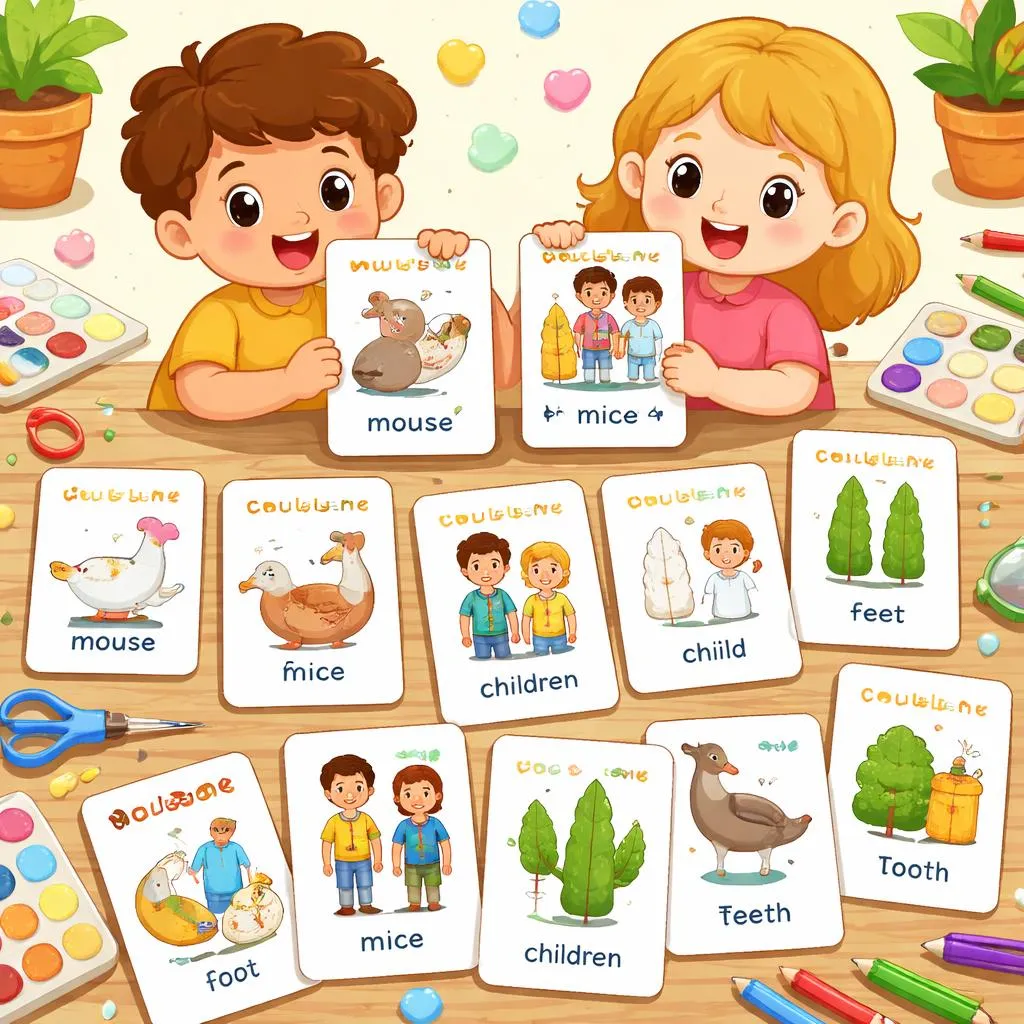

The set of 36 cards contains a singular and plural picture card for each vocabulary word. For example: 1 calf, 2 calves. Some of the patterns include: no change: moose – moose f -> ves: wolf – wolves vowel change: goose – geese word change: person – people
Word list: calf, calves, child, children, dice, die, feet, fish, foot, geese, goose, knife, knives, leaf, leaves, loaf, loaves, man, men, mice, moose, mouse, people, person, sheep, shelf, shelves, teeth, thief, thieves, tooth, wolf, wolves, woman, women
Click here to download the full Irregular Plural Nouns PDF — free
By practicing with flashcards, children can:
Using these irregular plural nouns flashcards, children develop their vocabulary and understanding of singular and plural forms that do not follow regular rules. The visual pairing of singular and plural images helps reinforce memory and recognition. Kids improve their reading, speaking, and grammar skills by associating words with pictures and practicing pronunciation. This interactive learning method makes mastering tricky plural forms fun and engaging, building confidence in language use.
How to Teach Irregular Plural Nouns Flashcards with Flashcards
Parents and educators can start by introducing one pair of singular and plural cards at a time, showing the images and saying the words aloud. Encourage children to repeat the words and notice the differences in spelling and pronunciation. Use the cards to tell simple stories or ask questions like “How many wolves do you see?” to promote conversation. Gradually add more cards as children become comfortable, mixing them up to test recognition and recall. Consistent short sessions help maintain interest and reinforce learning.
(1) Fun Irregular Plural Nouns Flashcard Games
Games such as memory matching, where children find pairs of singular and plural cards, or “Go Fish” using the flashcards, make learning playful and interactive. Another idea is a sorting game where kids group cards by pluralization patterns (no change, vowel change, word change, etc.). These activities encourage active engagement and help children internalize the irregular plural rules naturally.
(2) Example Sentences with Irregular Plural Nouns
Using flashcards, children can practice sentences like “The wolf is howling” and “The wolves are running,” or “I see one mouse” and “There are many mice.” Adding emotions or actions to these sentences, such as “The angry thief is stealing” or “The happy children are playing,” helps children connect vocabulary with real-life contexts and express feelings.
Free Irregular Plural Nouns Flashcards PDF Download
Parents and teachers can download and print the full set of irregular plural nouns flashcards for free from the provided link. This allows easy access to high-quality, ready-to-use materials that can be used at home or in the classroom. The printable format supports repeated practice and can be laminated for durability.
FAQ about Irregular Plural Nouns Flashcards
Q: What age group is best for these flashcards?
A: These flashcards are ideal for children aged 5-9 who are learning basic grammar and vocabulary.
Q: How often should children practice with the flashcards?
A: Short daily sessions of 10-15 minutes are most effective for retention.
Q: Can these flashcards be used for group activities?
A: Yes, they work well in both individual and group settings to encourage cooperative learning.
Q: Are there exercises to test understanding?
A: Yes, simple quizzes and matching exercises can be created using the flashcards to assess progress.
These flashcards provide a fun, interactive way to master irregular plural nouns, supporting children’s language development through visual and verbal practice.