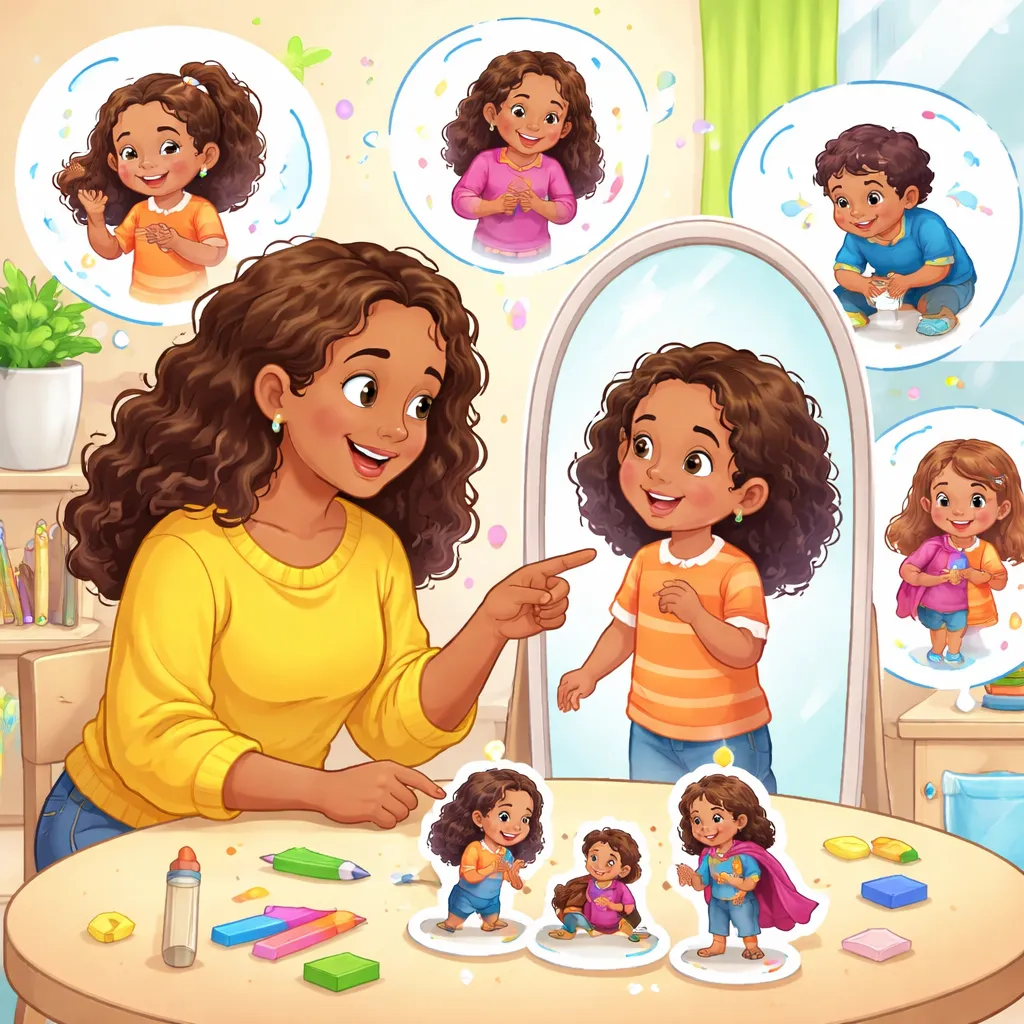

What Is Reflexive pronouns? Imagine you are standing in front of a shiny bedroom mirror. When you look into the glass, who do you see looking back? You see yourself, the same person who is doing the looking. In English, we use Reflexive pronouns when the "doer" and the "receiver" are the same.
These special words act like a grammar mirror for our sentences. They show that the action of the verb reflects back to the subject. If a cat licks its own paw, it is grooming itself in the sun. The action starts with the cat and ends with the cat too.
Using these words helps children talk about their independent actions. It allows them to explain things they do without any outside help. "I tied my shoes myself" is a proud moment for any young learner. It adds a sense of achievement and clarity to their daily English.
Mastering these pronouns is like adding a new color to a painting. It makes stories sound more detailed and much more sophisticated. Children will encounter these words in many favorite storybooks and movies. Understanding them early builds a very strong foundation for future fluency.
Rules of Reflexive pronouns The formation of Reflexive pronouns follows a very simple and clear pattern. For singular people or things, we add the suffix "-self" to the word. "My" becomes "myself," and "your" becomes "yourself" when talking to one friend. "Him," "her," and "it" become "himself," "herself," and "itself" for others.
When we talk about more than one person, the ending changes its shape. We replace "-self" with the plural suffix "-selves" to show a group. "Our" turns into "ourselves" to include the speaker and their companions. "Them" changes to "themselves" to describe a group of other people.
A very important rule is that the pronoun must match the subject. If the sentence starts with "I," the reflexive part must be "myself." You cannot say "I bought a gift for herself" if you mean you bought it for you. Matching the "self" to the "subject" keeps the meaning of the sentence correct.
These words always function as the object of a verb or a preposition. They cannot stand alone as the main subject of an English sentence. "Myself went to the park" is incorrect because a subject pronoun is needed. The reflexive word always follows an action that points back to the start.
How to Use Reflexive pronouns We use Reflexive pronouns primarily when the object is the same as the subject. "He hurt himself while playing soccer" means he is the person who feels the pain. It identifies the person receiving the action without repeating their name. This makes the sentence much more efficient and very easy to understand.
Another common use is to add emphasis to a person or an action. "The Queen herself opened the new park" shows how important the event was. In this case, the pronoun emphasizes that no one else did the job. It adds a "wow" factor to the story that your child is telling.
We often use the word "by" before a reflexive pronoun to show independence. "She walked home by herself" means she was alone during her journey. "I did the puzzle by myself" tells everyone that no help was needed. This is a great way for children to express their growing skills.
Practice using these words during daily chores and fun activities at home. Ask your child, "Did you brush your teeth yourself today?" Encourage them to answer with a full and proud reflexive sentence. Connecting the grammar rule to their real-life wins makes it stick forever.
Examples of Reflexive pronouns Let's look at a busy morning in a happy household to see these words. The little boy named Leo is learning to get ready for school early. "I can dress myself!" Leo shouts as he puts on his bright yellow shirt. The action of dressing starts and ends with Leo, so "myself" is perfect.
In the kitchen, Mom and Dad are preparing a big family breakfast. "We made this delicious meal all by ourselves," they say with a smile. Since there are two parents, they use the plural ending "-selves." This tells the children that the parents worked together as a team.
Later at the park, we might see a small puppy playing with a ball. The puppy sees its reflection in a puddle and barks at itself. Since the puppy is an animal, we use the neutral word "itself." It describes a funny moment where the puppy is the doer and the receiver.
Think about a group of students working on a science project at school. "The students organized the entire presentation themselves," says the teacher. The teacher is very impressed because the group worked without any help. Using "themselves" highlights their teamwork and their great independence.
Common Mistakes The most frequent error is using a reflexive pronoun as a subject. Some children say "Myself and Sam went to the store" by mistake. The correct way is "Sam and I went to the store" using a subject pronoun. Always remember that "-self" words need a "doer" to come before them.
Another common hurdle is the spelling of "himself" and "themselves." Learners sometimes write "hisself" or "theirselves" because they sound logical. Gently remind your child that these two words are special exceptions. Practicing the correct spelling through writing helps these words become habits.
Mixing up singular and plural endings is also a very common phase. A student might say "We did it ourself" instead of the correct "ourselves." If there is more than one person, the "f" always turns into a "v." Think of the plural "v" as a sign that the group is getting bigger.
Using a reflexive pronoun when it is not needed can make a sentence confusing. "I saw myself a movie" sounds very strange to a native English speaker. You only need the reflexive word if you are the one the movie is about. Usually, "I saw a movie" is all you need to say to be very clear.
Comparison It is helpful to compare Reflexive pronouns with object pronouns side-by-side. Object: "I saw her in the mirror" (Two different people are involved). Reflexive: "I saw myself in the mirror" (Only one person is involved). Seeing the difference in the "reflection" helps children pick the right word.
We can also compare them with "Intensive Pronouns," which look identical. Reflexive: "He cut himself" (The word is necessary for the meaning). Intensive: "He himself cut the cake" (The word just adds extra emphasis). If you can remove the word and the sentence still makes sense, it is intensive.
Compare "yourself" (singular) and "yourselves" (plural) when giving orders. To one child: "Please behave yourself during the long car ride." To a group of children: "Please behave yourselves at the birthday party." This shows how English changes based on how many people are listening.
Finally, compare reflexive actions with "reciprocal" actions using "each other." Reflexive: "They are looking at themselves" (Each person looks in a mirror). Reciprocal: "They are looking at each other" (They are making eye contact). Understanding this distinction helps children describe social scenes accurately.
Practice Exercises Let's test your knowledge with some fun challenges and sentence puzzles! Fill in the blanks with the correct form of Reflexive pronouns.
I taught ________ how to play the wooden flute last summer.
The little girl dressed ________ for the fancy costume party.
My cat washed ________ after eating a big bowl of tuna.
We enjoyed ________ very much at the colorful circus yesterday.
Did you and your brother do the homework ________?
The robot can fix ________ when it breaks a small metal part.
You should be proud of ________ for winning the race! (Singular)
The players felt disappointed in ________ after losing the game.
Now, try to spot the one mistake in each of these sentences.
Hisself is a very talented young artist.
We made the cookies all by ourself.
She looked at her in the mirror and smiled. (She saw her own face)
Answers and Explanations myself: The subject "I" always matches with the word "myself."
herself: Since the girl is a "she," we use the feminine form.
itself: We use "itself" for animals when we don't say their gender.
ourselves: "We" is plural, so we must use the "-selves" ending.
yourselves: Since it is "you and your brother," it is plural.
itself: The robot is an object, so it takes the neutral form.
yourself: This singular "you" refers to one person doing a great job.
themselves: The group of players requires the plural third-person form.
Mistake Identifications:
Hisself should be He. (A reflexive word cannot be the subject)
ourself should be ourselves. (Plural subjects need the plural ending)
her should be herself. (To see your own face, you need a reflexive word)
If your child got the plural "-selves" right, give them a big high-five! Understanding the shift from singular to plural is a major milestone. Remind them that "itself" is great for robots, toys, and animals. With steady practice, these matching rules will become second nature.
Learning Tips Create a "Mirror Challenge" where your child describes their reflection. "I see myself, I like myself, and I can take care of myself!" This positive activity practices the grammar while building self-esteem. It connects the word "myself" to their own identity in a happy way.
Play a game of "The Independent Chef" while making a simple snack. Let your child perform safe tasks like spreading jam on a piece of bread. Have them announce, "I am doing this myself!" as they work. Physical actions help the brain remember the reflexive meaning of the words.
Draw a "Self-Help Hero" poster featuring a character who can do anything. Label the hero's actions: "He washes himself," "He feeds himself," etc. Use bright markers to highlight the "-self" and "-selves" endings. Visual aids are wonderful tools for helping young learners organize ideas.
Read comic books together and look for characters talking to themselves. Speech bubbles in comics are a great place to find natural reflexive words. Discuss why the character is using that specific word in that moment. Active reading turns every story into a mini-lesson in English grammar.
Always keep the atmosphere light, encouraging, and full of joy. Reflexive pronouns can be tricky, so be patient with any spelling errors. Celebrate the moment your child starts using these words in their speech. Your encouragement is the most powerful fuel for their learning adventure.
Mastering these words gives children the tools to express their independence. It allows them to talk about their skills and their feelings with detail. Every "myself" and "ourselves" is a step toward becoming a better speaker. Enjoy the journey of discovering English together as a team!