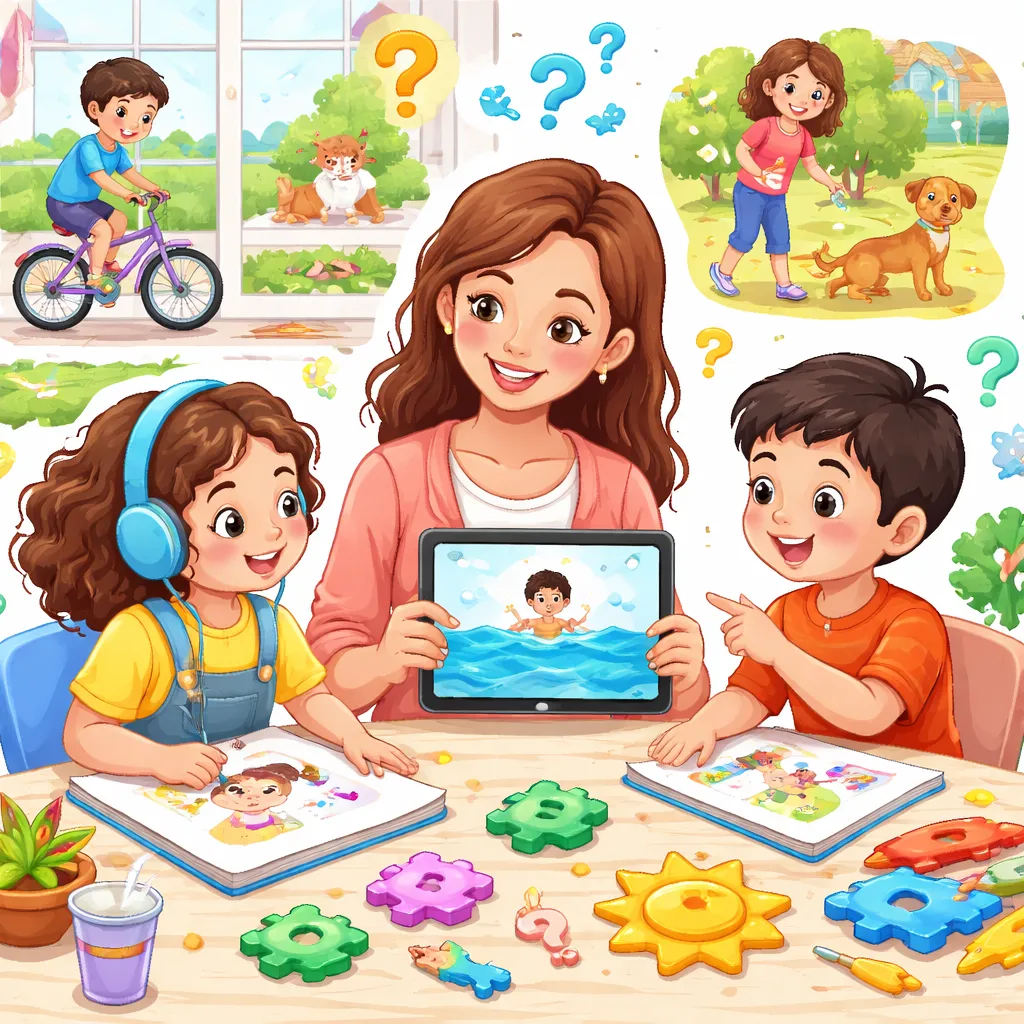

What Is Present continuous? Imagine you are sitting in a sunny park with your family. You look around and see a dog jumping for a red ball. You see your little brother eating a cold strawberry ice cream. To describe these actions happening right now, we use the Present continuous.
This special tense helps us talk about things that are in progress. It is the "action" tense of the English language for young learners. We use it to share what is happening at this very exact moment. It makes our stories feel alive and very exciting for the listener.
Think of the Present continuous as a live video of your daily life. While a simple tense tells a fact, this tense shows the movement. Instead of saying "I eat," you say "I am eating" your delicious lunch. It adds a sense of "now" to every single sentence your child speaks.
Learning this tense is a major milestone for every English student. It allows children to describe their play, their chores, and their dreams. It is one of the most common ways we communicate in our daily lives. Mastering it gives kids the confidence to speak about the world around them.
Rules of Present continuous? The Present continuous has a very simple and clear two-part recipe. The first part is a helping verb called the "to be" verb. We use "am" for I, "is" for he/she/it, and "are" for you/we/they. This helping verb acts like a strong anchor for the rest of the sentence.
The second part is the main action word with a special suffix. We add the three letters "-ing" to the end of the base verb. "Play" becomes "playing," and "jump" becomes "jumping" in this tense. Combining these two parts creates the perfect Present continuous structure.
There are a few small spelling rules to remember for the "-ing" part. If a short verb ends in a consonant-vowel-consonant, we double the last letter. "Run" becomes "running," and "swim" becomes "swimming" with an extra letter. This "Double the Power" rule keeps the word sounding exactly right.
If a verb ends in a silent "e," we drop the "e" before adding "-ing." The word "dance" transforms into "dancing" by removing the final "e." "Write" becomes "writing" using this same simple and helpful pattern. Following these rules helps children write and speak with great accuracy.
How to Use Present continuous? We use the Present continuous primarily for actions happening right now. If you are holding a pencil and drawing, you say "I am drawing a house." It identifies what is occupying your time at this very second. This is the most common and helpful way to use this grammar tool.
We also use this tense for temporary actions that are still unfinished. "I am reading a long book about space" might mean you are in the middle of it. You might not be reading it this second, but you are doing it these days. It shows that an activity is a current project in your busy life.
Another way to use this tense is to talk about your near future plans. "We are visiting Grandma tomorrow" shows a plan that is already decided. It adds a sense of certainty and excitement to your upcoming schedule. Children can use this to talk about parties, trips, and fun playdates.
To make a question, just flip the "to be" verb to the front. "Are you playing?" or "Is he sleeping?" are perfect ways to ask. To say "no," simply add the word "not" after the helping verb. "I am not crying" or "They are not running" shows the negative form.
Examples of Present continuous? Let's look at a busy morning in a happy classroom to see these words. "The students are listening to a story about a brave forest lion." "The teacher is pointing to a colorful map on the white wall." These examples show the actions that are filling the room right now.
In the school garden, nature is also very busy and full of life. "A small brown bird is building a nest in the tall oak tree." "Two orange butterflies are flying over the bright yellow flowers." The "-ing" words help us see the movement of the animals and insects.
Think about what you are doing at home on a rainy Saturday afternoon. "My mom is baking a delicious apple pie in the warm kitchen." "My dad is washing the car in the driveway with a big blue sponge." Every member of the family has their own action in the Present continuous.
Consider a group of friends playing a fun game of hide-and-seek. "I am hiding behind the big green sofa," whispers a little girl. "He is looking for us in the garden," says her brother quietly. The tense keeps the story moving and makes the game feel very real.
Common Mistakes The most frequent mistake is forgetting the "to be" helping verb. A child might say "I playing" instead of the correct "I am playing." Always remind them that the "-ing" word needs its "am, is, or are" partner. They work together like a team to make the sentence strong and clear.
Another common hurdle is using the wrong "to be" verb for the person. "They is running" is a very common error for young English learners. Match "is" with one person and "are" with many people for a perfect score. Remembering that "I" always takes "am" is also a very important rule.
Spelling mistakes with the "-ing" suffix are also quite common at first. Writing "runing" with only one "n" or "danceing" with an "e" happens often. Gently review the doubling and dropping rules to help the spelling stick. Practice makes these tiny adjustments feel natural over a little bit of time.
Some learners use this tense for things that are always true or facts. "The sun is rising in the east" is fine, but "The sun rises" is a general fact. Save the Present continuous for actions that are moving and changing. This keeps your child's English sounding very natural and professional.
Comparison It is helpful to compare the Present continuous with the "Simple Present." Simple Present: "I eat apples" (This is a general fact or a habit). Present continuous: "I am eating an apple" (This is happening right now). One is about your whole life, while the other is about this very moment.
We can also compare the "now" use with the "future plan" use. "I am wearing a hat" (Now) versus "I am wearing a hat to the party" (Future). The words around the verb, like "tomorrow," help us know the time. This flexibility is one of the coolest parts of the English language.
Compare the singular and plural forms to see how the helping verb changes. "The cat is sleeping" (One cat) versus "The cats are sleeping" (Many cats). The "-ing" part stays exactly the same, which makes it very easy to learn. Only the little helping verb changes its shape to match the group.
Understanding these comparisons helps children build a mental map of time. They can quickly decide which tense fits the situation perfectly. It turns grammar into a logical system of actions and movements. This clarity is the key to becoming a confident and fluent storyteller.
Practice Exercises Let's test your action-tracking skills with these fun grammar challenges! Change the verb in the brackets into the correct Present continuous form.
I ________ (read) a very funny book about a talking cat.
Look! The squirrels ________ (climb) the tall tree in the park.
My sister ________ (not / watch) TV; she is doing her homework.
________ you ________ (listen) to the beautiful music?
The baby ________ (sleep) soundly in her small white crib.
We ________ (have) a great time at the birthday party today.
He ________ (run) very fast to catch the school bus.
The sun ________ (shine) brightly through the open window.
Try to describe three things happening in your room right now. What is your pet doing, or what is the weather doing outside? Sharing your observations aloud is the best way to practice this tense.
Answers and Explanations am reading: "I" always pairs with "am" followed by the "-ing" verb.
are climbing: "The squirrels" are many, so we use the plural "are."
is not watching: This is a negative sentence for a single person.
Are ... listening: In a question, the helping verb moves to the front.
is sleeping: The baby is one person, so "is" is the correct choice.
are having: "We" is a group that always uses the helping verb "are."
is running: Remember to double the "n" in this short action word!
is shining: Drop the "e" from "shine" before you add the "-ing" part.
If your child got the "running" and "shining" spellings right, celebrate! Those tiny spelling changes show a very sharp eye for English rules. If they remembered every "am, is, and are," they are doing wonderful. Steady practice will make these combinations feel like second nature.
Learning Tips Create an "Action Photo Album" using pictures of your child's day. Ask them to describe each photo using the Present continuous tense. "In this picture, I am playing with my blocks" is a great example. Connecting the grammar to their own memories makes the lesson stick.
Play a game of "The Narrator" while you are doing chores or playing. Have your child describe what you are doing as if they are a reporter. "Mom is washing the dishes" or "You are jumping on the grass!" This turns a simple afternoon into an interactive English practice session.
Draw a "Spelling Flower" to help with the "-ing" transformation rules. Write the base verb in the center and the "-ing" form on a petal. Use different colors for words that double letters or drop the letter "e." Visual aids are powerful tools for helping young learners organize ideas.
Use stickers to label the Present continuous in your child's favorite books. Find a sentence like "The bear is eating honey" and talk about the action. Active reading is one of the best ways to see grammar in the real world. It helps children see that these rules are used by their favorite writers.
Always keep your sessions positive, light, and full of great encouragement. Learning a new tense is an adventure that takes a little bit of time. Celebrate every time your child describes an action correctly in speech. Your support is the most powerful engine for their educational journey.
Mastering Present continuous allows children to be descriptive and lively. It gives them the tools to share their "now" with everyone they meet. Every "I am playing" and "They are running" is a win for their skills. Enjoy the journey of exploring these active patterns together as a team!