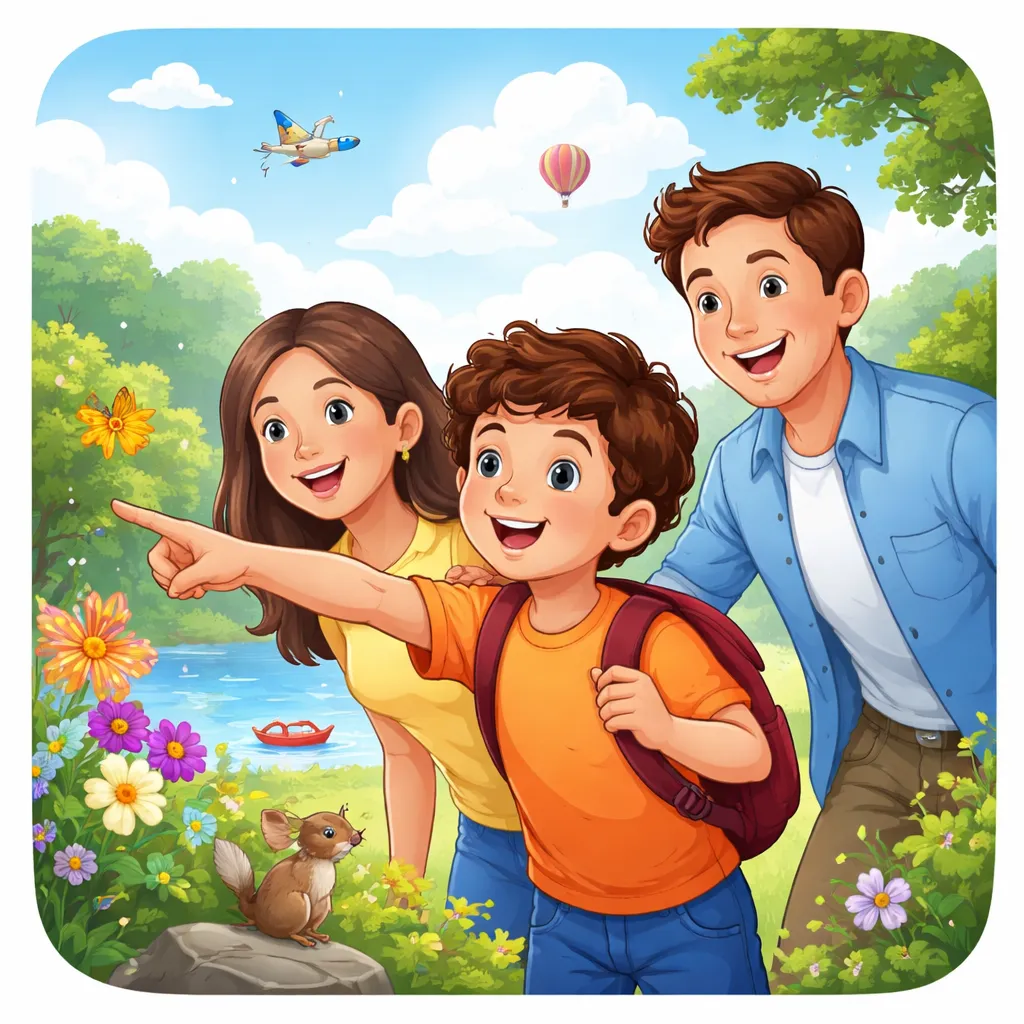

What Is Demonstratives: 'this', 'that', 'these', 'those'? Imagine you are at a busy toy store with your family. You see a beautiful teddy bear right in your hand. Then, you spot a giant toy airplane way up on the top shelf. In English, we use specific words to show exactly which object we mean.
These helpful words are called Demonstratives: 'this', 'that', 'these', 'those'. They act like invisible fingers pointing at things around us. They tell the listener two very important pieces of information. First, they show if the object is close to us or far away.
Second, they tell us if we are talking about one thing or many. Without these words, we would have to do a lot of extra pointing. They help children communicate their needs and desires more clearly. Using them correctly makes every sentence much more specific and meaningful.
Learning these words is a fundamental step for every young explorer. They are some of the most frequent words in the English language. You will hear them in every story, song, and daily conversation. Mastering them gives your child the power to identify the whole world.
Rules of Demonstratives: 'this', 'that', 'these', 'those' The rules for these words depend on distance and quantity. We use "this" for a single object that is within our reach. If you can touch it or hold it, "this" is the right choice. It is the singular partner for things that are very close by.
"That" is the partner for a single object that is further away. If you have to point across the room, you should use "that." It helps us talk about things that are out of our immediate reach. Both "this" and "that" always describe exactly one person, place, or thing.
When we have a group of items nearby, we use the word "these." It is the plural version of "this" for things we can easily touch. "These" tells the listener that there are at least two objects. It is perfect for a handful of markers or a pile of favorite books.
"Those" is the plural word for a group of items far away from us. If you see birds in the sky or cars on the street, use "those." It combines the idea of "many" with the idea of "distance." These four words create a perfect system for organizing everything we see.
How to Use Demonstratives: 'this', 'that', 'these', 'those' We use these words as both pronouns and adjectives in our speech. As a pronoun, the word stands alone to represent the object. "This is my favorite hat," you might say while wearing it. The word "this" completely replaces the name of the hat in that moment.
As an adjective, the word sits right before the noun it describes. "I like that blue balloon," you tell the person at the park. Here, "that" gives more information about the specific balloon you want. This double role makes these words extremely flexible and very useful.
Pay attention to the verb that follows your demonstrative word. "This" and "that" love to work with the singular verb "is." "These" and "those" always pair up with the plural verb "are." "This is a dog" versus "Those are dogs" shows perfect grammar harmony.
Encourage your child to use these words during their playtime. Ask them to sort their toys into "this" pile and "that" pile. Practicing the physical movement of pointing helps the brain learn. The more they use them, the more natural the distance rules will feel.
Examples of Demonstratives: 'this', 'that', 'these', 'those' Let's look at a morning in the kitchen to see these words in action. "This cereal is delicious," says a young girl eating her breakfast. She is touching the bowl, so "this" is the perfect word to use. It shows her enjoyment of the meal right in front of her.
Her brother points to the fruit basket on the far counter. "Can I have that banana, please?" he asks his father politely. The banana is across the room, so he uses "that" to specify which one. This helps his father know exactly which fruit to pick up.
In the playroom, the children are looking at their collection of blocks. "These blocks are for the castle," says the boy holding three blue ones. Since he has a group of them in his hands, he uses "these." It clearly defines the group of items he is currently using for his work.
Outside the window, a group of colorful kites flies high in the air. "Look at those kites!" the children shout with a lot of excitement. The kites are far away and there are many of them in the sky. Using "those" accurately describes the distance and the large number.
Common Mistakes A very frequent mistake is mixing up singular and plural forms. A child might say "this markers" instead of the correct "these markers." Always count the items before choosing the demonstrative word. Remember that "this" and "that" are only for a single, lonely object.
Another common hurdle is using "this" for things that are far away. If a child points to a mountain and says "this mountain," it sounds odd. Unless they are standing on top of it, "that mountain" is better. Thinking about "near" and "far" helps build a better spatial sense.
Sometimes learners forget to change the verb "is" to "are." "These is my shoes" is a common error for young English speakers. Match the plural "these" with the plural "are" for a perfect sentence. Consistent practice with "these are" and "those are" builds great habits.
Forgetting the "th" sound at the start is also a frequent challenge. Children might say "dis" or "dat" instead of the clear "th" sound. Practicing the soft "th" with the tongue against the teeth helps. Clear pronunciation makes these important words much easier to hear.
Comparison It is helpful to compare "this" and "these" side-by-side. Both are for things that are near us and within our reach. The only difference is the number of items we are talking about. "This" is for one, and "these" is for two or more.
We can also compare "that" and "those" in the same way. Both describe objects that are at a distance from the speaker. If you see one star, say "that star," but for a galaxy, say "those stars." Distance stays the same, but the quantity changes our word choice.
Compare these words with the simple articles "a," "an," and "the." "The book" is general, but "this book" is very specific and personal. Demonstratives add a sense of location that articles do not have. They ground the conversation in the physical world around the speaker.
Understanding these comparisons helps children build a mental map. They can quickly decide which word fits the situation perfectly. It turns grammar into a logical system of distance and numbers. This clarity is the key to becoming a confident and fluent speaker.
Practice Exercises Let's test your pointing skills with these fun grammar challenges! Choose the correct word from 'this', 'that', 'these', or 'those'.
I am holding ________ shiny red apple in my hand right now.
Look at ________ white clouds way up high in the blue sky!
________ cookies on the far table look very yummy to eat.
________ book I am reading is about a brave little dragon.
Can you see ________ tiny bird sitting on the distant fence?
________ shoes on my feet are very comfortable for running.
Is ________ your backpack over there by the classroom door?
Please put ________ colorful toys into the box on the floor. (Near you)
Try to act out the sentences as you say the words aloud. Point to something near you and then point to something far away. Which words feel the most natural for your favorite toys?
Answers and Explanations this: The apple is in your hand, so it is near and singular.
those: The clouds are far away and there are many of them.
those: The cookies are on a far table and are plural.
this: You are currently reading the book, so it is near you.
that: The bird is far away on a fence and it is just one bird.
these: The shoes are on your feet (near) and there are two of them.
that: The backpack is over by the door, which is a distance away.
these: The toys are near you and there is a group of them.
If your child got the distance questions right, give them a high-five! Understanding the "near" and "far" concept is the biggest hurdle. If they struggled with plural versus singular, review the "s" endings. Matching the word to the count is the second step to mastery.
Learning Tips Create a "Near and Far" scavenger hunt in your living room or garden. Give your child a list of things to find using the four demonstrative words. "Find 'this' shoe" and "Find 'that' tree" makes the lesson an adventure. Physical movement is one of the best ways for children to learn grammar.
Play the "Point and Name" game while you are driving or walking outside. Take turns pointing to objects and using the correct demonstrative word. "Those are tall buildings" and "That is a red car" are great examples. It turns a simple walk into an interactive English language lesson.
Draw a "Distance Map" on a large piece of paper with your child. Draw a stick figure of the child in the center of the page. Draw things close to the figure and label them with "this" and "these." Draw things at the edge of the page and label them with "that" and "those."
Use colorful stickers to label items around your child's bedroom. Put a "this" sticker on their bed and a "that" sticker on the window. Seeing the words in their own space helps with long-term memory. It makes the English language a part of their daily home environment.
Always keep your guidance warm, positive, and full of great encouragement. Learning to judge distance in a new language takes time and practice. Celebrate every time your child points to something and uses the right word. Your support is the most powerful tool for their educational success.
Mastering these words allows children to be precise and descriptive. It gives them the ability to share their world with others clearly. Every "this" and "those" is a step toward becoming a better communicator. Enjoy the journey of exploring the English language together every day.