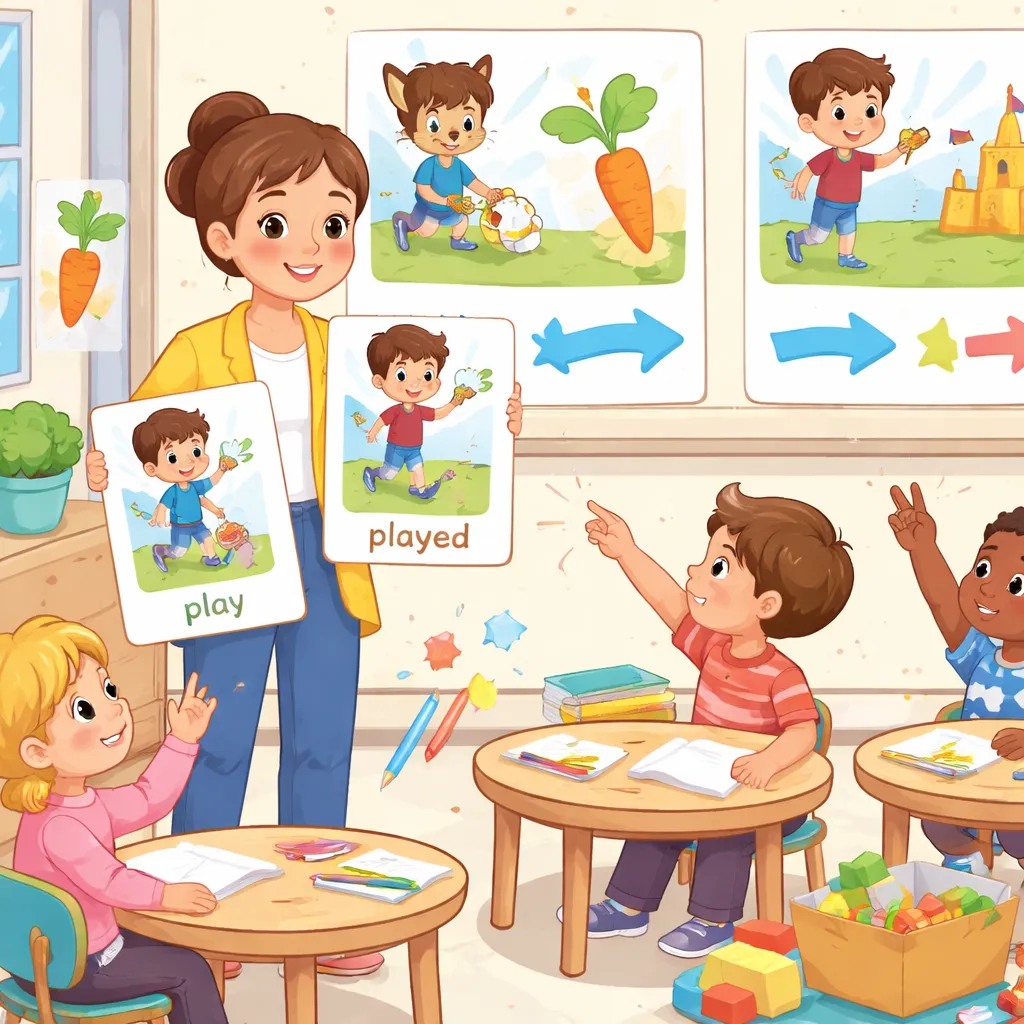

What Is Simple Past Tense vs Past Participle?
Understanding verb forms helps young learners build strong English skills. Two important forms are the simple past tense and the past participle. They may look similar, but they serve different roles in a sentence.
The simple past tense describes an action that finished in the past. It often answers the question: “What happened?” For example, “She played” or “They went.”
The past participle is a special verb form. It does not usually stand alone. It often works with helping verbs such as “has,” “have,” or “had.” It also appears in passive voice sentences.
Both forms come from the same verb. Regular verbs often look the same in both forms. Irregular verbs often change in unique ways.
Rules of Simple Past Tense vs Past Participle
Clear rules help learners avoid confusion. These rules are simple but important.
For regular verbs, both forms usually end in -ed. For example:
walk → walked (simple past) walk → walked (past participle)
For irregular verbs, forms may change differently. For example:
go → went (simple past) go → gone (past participle)
The simple past tense does not need a helping verb. It can stand alone in a sentence.
The past participle needs a helping verb. Common helpers include “has,” “have,” “had,” “is,” “are,” and “was.”
Past participles are also used in perfect tenses. For example:
She has eaten. They have finished.
They also appear in passive voice:
The cake was eaten.
Learning these patterns builds a strong grammar foundation.
How to Use Simple Past Tense vs Past Participle
The simple past tense is used for completed actions. It often includes time words such as “yesterday,” “last night,” or “ago.”
Example:
He watched a movie yesterday.
The past participle works with helping verbs. It forms perfect tenses.
Present perfect:
She has finished her homework.
Past perfect:
They had left before the rain started.
Past participles also describe states in passive voice:
The book was written by a famous author.
Simple past focuses on action. Past participle focuses on connection with another verb.
This difference is key for clear communication.
Examples of Simple Past Tense vs Past Participle
Seeing examples helps learners understand faster.
Regular verbs:
play → played / played She played outside. She has played outside before. clean → cleaned / cleaned He cleaned his room. He has cleaned his room.
Irregular verbs:
eat → ate / eaten She ate lunch. She has eaten lunch. see → saw / seen They saw a bird. They have seen a bird. take → took / taken He took a book. He has taken a book.
These examples show how forms change and how usage differs.
Common Mistakes
Many learners mix these two forms. This is normal and part of learning.
One common mistake is using simple past instead of past participle:
Incorrect: She has went home. Correct: She has gone home.
Another mistake is missing the helping verb:
Incorrect: She eaten lunch. Correct: She has eaten lunch.
Some learners also overuse “-ed” with irregular verbs:
Incorrect: He eated breakfast. Correct: He ate breakfast.
Confusion often happens with verbs that look the same in both forms:
cut → cut / cut put → put / put
These verbs require careful attention to context.
Clear practice helps reduce these mistakes over time.
Comparison
A direct comparison makes the difference clearer.
Simple past tense:
Describes finished actions Does not need helping verbs Example: She wrote a letter
Past participle:
Works with helping verbs Forms perfect tenses Used in passive voice Example: She has written a letter
Another comparison:
He broke the window. (simple past) The window was broken. (past participle in passive voice)
Both forms are important. Each has a clear role.
Understanding when to use each one improves sentence accuracy.
Practice Exercises
Practice builds confidence. These simple exercises support learning.
Fill in the blanks with the correct form:
She ______ (go) to the park yesterday. She has ______ (go) to the park many times. They ______ (eat) dinner early. They have ______ (eat) dinner. He ______ (take) a photo last week. He has ______ (take) many photos.
Choose the correct answer:
She has (saw / seen) that movie. They (did / done) their homework yesterday. He has (wrote / written) a story.
Rewrite the sentence using the correct form:
She has went home. They have ate lunch.
These exercises encourage active thinking.
Answers and Explanations
Checking answers helps learners understand better.
went gone
“Went” is simple past. “Gone” is past participle.
ate eaten
“Ate” describes a finished action. “Eaten” needs “have.”
took taken
“Took” is simple past. “Taken” works with “has.”
seen
“Seen” is the correct past participle with “has.”
did
“Did” is correct for simple past.
written
“Written” is the correct past participle.
She has gone home. They have eaten lunch.
These corrections show proper usage.
Mistakes become learning steps with clear explanations.
Learning Tips
Learning grammar becomes easier with simple strategies.
Focus on common irregular verbs first. Words like “go,” “eat,” and “see” appear often.
Practice in small steps. Short sentences help learners stay focused.
Use reading to see grammar in context. Stories provide natural examples.
Encourage speaking practice. Saying sentences aloud builds confidence.
Create simple charts. Compare simple past and past participle forms side by side.
Repeat learning regularly. Frequent exposure strengthens memory.
Celebrate progress, even small improvements. Consistency leads to strong grammar skills over time.