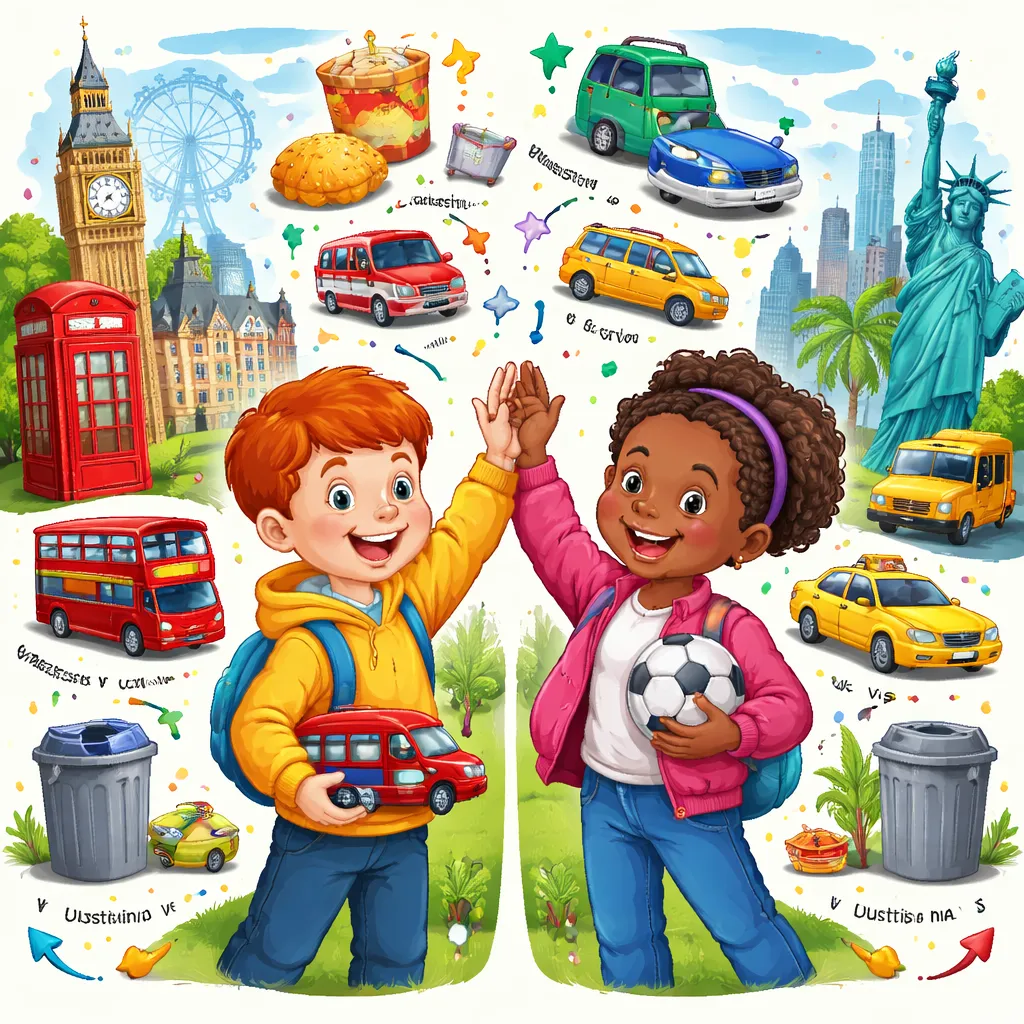

What Is British English and American English?
Language is a fascinating tool that connects us to the world around us, and in the case of English, there are different variations to explore. The two major types of English that children may encounter are British English and American English. While both versions share many similarities, they also have distinct differences that can sometimes be confusing. Understanding these differences helps children not only learn the language more effectively but also appreciate the rich diversity of English around the world.
British English and American English both originated from the same roots, yet evolved in different countries, influenced by culture, history, and geography. British English is spoken in the United Kingdom, which includes England, Scotland, Wales, and Northern Ireland. On the other hand, American English is the form of English spoken in the United States. Despite these regional variations, both versions of the language are widely understood globally.
Rules of British English and American English
The differences between British English and American English are not just about vocabulary. The rules governing spelling, grammar, and punctuation can also vary. For example, in British English, collective nouns (like "team" or "family") are usually treated as plural, while in American English, they are treated as singular.
A good example of a spelling rule difference is the suffix "ize" versus "ise." In British English, words like "realize" or "organize" are often spelled with "ise," while in American English, the same words use "ize." While both forms are correct, British English tends to follow the "ise" spelling.
How to Use British English and American English
When deciding which form of English to use, children need to be aware of where they are learning or communicating. For instance, if a child is learning English in the UK, they will be taught British English, which will influence their spelling, vocabulary, and pronunciation. Similarly, in the United States, American English will be the standard.
There is no one-size-fits-all approach to using British or American English. It’s more about consistency. For example, if a child is writing a school essay or taking a test, they should stick to one version of English. Mixing British and American spellings, like writing "colour" (British) and "color" (American) in the same text, may lead to confusion.
Examples of British English and American English Vocabulary Differences
One of the most noticeable differences between British and American English is the vocabulary. Even though both versions of English are widely understood, certain words mean different things or are entirely different words altogether. Here are a few examples:
British English: Lift / American English: Elevator British English: Biscuit / American English: Cookie British English: Lorry / American English: Truck British English: Flat / American English: Apartment
These variations in vocabulary are important because children will need to understand that while the words may differ, they still refer to the same object or concept.
Spelling Differences
As mentioned, spelling differences are one of the most obvious distinctions between British and American English. Here are some common examples:
British English: Centre / American English: Center British English: Theatre / American English: Theater British English: Colour / American English: Color British English: Defence / American English: Defense
The use of "ou" in British English (like "favour") versus "o" in American English (like "favor") is another classic example.
Pronunciation Differences
Although pronunciation is not always written down, it's another area where British and American English differ. For instance, in British English, the word "schedule" is often pronounced as "shed-yool," while in American English, it is more commonly pronounced as "sked-yool." There are also differences in how certain vowel sounds are pronounced, especially the "a" sound in words like "dance" or "bath," which is pronounced with a broad "a" in British English but with a flat "a" in American English.
Common Mistakes in British and American English
When children start learning both British and American English, they may accidentally mix up some common words and rules. Here are a few common mistakes to watch out for:
Spelling Confusion: Sometimes, children may use the British spelling "colour" in an American setting, where "color" would be expected, or vice versa. Vocabulary Mix-ups: A child might say "biscuit" when they mean "cookie," or "flat" when they mean "apartment." These errors can cause confusion, especially in international conversations. Pronunciation Issues: For example, when children use British pronunciation in an American context, people might not always understand them, and vice versa.
It’s important to correct these mistakes early so that children can feel confident using the correct version of English in any given situation.
Comparison of British and American English
Although British and American English differ in several ways, they are still the same language. The rules and vocabulary of each version reflect the culture and history of the countries where they originated. Here’s a quick comparison of some of the most noticeable differences:
Feature British English American English Spelling Colour, Theatre, Centre Color, Theater, Center Vocabulary Lorry, Biscuit, Flat Truck, Cookie, Apartment Grammar Collective nouns are plural Collective nouns are singular Pronunciation More emphasis on vowels More emphasis on consonants
This comparison shows that while there are many differences between the two forms of English, both are equally valid and useful.
Practice Exercises for British and American English
The best way for children to master British and American English is through practice. Here are some simple exercises to help reinforce these differences:
Vocabulary Matching: Create a list of British and American words. Have children match the British word with its American counterpart.
Example:
Biscuit → Cookie Lorry → Truck Flat → Apartment Spelling Dictation: Read a passage aloud, and have children write down the words in both British and American spelling. For example: Colour (British) / Color (American) Theatre (British) / Theater (American) Sentence Correction: Provide a sentence with a mix of British and American English. Have children correct it to use only one version of English. For example: "I went to the theatre and saw a colour film." Correct: "I went to the theater and saw a color film." (in American English) Answers and Explanations
Here are the answers to the above practice exercises:
Vocabulary Matching: Biscuit → Cookie Lorry → Truck Flat → Apartment Spelling Dictation: Colour (British) / Color (American) Theatre (British) / Theater (American) Sentence Correction: Corrected American English: "I went to the theater and saw a color film." Corrected British English: "I went to the theatre and saw a colour film." Learning Tips for British and American English
To make the process of learning British and American English more enjoyable, here are a few helpful tips:
Watch Movies and Shows in Both Variations: Watching shows or movies from both the UK and the US will help children hear the differences in pronunciation and vocabulary. Use Flashcards for Vocabulary: Create flashcards with British and American words to make learning more interactive and fun. Practice Speaking: Encourage children to speak both British and American English to get comfortable with pronunciation differences. Read Books in Both Styles: Look for books that feature both British and American spelling to familiarize children with both forms of English.
By making learning fun and engaging, children can grow to appreciate both British and American English and use them confidently in the right context.