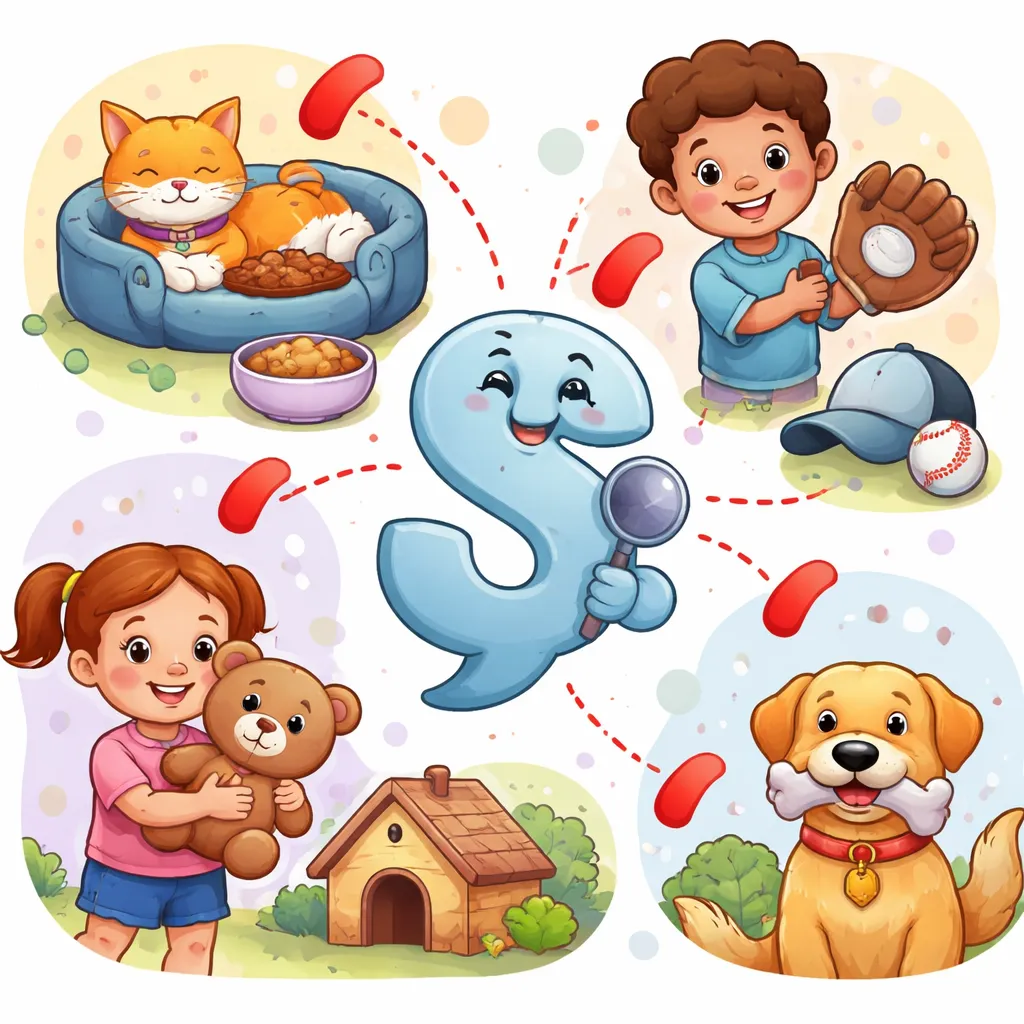

A small apostrophe followed by the letter s changes everything. It tells us who owns what. It connects people to their things. It also connects children to their toys and parents to their cars.
English uses this tiny mark every day. “Sarah’s book” means the book belongs to Sarah. “My brother’s bike” means the bike belongs to my brother.
Children see possessive ‘s everywhere. On book covers. In text messages. On classroom signs. Understanding this small grammar point builds strong reading and writing skills.
Parents can learn alongside their kids. You will both notice possessive ‘s more often. You will use it correctly. And you will feel proud of this simple but powerful tool.
Let us explore the apostrophe s together.
What Is Possessive ‘s? Possessive ‘s shows ownership or relationship. One person or thing belongs to another person or thing. The apostrophe plus s turns a noun into a possessive noun.
Think of it as a pointing finger. “Emma’s pencil” points to Emma. Then it points to her pencil. The apostrophe s connects them.
English does not need extra words like “belonging to.” You do not say “the pencil belonging to Emma.” You say “Emma’s pencil.” It is shorter. It is clearer.
Possessive ‘s works with people. “Mom’s phone.” “Dad’s keys.” “Grandma’s house.” It also works with animals. “The dog’s collar.” “The cat’s bed.” “The bird’s nest.”
Sometimes it works with time. “Today’s news.” “An hour’s wait.” “A week’s vacation.” Time owns the event or duration.
Children learn possessive ‘s naturally through speaking. They say “my friend’s toy” without thinking. The written form just adds the apostrophe. That small mark makes the meaning clear.
Without the apostrophe, “my friends toy” looks like two friends and one toy. With the apostrophe, “my friend’s toy” shows one friend owning one toy. The apostrophe saves confusion.
Rules of Possessive ‘s Rules keep grammar consistent. Learn these four simple rules. Practice them one at a time.
Rule one: Singular nouns add ‘s Take a single person or thing. Add apostrophe s. Always. “Anna’s hat.” “The teacher’s desk.” “A child’s game.” Even names ending in S follow this rule in modern English. “James’s car” is correct. “Thomas’s bag” is correct.
Rule two: Plural nouns ending in S add only apostrophe If the noun already ends with S because it is plural, add only the apostrophe. No extra S. “The dogs’ park” means one park for many dogs. “The parents’ meeting” means a meeting for many parents. “The girls’ bathroom” means a bathroom for many girls.
Rule three: Plural nouns not ending in S add ‘s Some plurals change their spelling. “Children” does not end in S. Add ‘s. “The children’s toys.” “Men” becomes “men’s.” “Women” becomes “women’s.” “People” becomes “people’s choices.”
Rule four: Two people owning together When two people own the same thing, add ‘s only to the last person. “Tom and Jerry’s cartoon” means one cartoon they share. “Mom and Dad’s bedroom” means one bedroom they share.
If they own separate things, add ‘s to each person. “Tom’s and Jerry’s lunches” means two different lunches. One for Tom. One for Jerry.
These rules look tricky at first. But children remember them with practice. Use real objects at home. “This is Sara’s cup.” “These are the cats’ bowls.” Point and say the possessive form.
How to Use Possessive ‘s Use possessive ‘s in four everyday situations. Each situation feels natural for family conversations.
Situation one: Personal belongings Talk about who owns what. “Where is Lily’s shoe?” “Have you seen Dad’s wallet?” “Please put away the baby’s blanket.” These sentences happen dozens of times each day.
Situation two: Family relationships Show how people connect. “My cousin’s name is Max.” “Your grandmother’s sister lives in Florida.” “My brother’s best friend came over.” Possessive ‘s shows family trees clearly.
Situation three: Time expressions Describe durations and events. “We have a month’s worth of homework.” “I need an hour’s break.” “Did you see yesterday’s game?” Time expressions without possessive ‘s sound strange. “Yesterday game” misses the meaning.
Situation four: Places and businesses Name shops and locations. “Let’s go to the doctor’s office.” “I bought this at the baker’s shop.” “We visited St. Paul’s Cathedral.” Many business names use possessive ‘s. “McDonald’s” means the restaurant belonging to McDonald.
Parents can point out possessive ‘s during daily routines. “Look at the sign. It says Claire’s Hair Salon. Claire owns the salon.” These small moments teach more than worksheets.
Children can practice by labeling their own things. Write “Elena’s notebook” on a notebook. Write “Leo’s water bottle” on a bottle. Seeing their name with apostrophe s builds ownership of the grammar rule.
Examples of Possessive ‘s Examples make rules real. Read these aloud with your child. Group them by rule type.
Singular nouns with ‘s
The cat’s tail is fluffy.
My sister’s room is pink.
A bird’s nest fell from the tree.
Dr. Patel’s office opens at nine.
Charles’s backpack is blue. (Yes, the extra S is fine)
Plural nouns ending in S with only apostrophe
The teachers’ lounge is quiet.
Both cars’ tires need air.
The babies’ toys are everywhere.
My grandparents’ house feels cozy.
The students’ questions showed curiosity.
Irregular plurals with ‘s
The children’s playground closes at sunset.
Women’s shoes are on sale.
Men’s clothing costs more sometimes.
The people’s voices filled the hall.
Mice’s tails are long and thin.
Shared and separate ownership
Lucy and Emma’s room is shared. (One room)
Lucy’s and Emma’s backpacks are different. (Two backpacks)
Mom and Dad’s car is red. (One car)
Mom’s and Dad’s phones are black. (Two phones)
Time expressions
I need a moment’s peace.
We enjoyed two weeks’ vacation.
Did you read today’s newspaper?
She took a year’s leave from work.
Read each example twice. Ask your child to find the owner first. Then find the thing owned. This simple habit builds accuracy.
Common Mistakes Mistakes happen. Fix them kindly. Here are five frequent errors with possessive ‘s.
Mistake one: Forgetting the apostrophe Wrong: “My brothers bike is new.” Right: “My brother’s bike is new.”
Without the apostrophe, “brothers” looks plural. The apostrophe shows one brother owns the bike.
Mistake two: Putting the apostrophe in the wrong place for plurals Wrong: “The parent’s meeting started late.” (One parent) Right: “The parents’ meeting started late.” (Many parents)
The apostrophe moves after the S for plural owners. This small shift changes the meaning.
Mistake three: Using ‘s with possessive pronouns Wrong: “That book is her’s.” Right: “That book is hers.”
Possessive pronouns never use apostrophes. Hers, his, its, ours, yours, theirs. No apostrophe anywhere.
Mistake four: Adding ‘s to non-living things incorrectly Wrong: “The door’s handle is broken.” (Acceptable but awkward) Better: “The door handle is broken.”
English prefers “of” for objects. “The top of the box” sounds more natural than “the box’s top.” But both work. Teach children to listen for what sounds normal.
Mistake five: Confusing its and it’s Wrong: “The dog hurt it’s paw.” Right: “The dog hurt its paw.”
Its shows possession. It’s means it is. No apostrophe for possession with it. This confuses everyone. Practice this one the most.
Write mistakes on a whiteboard. Correct them together. Turn errors into a game. “I see a mistake. Can you fix the apostrophe?” Positive correction builds confidence.
Comparison: Possessive ‘s vs. Of the English has two ways to show possession. The apostrophe s and the “of the” phrase. They are not the same. Use them in different situations.
Use possessive ‘s for people and animals “Maria’s smile” sounds better than “the smile of Maria.” “The dog’s bark” sounds better than “the bark of the dog.” People and animals feel natural with ‘s.
Use “of the” for objects and ideas “The color of the sky” sounds better than “the sky’s color.” “The end of the movie” sounds better than “the movie’s end.” Objects and concepts prefer “of the.”
Use possessive ‘s for time and distance “A day’s work” works perfectly. “A mile’s walk” works perfectly. Time and distance always take ‘s.
Use both sometimes “The name of the restaurant’s owner” combines both. This happens in complex sentences. Keep it simple for children.
A simple rule for children: Use ‘s for living things. Use “of the” for non-living things. This rule works most of the time.
Parents can model both forms. “Look at the bird’s feather. Now look at the color of the feather.” Hearing both builds intuition.
Practice Exercises Complete these exercises together. Write answers on a separate paper.
Exercise one: Add the apostrophe Add ‘s or only an apostrophe to each underlined word.
My mother car is red.
The two dogs leashes are tangled.
James backpack fell on the floor.
The children voices grew loud.
We need one hour break.
Exercise two: Choose the correct form Pick the right possessive for each sentence.
(Lucy / Lucys / Lucy’s) pencil broke.
The (girls / girl’s / girls’) bathroom is on the left.
Have you seen (yesterdays / yesterday’s / yesterdays’) homework?
(Tom and Jerry’s / Tom’s and Jerry’s) project got an A. (They worked together)
The cat hurt (its / it’s) paw.
Exercise three: Rewrite the phrase Change each phrase to use possessive ‘s or only an apostrophe.
The room belonging to the baby
The toys belonging to the children
The meeting for all the parents
The car owned by Mr. and Mrs. Lee (one car)
A vacation lasting one week
Exercise four: Find and fix the mistakes Each sentence has one error. Rewrite it correctly.
My friends house is near the park.
The mens’ room is down the hall.
The dog wagged it’s tail.
Sara and Tom’s backpacks are different colors. (They own separate backpacks)
We read yesterdays news online.
Answers and Explanations Check your answers. Read each explanation aloud.
Exercise one answers:
mother’s
dogs’
James’s (or James’ – both acceptable)
children’s
hour’s
Exercise two answers: 6. Lucy’s 7. girls’ 8. yesterday’s 9. Tom and Jerry’s 10. its
Exercise three answers: 11. the baby’s room 12. the children’s toys 13. the parents’ meeting 14. Mr. and Mrs. Lee’s car 15. one week’s vacation
Exercise four answers: 16. My friend’s house is near the park. 17. The men’s room is down the hall. (Men is irregular plural) 18. The dog wagged its tail. (No apostrophe for its) 19. Sara’s and Tom’s backpacks are different colors. 20. We read yesterday’s news online.
Explanations for tricky ones: Number 17 confuses many people. Men does not end in S. Add ‘s. Men’s. Never mens’.
Number 19 shows separate ownership. Each person gets an apostrophe s. Sara’s and Tom’s backpacks means two backpacks.
Number 20 uses time. Yesterday owns the news. Add ‘s.
Celebrate correct answers. Review mistakes without pressure. Learning possessive ‘s takes time. Every practice session builds skill.
Learning Tips Make possessive ‘s part of your family routine. These seven tips work for busy families.
Tip one: Label everything at home Use sticky notes. Write “Mom’s cup.” Write “Leo’s chair.” Write “the cat’s corner.” Leave labels for one week. Read them together each day.
Tip two: Play the “Who owns it?” game Point to an object. Ask “Whose shoe is this?” Answer “Sofia’s shoe.” Point to another object. “Whose phone?” “Dad’s phone.” Play for two minutes during dinner.
Tip three: Read books with possessive ‘s Choose any picture book. Find every apostrophe s. Count how many appear on one page. Turn it into a treasure hunt.
Tip four: Write shopping lists together “Let’s buy Grandma’s favorite tea.” “Please add Baby’s cereal.” “We need Dad’s toothpaste.” Writing lists naturally uses possessive ‘s many times.
Tip five: Create a family photo album Write captions. “Aunt Maria’s visit.” “Tom’s birthday party.” “The twins’ first steps.” Real memories make grammar meaningful.
Tip six: Correct gently When your child writes “my dogs bowl,” say “I see a dog. How many dogs? One. Where does the apostrophe go?” Let them find the answer. Do not just give corrections.