
Every sentence needs a verb. Many sentences need the most important verb of all. That verb is “to be.” It tells us who someone is. It tells us how something feels. It also tells us where something exists.
The present simple: 'to be' has three forms. Am. Is. Are. These three small words carry huge meaning. “I am happy.” “She is a doctor.” “They are outside.”
Children use “to be” before any other verb. “I am hungry.” “He is my friend.” “We are tired.” They do not think about it. They just speak.
Parents can help by noticing “to be” in daily talk. When you say “It is cold today,” you use the present simple of “to be.” When your child says “I am five years old,” they use it too.
This verb breaks the normal rules. It does not add -s like other verbs. It changes completely. Am, is, are. No pattern. Just memorization.
But that is okay. “To be” is short. It is common. Children learn it fast because they hear it hundreds of times each day.
Let us explore this essential verb together.
What Is Present Simple: 'To Be'? Present simple: 'to be' describes states of being. It does not show action. It shows existence, identity, or condition.
Think of “to be” as an equal sign. “She is a teacher” means she = teacher. “The sky is blue” means sky = blue. “I am tired” means I = tired state.
English uses “to be” for many purposes. To give your name: “I am Maria.” To state your age: “He is seven.” To describe feelings: “We are excited.” To say where things are: “The book is on the table.”
Other verbs show actions. Run, jump, eat, sleep. “To be” shows no action. It simply connects the subject to more information.
Children learn “to be” first because it answers basic questions. “Who are you?” “I am Leo.” “How are you?” “I am fine.” “Where is Dad?” “He is at work.”
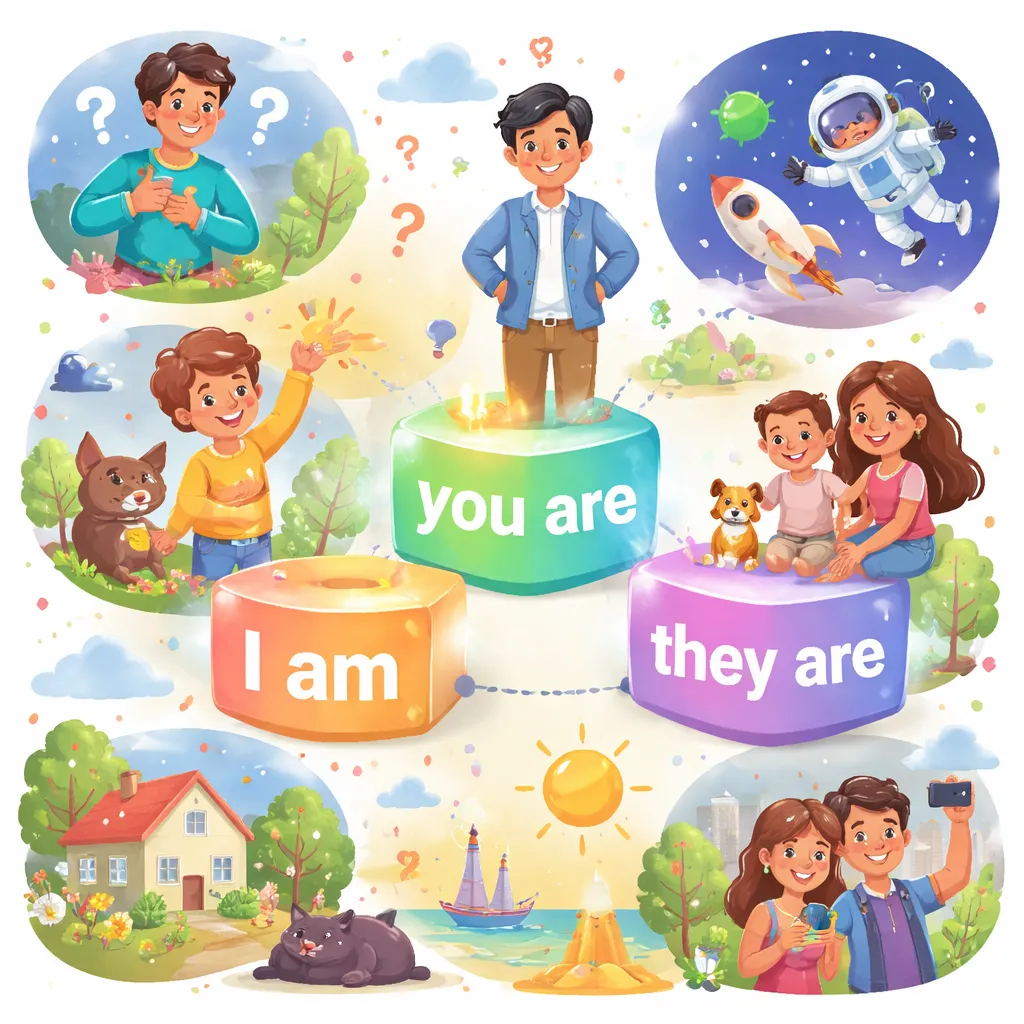
The three forms in present simple are: am, is, are. Am goes with I. Is goes with he, she, it. Are goes with you, we, they.
Parents can point out that “to be” changes more than any other verb. Most verbs add -s for he/she/it. “To be” changes completely. That makes it special. That also makes it worth practicing.
The name “present simple: 'to be'” reminds us this is the now form. Not past (was/were). Not future (will be). Just now.
Rules of Present Simple: 'To Be' Rules for “to be” are different from all other verbs. Learn these five rules. They never change.
Rule one: Use 'am' with the pronoun I I am a student. I am hungry. I am here. Always “I am.” Never “I is.” Never “I are.” I am is a fixed pair.
Rule two: Use 'is' with he, she, it He is my brother. She is a dentist. It is a sunny day. He is. She is. It is. Any single person, place, or thing takes is.
Rule three: Use 'are' with you, we, they You are my best friend. We are ready. They are late. You always takes are. Even one person. “You are kind” uses are for one person.
Rule four: Form questions by moving am/is/are to the front Am I late? Is she sleeping? Are you okay? Where is the bathroom? Do not use do or does. Just move the verb. “Is he happy?” Not “Does he be happy?”
Rule five: Form negatives by adding 'not' after am/is/are I am not tired. He is not here. They are not home. Use contractions: I'm not, isn't, aren't. “She isn't ready.” “We aren't lost.”
These five rules cover everything. “To be” has no exceptions. Practice each rule separately. Master am, is, are one by one.
How to Use Present Simple: 'To Be' Use present simple: 'to be' in eight everyday situations. Each situation feels natural for family conversations.
Situation one: Identifying people and things Tell who or what something is. “I am your father.” “This is my house.” “That is a butterfly.”
Situation two: Describing characteristics Talk about qualities. “She is tall.” “He is funny.” “The soup is hot.” These descriptions use adjectives after “to be.”
Situation three: Stating feelings and emotions Share how you feel. “I am happy.” “We are worried.” “She is excited about the party.”
Situation four: Giving age Say how old someone is. “I am eight years old.” “My sister is five.” “They are teenagers.”
Situation five: Talking about location Say where something exists. “The keys are on the table.” “Mom is in the kitchen.” “We are at the park.”
Situation six: Describing the weather Talk about outside conditions. “It is rainy.” “The sky is cloudy.” “It is very hot today.”
Situation seven: Stating occupations Say what job someone has. “She is a teacher.” “He is a firefighter.” “I am a student.”
Situation eight: Expressing time Tell what time it is. “It is three o'clock.” “It is time for bed.” “Lunch is at noon.”
Parents can use “to be” all day long. “It is time to wake up.” “You are doing great.” “Where is your shoe?” Each sentence teaches naturally.
Children can play “I am...” before bed. Say three things about yourself. “I am tired. I am happy. I am ready for a story.” This builds self-expression and grammar together.
Examples of Present Simple: 'To Be' Read these examples aloud. Group them by subject and use.
Examples with I am
I am a kind person.
I am seven years old.
I am in my bedroom.
I am hungry for breakfast.
I am not afraid of the dark.
Am I late for dinner?
Examples with he, she, it
He is my best friend from school.
She is a wonderful painter.
It is a beautiful morning.
The cat is sleeping on the couch.
My grandpa is seventy years old.
Is she your sister?
He isn't feeling well today.
Examples with you, we, they
You are very good at drawing.
We are all ready to go.
They are outside playing soccer.
You are my favorite person.
We are excited about the trip.
Are they coming to the party?
You aren't wearing shoes!
Questions with am, is, are
Am I in the right classroom?
Is the movie starting soon?
Are you listening to me?
Where is my blue backpack?
Why are they so happy?
How old is your dog?
Negatives with not
I am not tired. I am wide awake.
He is not here right now.
She isn't a doctor. She is a nurse.
We are not lost. We know where we are.
They aren't ready yet.
Read three examples before each meal. Ask your child to change “I am” to “She is.” Change “They are” to “He is.” These small changes build flexibility.
Common Mistakes These five mistakes happen often. Fix them gently with practice.
Mistake one: Using is with I Wrong: “I is happy.” Right: “I am happy.” I always takes am. Never is. This is the most common mistake for young children. Correct it kindly every time.
Mistake two: Using are with he/she/it Wrong: “She are a teacher.” Right: “She is a teacher.” He, she, it use is. Not are. Single subjects need is.
Mistake three: Forgetting to be in questions Wrong: “Where the bathroom?” Right: “Where is the bathroom?” Questions need am, is, or are. Do not drop the verb.
Mistake four: Using do/does with to be Wrong: “Does she be happy?” Right: “Is she happy?” To be does not use do or does. Move the verb to the front instead.
Mistake five: Confusing it's and its Wrong: “The dog wagged it's tail.” Right: “The dog wagged its tail.” (possession) Right: “It's a beautiful day.” (it is) It's = it is. Its = belonging to it. No apostrophe for possession.
Write these mistakes on the fridge. Each time someone catches a mistake, they put a star next to it. Five stars earn a small reward. This turns correction into a game.
Comparison: 'To Be' vs. Other Verbs Compare “to be” with regular action verbs. They work very differently.
Meaning difference To be: describes state. “I am tired.” (condition) Action verb: describes action. “I sleep.” (what you do)
Question difference To be: move verb to front. “Are you ready?” Action verb: add do/does. “Do you sleep well?”
Negative difference To be: add not after verb. “She is not here.” Action verb: add don't/doesn't. “She doesn't sleep here.”
Subject-verb agreement difference To be: changes completely. I am, he is, you are. Action verb: only adds -s for he/she/it. I eat, he eats, you eat.
With adjectives To be + adjective: “The flower is red.” Action verbs rarely take adjectives. “The flower smells red” is wrong.
A simple rule for children: Use “to be” for how things are. Use action verbs for what things do.
Parents can play the “State or action?” game. Say a sentence. “The baby sleeps.” Action. “The baby is tired.” State. “The dog runs.” Action. “The dog is fast.” State. This game takes two minutes. It builds clear thinking.
Practice Exercises Complete these exercises together. Write answers on paper.
Exercise one: Choose am, is, or are
I ______ a student at this school.
She ______ my best friend.
They ______ playing in the garden.
He ______ a very good cook.
We ______ ready for the test.
It ______ cold outside today.
You ______ so kind to me.
The books ______ on the shelf.
Exercise two: Make questions Turn each statement into a question.
You are happy.
He is a doctor.
They are at home.
She is seven years old.
We are late.
Exercise three: Make negative sentences Turn each statement into a negative using not.
I am tired.
She is a teacher.
They are ready.
He is my brother.
We are lost.
Exercise four: Correct the mistakes Each sentence has one error. Rewrite correctly.
I is hungry for lunch.
Where the nearest bathroom?
She are a wonderful singer.
Does he be a firefighter?
The dog wagged it's tail.
Exercise five: Fill in the blank with the correct form 24. ______ (I / be) late for school? 25. The children ______ (be) very noisy today.
Answers and Explanations Check your answers together. Read each explanation.
Exercise one answers:
am (I + am)
is (she + is)
are (they + are)
is (he + is)
are (we + are)
is (it + is)
are (you + are)
are (the books = they)
Exercise two answers: 9. Are you happy? 10. Is he a doctor? 11. Are they at home? 12. Is she seven years old? 13. Are we late?
Exercise three answers: 14. I am not tired. / I'm not tired. 15. She is not a teacher. / She isn't a teacher. 16. They are not ready. / They aren't ready. 17. He is not my brother. / He isn't my brother. 18. We are not lost. / We aren't lost.
Exercise four answers: 19. I am hungry for lunch. (I needs am) 20. Where is the nearest bathroom? (Needs is) 21. She is a wonderful singer. (She needs is) 22. Is he a firefighter? (No does. Move is) 23. The dog wagged its tail. (Its, no apostrophe)
Exercise five answers: 24. Am I late for school? (I + am in question form) 25. The children are very noisy today. (children = they)
Key explanations: Question 22 shows the most common error. Never use “does” with “to be.” Just move “is” to the front.
Question 24 uses “am I” because the subject is I. Even in questions, I keeps am.
Celebrate every correct answer. Review mistakes calmly. Learning “to be” takes time for everyone.
Learning Tips Make present simple: 'to be' part of every conversation. These seven tips work for busy families.
Tip one: Start every morning with feelings At breakfast, ask “How are you?” Answer “I am happy.” “I am sleepy.” “I am excited.” Everyone practices “to be” before the day begins.
Tip two: Play “I spy” with location “I spy with my little eye something that is on the wall.” “I spy something that is under the table.” This game practices is and are naturally.
Tip three: Describe people you see On a walk, describe strangers. “That man is tall.” “Those children are young.” “The dog is brown.” Quick descriptions use “to be” again and again.
Tip four: Use sticky notes for am, is, are Write “I am” on a blue note. Write “He is / She is / It is” on yellow notes. Write “You are / We are / They are” on green notes. Stick them on the wall. Point to them during practice.
Tip five: Sing songs with “to be” Many children's songs use “to be.” “I am the music man.” “If you are happy and you know it.” “Row, row, row your boat” uses “are” in “are you listening?” Sing together.
Tip six: Create an “About Me” poster Write “I am...” at the top. Help your child finish the sentence. “I am 7 years old. I am a sister. I am good at drawing. I am brave.” Hang the poster on the bedroom door.
Tip seven: Correct with a smile When your child says “She are nice,” say “She is nice. She is one person. One person uses is. Can you say it for me?” Smile while you correct. No pressure. Just practice.
Present simple: 'to be' is the most used verb in English. You cannot have a real conversation without it. Mastering am, is, and are opens every door.
Practice for five minutes each day. Describe your world. “The sky is blue. The grass is green. I am happy we are learning together.”
Now say three sentences with “to be” about this moment. “I am reading. The words are clear. This lesson is helpful.” You just practiced the most important verb in English. Keep going. You are doing beautifully.