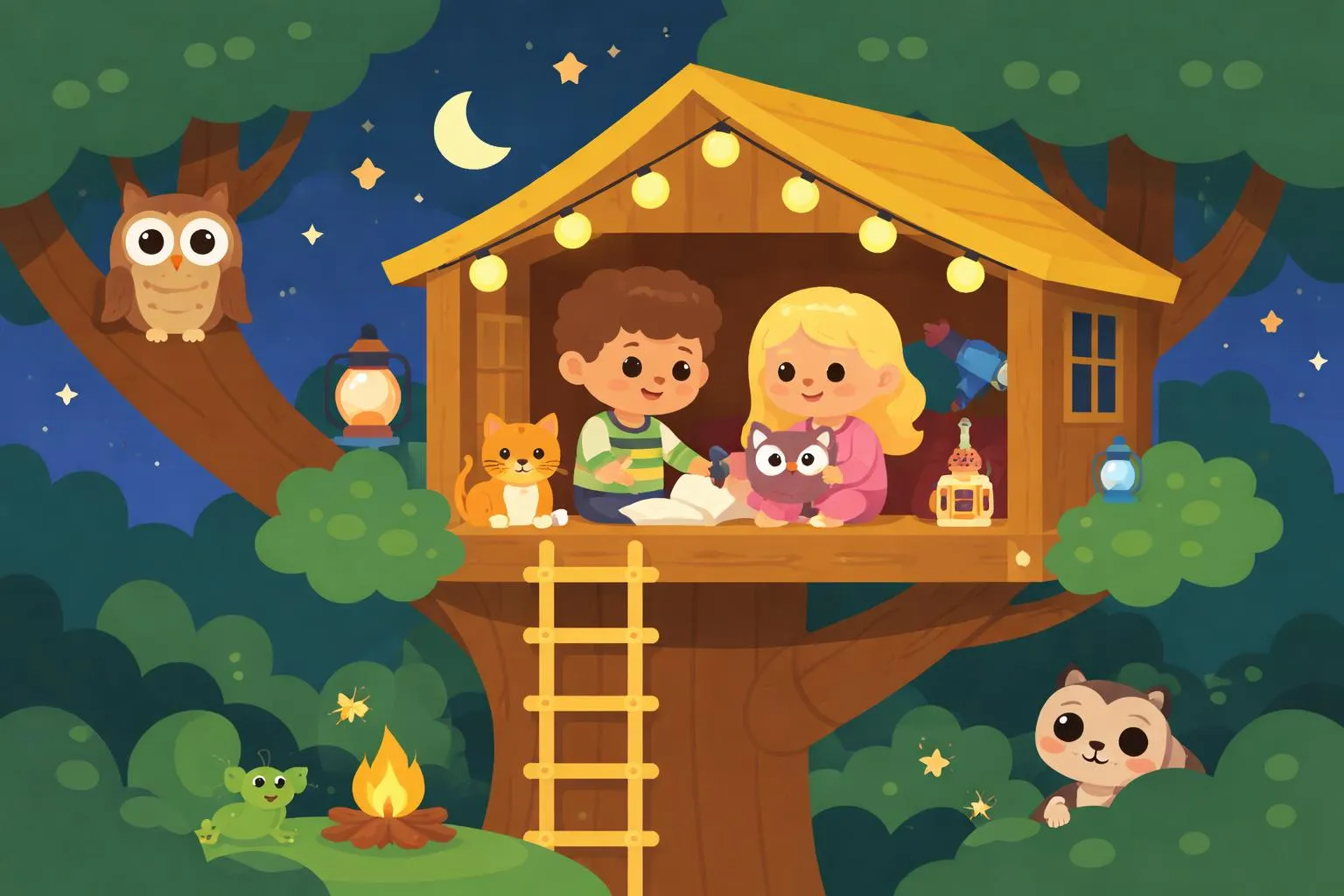

Original Poem:
And now the green household is dark.
The half-moon completely is shining
On the earth-lighted tops of the trees.
To be dead, a house must be still.
The floor and the walls wave me slowly;
I am deep in them over my head.
The needles and pine cones about me
Are full of small birds at their roundest,
Their fists without mercy gripping
Hard down through the tree to the roots
To sing back at light when they feel it.
We lie here like angels in bodies,
My brothers and I, one dead,
The other asleep from much living,
In mid-air huddled beside me.
Dark climbed to us here as we climbed
Up the nails I have hammered all day
Through the sprained, comic rungs of the ladder
Of broom handles, crate slats, and laths
Foot by foot up the trunk to the branches
Where we came out at last over lakes
Of leaves, of fields disencumbered of earth
That move with the moves of the spirit.
Each nail that sustains us I set here;
Each nail in the house is now steadied
By my dead brother’s huge, freckled hand.
Through the years, he has pointed his hammer
Up into these limbs, and told us
That we must ascend, and all lie here.
Step after step he has brought me,
Embracing the trunk as his body,
Shaking its limbs with my heartbeat,
Till the pine cones danced without wind
And fell from the branches like apples.
In the arm-slender forks of our dwelling
I breathe my live brother’s light hair.
The blanket around us becomes
As solid as stone, and it sways.
With all my heart, I close
The blue, timeless eye of my mind.
Wind springs, as my dead brother smiles
And touches the tree at the root;
A shudder of joy runs up
The trunk; the needles tingle;
One bird uncontrollably cries.
The wind changes round, and I stir
Within another’s life. Whose life?
Who is dead? Whose presence is living?
When may I fall strangely to earth,
Who am nailed to this branch by a spirit?
Can two bodies make up a third?
To sing, must I feel the world’s light?
My green, graceful bones fill the air
With sleeping birds. Alone, alone
And with them I move gently.
I move at the heart of the world.
Analysis and Interpretation of the Poem
This evocative poem explores themes of life, death, memory, and connection with nature through vivid imagery and metaphorical language. The "green household" symbolizes a living tree, a natural home that becomes dark as night falls, illuminated by the half-moon. The speaker reflects on the stillness required for death, contrasting it with the lively movement of the tree’s needles and pine cones, which are described as "full of small birds," symbolizing life and vitality.
The poem portrays a deep bond between the speaker and his brothers — one dead, one asleep from exhaustion — suggesting the fragile boundary between life and death. The imagery of climbing a ladder made of broom handles and crate slats up the tree trunk to the branches creates a dreamlike ascent into a spiritual realm. The nails hammered into the tree represent the speaker’s efforts to build and sustain this connection, with the dead brother’s hand symbolizing support from beyond the grave.
The poem’s mood is contemplative and mystical, inviting readers to ponder existence beyond physical life, the intertwining of human spirit with nature, and the question of identity and presence after death. The final lines express a feeling of unity with the world — the speaker moves "at the heart of the world," suggesting a transcendence of individual life into a greater universal existence.
Background and Author Introduction
This poem is written by Mary Oliver, a renowned American poet known for her profound reflections on nature, life, and spirituality. Oliver’s poetry often explores the intimate relationship between humans and the natural world, emphasizing mindfulness and the beauty of everyday moments.
Mary Oliver’s work is celebrated for its accessibility and emotional depth, making complex themes understandable and relatable. She received numerous awards, including the Pulitzer Prize and the National Book Award, for her contributions to contemporary poetry.
Reflection and Insights
Reading this poem encourages us to reflect on the cycles of life and death, and how memory and love sustain connections beyond physical separation. It also highlights the importance of nature as a source of comfort and spiritual insight. The imagery of the tree as a home and the act of climbing symbolize personal growth and the journey toward understanding deeper truths.
Learning Points for Children and Students
- Imagery and Metaphor: The poem is rich in vivid imagery (e.g., "needles and pine cones," "half-moon shining") that helps students understand how poets use descriptive language to evoke feelings and create pictures in the reader’s mind.
- Themes of Life and Death: It introduces complex themes in a gentle, symbolic way, helping young learners approach these topics thoughtfully.
- Connection with Nature: Encourages appreciation for the natural world and its symbolic meanings.
- Symbolism of the Ladder and Nails: Teaches how objects can represent abstract ideas like support, growth, and connection.
- Emotional Expression: Shows how poetry can express feelings of loss, hope, and unity.
Practical Applications in Life and Learning
- Creative Writing: Students can write their own poems or stories inspired by nature and personal experiences.
- Mindfulness and Reflection: The poem can be used in lessons about mindfulness, encouraging students to observe and appreciate their surroundings.
- Discussion on Life and Death: Provides a gentle entry point for conversations about mortality and remembrance.
- Art Projects: Students can create visual art based on the poem’s imagery, reinforcing comprehension and creativity.
Reading Comprehension Questions
- What does the "green household" in the poem represent?
- How does the poem describe the relationship between the speaker and his brothers?
- What is the significance of the nails mentioned in the poem?
- How does the poem use nature to explore the theme of life and death?
- What feelings or mood does the poem evoke in the reader?
- Explain the meaning of the line: "Can two bodies make up a third?"
- How does the speaker describe their movement at the end of the poem?
- What role does the half-moon play in the imagery of the poem?
- Why do you think the poet compares lying in the tree to being "like angels in bodies"?
- How does the poem suggest that life and death are connected?
Answers to Reading Comprehension Questions
- The "green household" represents a living tree, which serves as a natural home.
- The speaker shares a close, spiritual bond with his brothers, one dead and one asleep, symbolizing different states of being.
- The nails symbolize the speaker’s efforts to build and maintain a connection with the tree and with his brothers.
- The poem uses elements of nature, like trees, birds, and wind, to symbolize the cycle of life, death, and spiritual continuity.
- The poem evokes a contemplative, mystical, and peaceful mood, blending sadness with hope.
- This line questions whether the union of two people (living and dead) can create a new spiritual presence or identity.
- The speaker moves "gently" and "at the heart of the world," suggesting harmony with nature and existence.
- The half-moon provides a soft, illuminating light that enhances the peaceful, nighttime setting.
- The comparison suggests a pure, serene state of being, combining physical presence with spiritual grace.
- The poem suggests that life and death are intertwined and that death is not an end but a transformation connected to nature and spirit.
This poem offers rich material for students to explore literary devices, themes, and emotional expression, while also inspiring reflection on life’s deeper meanings through the lens of nature.














