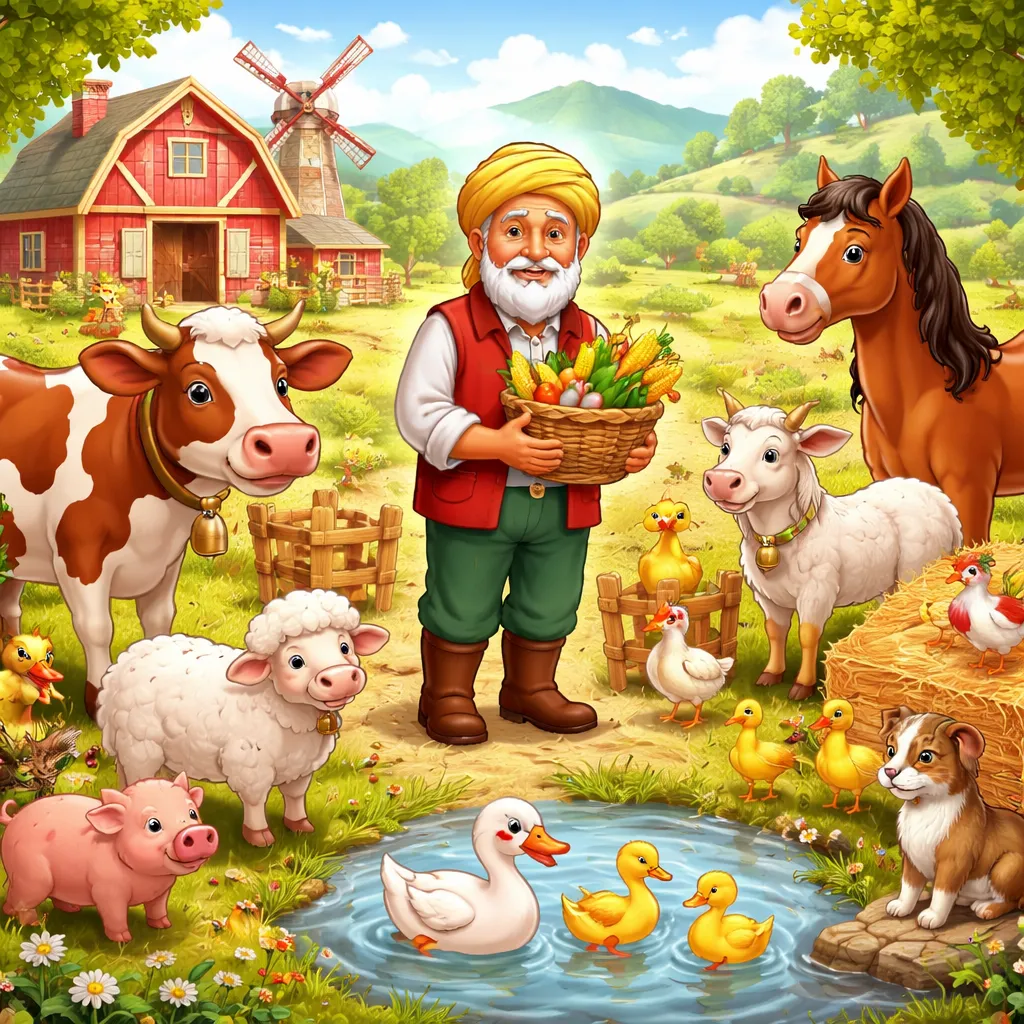

Have you ever been to a farm, or seen one in a book? It’s a busy, noisy, happy place! Can you imagine the sounds? Maybe the "moo" of a cow, the "baa" of a sheep, or the "cluck" of a chicken. In Turkey, a beautiful country between Europe and Asia, there is a very famous song that takes you on a tour of a funny farm. Let’s visit the animals in the Turkish Song: Ali Baba Has a Farm (Ali Babanın Bir Çiftliği Var).
About the Song Here are the classic, fun lyrics in Turkish and English: Ali Babanın bir çiftliği var (Ali Baba has a farm) Çiftliğinde inekleri var (On his farm he has cows) "Mö mö" diye bağırır (They shout "moo moo") Çiftliğinde Ali Babanın (On the farm of Ali Baba)
The song continues with different animals! After cows, it might add sheep ("mee mee"), roosters ("ü ürü üü"), and chicks ("cik cik").
This song’s original Turkish name is “Ali Babanın Bir Çiftliği Var.” It is the Turkish version of the global folk song “Old MacDonald Had a Farm.” The song is about a friendly farmer named Ali Baba. The music is bouncy, simple, and full of fun animal sounds. The Turkish Song: Ali Baba Has a Farm (Ali Babanın Bir Çiftliği Var) is a playful, musical game where you collect animals and their sounds, one fun verse at a time.
What the Song is About The song paints a picture of a growing, lively farm. First, we meet the farmer, Ali Baba, and learn he has a farm. Then, we look around. What’s on his farm? He has cows! The song makes us hear them: they shout "Mö mö!" (the Turkish sound for "moo"). We sing that line again: "On the farm of Ali Baba." Then, we add a new animal. Maybe sheep! Now the farm has cows AND sheep that shout "Mee mee!" (baa). With every new verse, the farm gets bigger and noisier. You have to remember all the animals and sounds that came before. The song is a fun, challenging memory game about the happy chaos of farm life.
Who Made It & Its Story This song is a traditional Turkish folk song for children. Like "Old MacDonald," its original creator is unknown because it has been sung by generations of families and in schools. It became a part of Turkish childhood, just like playground rhymes. The name "Ali Baba" is a very common and friendly name from Turkish and Middle Eastern stories. The Turkish Song: Ali Baba Has a Farm (Ali Babanın Bir Çiftliği Var) is beloved for three simple reasons. First, it is incredibly interactive and fun, letting children make silly animal sounds. Second, it teaches animal names and their sounds in a memorable, repetitive way. Third, it gives Turkish children a familiar, local version (with Ali Baba) of a song that children all over the world enjoy, creating a sense of both local and global connection.
When to Sing It You can sing this song on a long car ride, taking turns with family to pick a new animal and its sound for each verse. It’s perfect during classroom circle time, where each child can act out a different animal from the song. You could also sing it while visiting a petting zoo or looking at a picture book about farms, matching the animals you see to the song.
The Turkish Song: Ali Baba Has a Farm (Ali Babanın Bir Çiftliği Var) is more than just a list of animals. It’s a clever teacher in disguise. This song helps us learn new words, understand how language builds, and discover the musical patterns of another culture. Let’s put on our learning hats and see what lessons are hiding in the barn!
What Children Can Learn
Vocabulary This song is a perfect way to learn animal names and the sounds they make in Turkish and English. Çiftlik (Farm): The land and buildings where people keep animals and grow crops. Ali Baba’s çiftlik is busy.
İnek (Cow): A large farm animal that gives milk. The inek says "mö" (moo).
Koyun (Sheep): A farm animal with thick woolly fur. The koyun says "mee" (baa).
Horoz (Rooster): A male chicken that crows in the morning. The horoz says "ü ürü üü" (cock-a-doodle-doo).
Civciv (Chick): A baby chicken. The civciv says "cik cik" (cheep cheep).
Animal Sounds (Onomatopoeia): Words that imitate the sound they describe, like "moo" or "meow." Every language has its own versions!
Language Skills This song is a masterclass in two things: using the Simple Present Tense for possessions and facts, and the possessive form ‘s (apostrophe s). What Is It?:
◦   Simple Present for Facts: We use this tense to talk about things that are generally true. "Ali Baba has a farm." "Cows shout 'moo'." These are facts about his farm.

◦   Possessive 's: This shows that something belongs to someone. "Ali Baba's farm" means the farm belongs to Ali Baba.
Finding the Secret:
◦   For facts: Look for verbs like "has" or "shout" that describe a general state or repeated action.

◦   For possession: Look for a person's name followed by an 's and then a thing (like "farm").
Using It:
◦   Fact Formula: [Person/Thing] + has/have + [object]. or [Thing] + [verb] + [action]. "Ali Baba has cows." "Cows shout."

◦   Possessive Formula: [Owner] + 's + [thing owned]. "Ali Baba's farm is fun."
Sounds & Rhythm Fun Get ready to make noise! The Turkish Song: Ali Baba Has a Farm (Ali Babanın Bir Çiftliği Var) has a very clear, repetitive, and catchy melody. The same tune repeats for every single animal. The most fun part is the "sound break" where everyone gets to shout the animal noise ("Mö mö!"). This strong repetition and the silly sounds make the song incredibly easy to remember and perfect for singing in a big, loud group. The rhythm is bouncy and joyful. You can use this same repeating tune and structure to invent new verses about any group of things, like vehicles and their sounds, or instruments and their noises.
Culture & Big Ideas This song connects to Turkey’s history as a place where agriculture and village life have been important for thousands of years. A fun tradition is a Köy Şenliği (Village Festival), where communities celebrate harvests with music, dancing, and food. The song’s setting reflects this rural life. The Turkish Song: Ali Baba Has a Farm (Ali Babanın Bir Çiftliği Var) teaches three big ideas. First, Universal Themes: Children all over the world love animals and farms, showing how we are connected by simple, happy things. Second, Memory Through Music: Repetition and melody are powerful tools to help our brains remember lists and information. Third, Linguistic Curiosity: Animals "speak" different languages! A Turkish cow says "Mö," not "Moo." This introduces the fun idea that languages are different and cool.
Values & Imagination Imagine you are on Ali Baba’s farm. Can you smell the hay? Can you feel the wool of the sheep? What other animals would you add? A buzzing bee? A busy dog? This song teaches you about caring for animals and where our food and wool come from. It encourages listening closely to the different sounds in the world. A simple idea: Go on a "sound hunt" in your home or yard. Close your eyes for one minute. How many different sounds can you hear? A clock ticking? A bird chirping? You are discovering your own world’s "song," just like Ali Baba’s farm.
Your Core Takeaways The Turkish Song: Ali Baba Has a Farm (Ali Babanın Bir Çiftliği Var) is a joyful, global tune with a Turkish twist. You learned animal names in Turkish like inek (cow) and koyun (sheep). You practiced the Simple Present Tense for facts and the possessive 's. You sang along to the song’s incredibly catchy, repetitive rhythm. You also connected the farm to Turkish rural life and village festivals. Most importantly, the song teaches that music is a fun way to learn and remember, that animals connect children everywhere, and that every language has its own special, funny way of describing the world’s sounds.
Your Practice Missions
- Be a "Possessive Detective." Look around your room. Choose three things (e.g., a book, a toy, a cup). Say who they belong to using the 's. For example: "This is Mom's book. This is my sister's toy. This is Ali Baba's cup (pretend!)." This practices the possessive form.
- Create Your Own "Ali Baba" Verse. Think of an animal not in the song (like a bee, a frog, or a horse). Decide what sound it makes. Now, sing a NEW verse to the tune of the song: "Ali Babanın bir çiftliği var, Çiftliğinde [your animal]ları var, [sound] diye bağırır, Çiftliğinde Ali Babanın!" Share your new verse with someone.