
Three passengers, including Passepartout, had vanished. Were they killed during the fight? Had the Sioux taken them prisoner? No one could say for sure.
Many were wounded, but none fatally. Colonel Proctor was among the most seriously hurt; he had fought bravely, but a bullet had struck his groin. He was carried into the station with the other injured passengers to receive whatever care was possible.
Aouda was safe, and Phileas Fogg, who had been in the heart of the battle, was unscathed. Fix had a slight wound on his arm. But Passepartout was missing, and tears ran down Aouda’s cheeks.
All the passengers had left the train, whose wheels were stained with blood. Ragged pieces of flesh hung from the tyres and spokes. As far as the eye could see across the white plain behind, red trails marked the ground. The last Sioux were disappearing southward along the banks of the Republican River.
Mr. Fogg stood motionless with folded arms. He had a grave decision to make. Aouda stood nearby, silently watching him, and he understood her look. If his servant was a prisoner, should he risk everything to rescue him from the Indians? “I will find him, living or dead,” he said quietly to Aouda.
“Ah, Mr.—Mr. Fogg!” she cried, clasping his hands and covering them with tears.
“Living,” Mr. Fogg added, “if we do not lose a moment.”
By this decision, Phileas Fogg inevitably sacrificed himself; he sealed his own fate. A delay of even one day would cause him to miss the steamer in New York and lose his bet. But thinking, “It is my duty,” he did not hesitate.
The commanding officer of Fort Kearney was present. A hundred soldiers had taken positions to defend the station in case of a Sioux attack.
“Sir,” said Mr. Fogg to the captain, “three passengers have disappeared.”
“Dead?” asked the captain.
“Dead or prisoners; that is the uncertainty we must resolve. Do you intend to pursue the Sioux?”
“That is a serious matter, sir,” returned the captain. “These Indians may retreat beyond the Arkansas, and I cannot leave the fort unprotected.”
“The lives of three men are at stake, sir,” said Phileas Fogg.
“Doubtless; but can I risk the lives of fifty men to save three?”
“I don’t know whether you can, sir; but you ought to.”
“No one here,” replied the captain, “has the right to tell me my duty.”
“Very well,” said Mr. Fogg coldly. “I will go alone.”
“You, sir!” cried Fix, rushing up. “You would go alone in pursuit of the Indians?”
“Would you have me leave this poor fellow to perish—him to whom everyone here owes their life? I shall go.”
“No, sir, you shall not go alone,” said the captain, moved despite himself. “No! You are a brave man. Thirty volunteers!” he added, turning to the soldiers.
The entire company moved forward at once. The captain selected thirty men, and an old sergeant was placed in command.
“Thanks, captain,” said Mr. Fogg.
“Will you let me go with you?” asked Fix.
“Do as you please, sir. But if you wish to do me a favor, you will stay with Aouda. In case anything happens to me—”
A sudden pallor spread across the detective’s face. To separate himself from the man he had so persistently followed around the world! To leave him to wander alone in this desert! Fix looked intently at Mr. Fogg, and despite his suspicions and inner turmoil, he lowered his eyes before that calm and honest gaze.
“I will stay,” he said.
A few moments later, Mr. Fogg pressed the young woman’s hand, entrusted her with his precious carpet-bag, and set off with the sergeant and his squad. Before leaving, he told the soldiers, “My friends, I will divide five thousand dollars among you if we save the prisoners.”
It was just after noon.
Aouda retired to a waiting room and waited alone, thinking about the simple and noble generosity and quiet courage of Phileas Fogg. He had sacrificed his fortune and was now risking his life without hesitation, out of duty and silence.
Fix did not share the same thoughts and could hardly hide his agitation. He paced feverishly on the platform but soon regained his outward composure. He now saw the folly of letting Fogg go alone. What! This man, whom he had just followed around the world, was now allowed to separate from him! He began to accuse and scold himself, as if he were a police chief giving himself a stern lecture for his naïveté.
“I have been an idiot!” he thought. “And this man will see it. He has gone and won’t come back! But how is it that I, Fix, who have a warrant for his arrest in my pocket, have been so fascinated by him? Decidedly, I am nothing but a fool!”
So reasoned the detective, while the hours passed too slowly. He did not know what to do. Sometimes he was tempted to tell Aouda everything; but he could not doubt how she would receive his confidences. What should he do? He thought of pursuing Fogg across the vast white plains; footprints were easy to see on the snow! But soon, under a new snowfall, every trace would be erased.
Fix became discouraged. He felt an overwhelming urge to abandon the chase altogether. He could now leave Fort Kearney station and continue his journey home in peace.
Around two o’clock in the afternoon, while it was snowing heavily, long whistles were heard approaching from the east. A great shadow, preceded by a wild light, slowly appeared, growing larger through the mist, which gave it a fantastic appearance. No train was expected from the east, nor had the aid requested by telegraph arrived; the train from Omaha to San Francisco was due the next day. The mystery was soon explained.
The locomotive, which was slowly approaching with deafening whistles, was the one that had been detached from the train and continued alone with the unconscious engineer and stoker aboard. It had traveled several miles when the fire grew low from lack of fuel, the steam pressure dropped, and it finally stopped about twenty miles beyond Fort Kearney. Neither engineer nor stoker was dead; after some time unconscious, they regained consciousness. The engineer, finding himself in the desert with the locomotive but no cars, understood what had happened. He could not imagine how the locomotive had become separated from the train but knew the train left behind was in trouble.
He did not hesitate. It would be safer to continue to Omaha rather than return to the train, which the Indians might still be looting. Nevertheless, he rebuilt the fire in the furnace; the steam pressure rose again, and the locomotive returned, running backward to Fort Kearney. This was the train whistling in the mist.
The travelers were glad to see the locomotive return to the front of the train. They could now continue their journey, which had been so terribly interrupted.
Aouda, seeing the locomotive arrive, hurried out of the station and asked the conductor, “Are you going to start?”
“At once, madam.”
“But the prisoners, our unfortunate fellow travelers—”
“I cannot delay the trip,” replied the conductor. “We are already three hours behind schedule.”
“And when will another train pass here from San Francisco?”
“Tomorrow evening, madam.”
“Tomorrow evening! But then it will be too late! We must wait—”
“It is impossible,” said the conductor. “If you wish to go, please get on.”
“I will not go,” said Aouda.
Fix had heard this conversation. A little earlier, when there was no hope of continuing the journey, he had decided to leave Fort Kearney; but now that the train was ready to depart and he only had to take his seat, an irresistible force held him back. The platform seemed to burn his feet, and he could not move. The conflict within him resumed; anger and frustration overwhelmed him. He wanted to fight to the end.
Meanwhile, the passengers and some of the wounded, including Colonel Proctor, whose injuries were serious, had taken their places on the train. The boiler hissed from overheating, steam escaped from the valves, the engineer whistled, and the train started, soon disappearing into the falling snow.
The detective stayed behind.
Several hours passed. The weather was bleak and cold. Fix sat motionless on a bench in the station; he might have seemed asleep. Aouda, despite the storm, kept coming out of the waiting room, walking to the end of the platform and peering into the snowy tempest, as if trying to pierce the mist narrowing the horizon and hear some welcome sound. She saw and heard nothing. Then she would return, chilled, only to go out again after a few moments, always in vain.
Evening came, and the little group had not returned. Where could they be? Had they found the Indians and were fighting them? Or were they still lost in the mist? The fort’s commander was anxious, though he tried to hide it. As night fell, the snow lessened but the cold intensified. Absolute silence lay over the plains. No bird flew, no animal passed to disturb the perfect calm.
Throughout the night, Aouda wandered near the plains’ edge, full of sad forebodings and anguish. Her imagination carried her far, showing her countless dangers. What she suffered during those long hours is impossible to describe.
Fix remained in the same place, awake but still. Once a man approached and spoke to him, but the detective only shook his head.
Thus the night passed. At dawn, the half-faint sun rose above a misty horizon; objects two miles away became visible. Phileas Fogg and the squad had gone south; all was still empty in that direction. It was seven o’clock.
The captain, truly alarmed, did not know what to do.
Should he send another detachment to rescue the first? Should he risk more men with little chance of saving those already lost? His hesitation was brief. Calling a lieutenant, he was about to order a reconnaissance when gunshots were heard. Was it a signal? The soldiers rushed out of the fort and saw a small group returning in good order.
Mr. Fogg led them, with Passepartout and the other two travelers, rescued from the Sioux, just behind him.
They had met and fought the Indians ten miles south of Fort Kearney. Just before the detachment arrived, Passepartout and his companions had struggled with their captors, three of whom the Frenchman had knocked down with his fists, when his master and the soldiers came to their aid.
All were greeted with joyful cries. Phileas Fogg distributed the reward he had promised the soldiers, while Passepartout muttered to himself, “I must certainly confess that I cost my master dearly!”
Fix said nothing but looked at Mr. Fogg; it would have been difficult to analyze the thoughts battling within him. As for Aouda, she took her protector’s hand and pressed it in hers, too moved to speak.
Meanwhile, Passepartout looked around for the train; he expected to find it ready to depart for Omaha and hoped to regain lost time.
“The train! The train!” he cried.
“Gone,” replied Fix.
“When does the next train pass here?” asked Phileas Fogg.
“Not until this evening.”
“Ah!” said the impassive gentleman quietly.
Background and Author Introduction
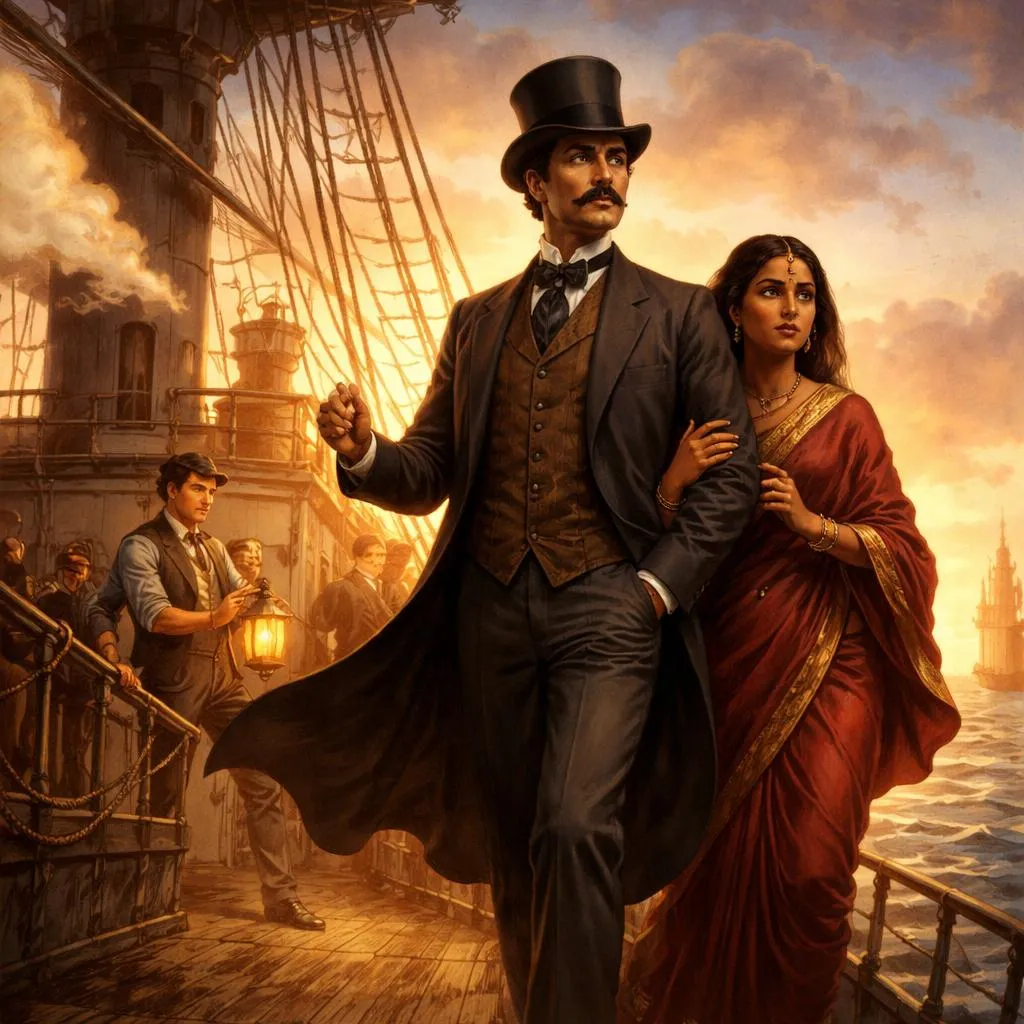
This passage is from Around the World in Eighty Days, a classic adventure novel written by Jules Verne, a French author born in 1828. Verne is considered one of the fathers of science fiction and is known for his imaginative and detailed storytelling. This novel, first published in 1873, tells the story of Phileas Fogg, a precise and wealthy Englishman who wagers that he can circle the globe in just eighty days. Accompanied by his loyal servant Passepartout and joined by other characters such as Aouda and Fix, Fogg encounters numerous challenges and adventures.
Detailed Interpretation and Significance
This excerpt illustrates a critical moment in the story where Phileas Fogg chooses to risk everything to save his missing companions, especially Passepartout. His decision to pursue the Sioux alone or with volunteers, despite the dangers and the risk of losing his bet, highlights his strong sense of duty, loyalty, and courage. The narrative also shows the tension between personal goals and moral responsibilities.
The characters’ interactions reveal their personalities: Fogg’s calm resolve, Aouda’s emotional concern, Fix’s inner conflict as a detective torn between duty and admiration, and Passepartout’s bravery and resourcefulness.
The story combines thrilling action with themes of friendship, honor, sacrifice, and perseverance. It also depicts the challenges of travel and cultural encounters in the 19th century, reflecting the era’s fascination with exploration and technology.
Lessons and Insights for Students
-
Duty and Responsibility: Phileas Fogg’s choice to risk his journey to save others teaches the importance of putting moral duty above personal gain. Students can learn that true courage often means making sacrifices for others.
-
Loyalty and Friendship: The bond between Fogg and Passepartout shows the value of loyalty and standing by friends in times of danger.
-
Perseverance and Problem-Solving: The characters face unexpected obstacles, yet they adapt and persist. This encourages students to be resilient and resourceful when facing difficulties.
-
Empathy and Compassion: Aouda’s concern and Fix’s inner struggle remind readers to understand others’ feelings and to act with kindness, even when conflicted.
-
Cultural Awareness: The story introduces readers to different cultures and historical contexts, promoting curiosity and respect for diversity.
Application in Daily Life
-
In School: Students can apply Fogg’s determination by setting clear goals and working steadily toward them, even when challenges arise.
-
In Friendships: Like Passepartout’s loyalty, students can support their friends and stand up for them during tough times.
-
In Decision-Making: Fogg’s example shows the importance of weighing moral values when making choices, encouraging students to consider the impact of their actions on others.
-
In Facing Challenges: The story encourages embracing difficulties as opportunities to grow stronger and more capable.
Cultivating Positive Traits from the Story
-
Courage: Practice stepping out of comfort zones and facing fears with confidence.
-
Selflessness: Engage in acts of kindness and help others without expecting anything in return.
-
Resilience: Learn from setbacks and keep trying until success is achieved.
-
Integrity: Be honest and uphold your principles, even when it is difficult.
-
Curiosity: Explore new ideas and cultures to broaden understanding and empathy.
Reflection and Appreciation
Reading this story invites students to reflect on what it means to be brave and honorable. It encourages admiration for characters who act with integrity and compassion. Students can write about how they might respond in similar situations or discuss the qualities they admire most in the characters.
By engaging with Around the World in Eighty Days, young readers not only enjoy an exciting adventure but also gain valuable insights into character, ethics, and the human spirit that can inspire their own lives.