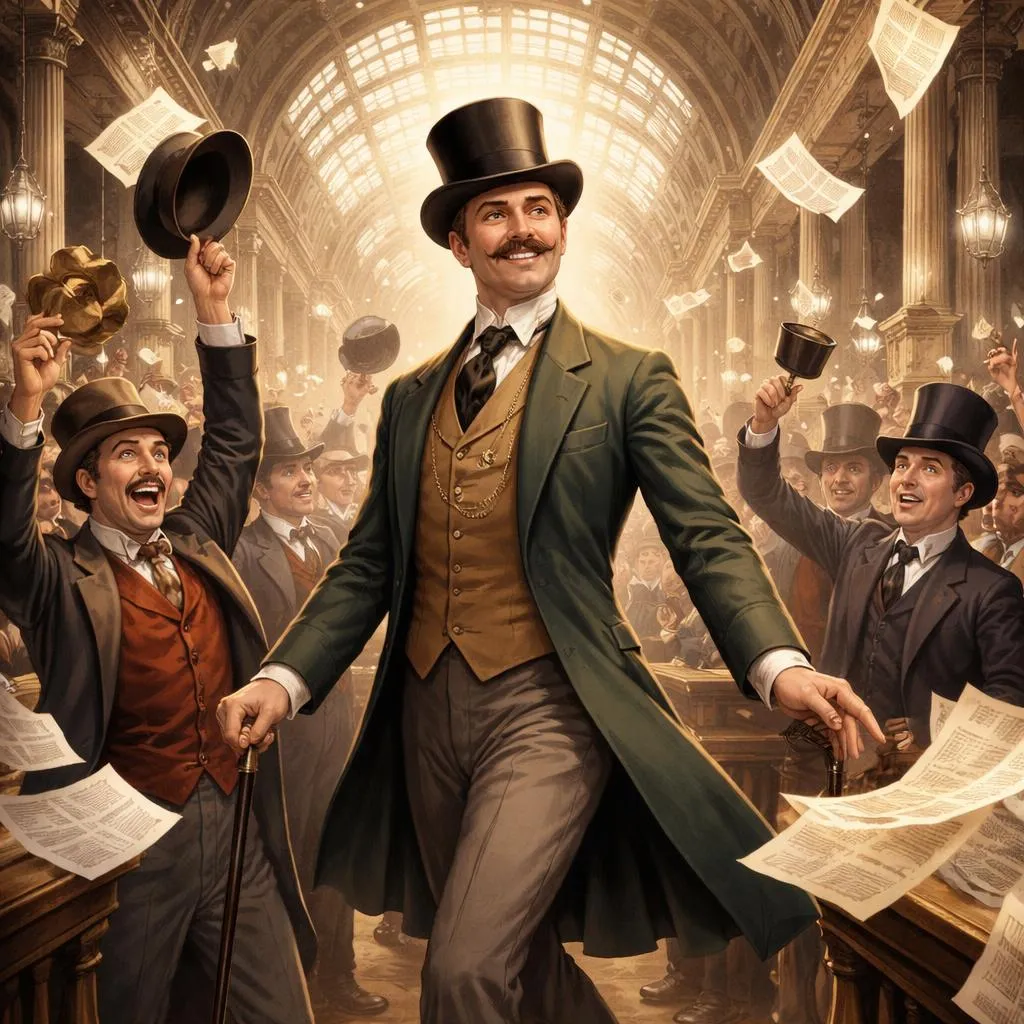

It is time to relate what a change took place in English public opinion when it transpired that the real bankrobber, a certain James Strand, had been arrested, on the 17th day of December, at Edinburgh. Three days before, Phileas Fogg had been a criminal, who was being desperately followed up by the police; now he was an honourable gentleman, mathematically pursuing his eccentric journey round the world.
The papers resumed their discussion about the wager; all those who had laid bets, for or against him, revived their interest, as if by magic; the "Phileas Fogg bonds" again became negotiable, and many new wagers were made. Phileas Fogg's name was once more at a premium on 'Change.
His five friends of the Reform Club passed these three days in a state of feverish suspense. Would Phileas Fogg, whom they had forgotten, reappear before their eyes! Where was he at this moment? The 17th of December, the day of James Strand's arrest, was the seventy–sixth since Phileas Fogg's departure, and no news of him had been received. Was he dead? Had he abandoned the effort, or was he continuing his journey along the route agreed upon? And would he appear on Saturday, the 21st of December, at a quarter before nine in the evening, on the threshold of the Reform Club saloon?
The anxiety in which, for three days, London society existed, cannot be described. Telegrams were sent to America and Asia for news of Phileas Fogg. Messengers were dispatched to the house in Saville Row morning and evening. No news. The police were ignorant what had become of the detective, Fix, who had so unfortunately followed up a false scent. Bets increased, nevertheless, in number and value. Phileas Fogg, like a racehorse, was drawing near his last turning–point. The bonds were quoted, no longer at a hundred below par, but at twenty, at ten, and at five; and paralytic old Lord Albemarle bet even in his favour.
A great crowd was collected in Pall Mall and the neighbouring streets on Saturday evening; it seemed like a multitude of brokers permanently established around the Reform Club. Circulation was impeded, and everywhere disputes, discussions, and financial transactions were going on. The police had great difficulty in keeping back the crowd, and as the hour when Phileas Fogg was due approached, the excitement rose to its highest pitch.
The five antagonists of Phileas Fogg had met in the great saloon of the club. John Sullivan and Samuel Fallentin, the bankers, Andrew Stuart, the engineer, Gauthier Ralph, the director of the Bank of England, and Thomas Flanagan, the brewer, one and all waited anxiously.
When the clock indicated twenty minutes past eight, Andrew Stuart got up, saying, "Gentlemen, in twenty minutes the time agreed upon between Mr. Fogg and ourselves will have expired."
"What time did the last train arrive from Liverpool?" asked Thomas Flanagan.
"At twenty–three minutes past seven," replied Gauthier Ralph; "and the next does not arrive till ten minutes after twelve."
"Well, gentlemen," resumed Andrew Stuart, "if Phileas Fogg had come in the 7:23 train, he would have got here by this time. We can, therefore, regard the bet as won."
"Wait; don't let us be too hasty," replied Samuel Fallentin. "You know that Mr. Fogg is very eccentric. His punctuality is well known; he never arrives too soon, or too late; and I should not be surprised if he appeared before us at the last minute."
"Why," said Andrew Stuart nervously, "if I should see him, I should not believe it was he."
"The fact is," resumed Thomas Flanagan, "Mr. Fogg's project was absurdly foolish. Whatever his punctuality, he could not prevent the delays which were certain to occur; and a delay of only two or three days would be fatal to his tour."
"Observe, too," added John Sullivan, "that we have received no intelligence from him, though there are telegraphic lines all along is route."
"He has lost, gentleman," said Andrew Stuart, "he has a hundred times lost! You know, besides, that the China the only steamer he could have taken from New York to get here in time arrived yesterday. I have seen a list of the passengers, and the name of Phileas Fogg is not among them. Even if we admit that fortune has favoured him, he can scarcely have reached America. I think he will be at least twenty days behind–hand, and that Lord Albemarle will lose a cool five thousand."
"It is clear," replied Gauthier Ralph; "and we have nothing to do but to present Mr. Fogg's cheque at Barings to–morrow."
At this moment, the hands of the club clock pointed to twenty minutes to nine.
"Five minutes more," said Andrew Stuart.
The five gentlemen looked at each other. Their anxiety was becoming intense; but, not wishing to betray it, they readily assented to Mr. Fallentin's proposal of a rubber.
"I wouldn't give up my four thousand of the bet," said Andrew Stuart, as he took his seat, "for three thousand nine hundred and ninety–nine."
The clock indicated eighteen minutes to nine.
The players took up their cards, but could not keep their eyes off the clock. Certainly, however secure they felt, minutes had never seemed so long to them!
"Seventeen minutes to nine," said Thomas Flanagan, as he cut the cards which Ralph handed to him.
Then there was a moment of silence. The great saloon was perfectly quiet; but the murmurs of the crowd outside were heard, with now and then a shrill cry. The pendulum beat the seconds, which each player eagerly counted, as he listened, with mathematical regularity.
"Sixteen minutes to nine!" said John Sullivan, in a voice which betrayed his emotion.
One minute more, and the wager would be won. Andrew Stuart and his partners suspended their game. They left their cards, and counted the seconds.
At the fortieth second, nothing. At the fiftieth, still nothing.
At the fifty–fifth, a loud cry was heard in the street, followed by applause, hurrahs, and some fierce growls.
The players rose from their seats.
At the fifty–seventh second the door of the saloon opened; and the pendulum had not beat the sixtieth second when Phileas Fogg appeared, followed by an excited crowd who had forced their way through the club doors, and in his calm voice, said, "Here I am, gentlemen!"
Background and Author Introduction
This passage is from the classic adventure novel Around the World in Eighty Days by Jules Verne, a French author known for his pioneering works in science fiction and adventure literature. Written in 1873, this novel captures the spirit of the 19th century—a time of rapid technological progress and global exploration. Verne’s imaginative storytelling and detailed descriptions made his works timeless, inspiring generations of readers to dream about distant places and daring exploits.
Detailed Interpretation and Significance
The story revolves around Phileas Fogg, a precise and methodical English gentleman who wagers that he can circle the globe in just eighty days. This excerpt captures the climax of the tale, where public opinion swings dramatically as Fogg’s fate hangs in the balance. Initially suspected of a crime, Fogg’s honor and determination are restored when the true culprit is caught. The tension builds as the clock ticks down to the final moment of the wager, culminating in Fogg’s triumphant return.
This scene highlights themes of perseverance, punctuality, and the triumph of human will against seemingly impossible odds. It also reflects the Victorian era’s fascination with progress, punctuality, and the expanding reach of the British Empire. The story cleverly combines adventure with a subtle critique of social norms and the value placed on appearances and reputation.
Lessons and Inspirations for Students
-
Perseverance and Determination: Phileas Fogg’s journey teaches the importance of staying committed to one’s goals, even when faced with setbacks and doubts. Students can learn to persist in their studies and personal challenges by adopting a similar mindset.
-
Time Management and Punctuality: Fogg’s strict adherence to his schedule is a powerful example of how managing time effectively can lead to success. Young readers can reflect on how planning and punctuality help in schoolwork and daily responsibilities.
-
Critical Thinking and Judgement: The fluctuating public opinion about Fogg reminds us not to jump to conclusions based on incomplete information. Students should cultivate critical thinking skills and avoid hasty judgments about others.
-
Courage to Take Risks: Fogg’s wager is bold and risky, yet it pushes him to explore the world and grow. This encourages students to step out of their comfort zones and embrace challenges that promote learning and self-discovery.
-
Social and Emotional Resilience: Despite public suspicion and the pressure of the wager, Fogg remains calm and composed. This teaches emotional resilience and the value of maintaining composure under stress.
Applying These Lessons in Daily Life
-
In Learning: Students can set clear goals and deadlines for their assignments, just like Fogg planned his journey. Breaking big tasks into smaller steps and sticking to a schedule can improve academic performance.
-
In Social Interactions: Understanding the importance of not judging others prematurely helps build empathy and better relationships. Students can practice listening and gathering facts before forming opinions.
-
In Personal Growth: Taking calculated risks, such as joining new clubs or trying new hobbies, can broaden horizons and build confidence.
-
In Developing Character: Emulating Fogg’s calmness and determination can help students face exams, competitions, or personal challenges with a steady mind.
Cultivating Positive Traits from the Story
Teachers and parents can encourage children to:
- Develop a sense of responsibility by setting personal goals.
- Practice punctuality by creating daily routines.
- Build resilience by discussing stories of overcoming obstacles.
- Foster curiosity about the world through reading and exploration.
- Appreciate the value of friendship and support, as seen in Fogg’s companions.
In summary, Around the World in Eighty Days is not just an exciting adventure; it is a rich source of life lessons that inspire young readers to dream big, work hard, and face life’s challenges with courage and integrity.