
Original Story:
The allusion to the waif-poles in the last chapter but one, necessitates some account of the laws and regulations of the whale fishery, of which the waif may be deemed the grand symbol and badge.
It frequently happens that when several ships are cruising in company, a whale may be struck by one vessel, then escape, and be finally killed and captured by another vessel; and herein are indirectly comprised many minor contingencies, all partaking of this one grand feature. For example,- after a weary and perilous chase and capture of a whale, the body may get loose from the ship by reason of a violent storm; and drifting far away to leeward, be retaken by a second whaler, who, in a calm, snugly tows it alongside, without risk of life or line. Thus the most vexatious and violent disputes would often arise between the fishermen, were there not some written or unwritten, universal, undisputed law applicable to all cases.
Perhaps the only formal whaling code authorized by legislative enactment, was that of Holland. It was decreed by the States-General in A.D. 1695. But though no other nation has ever had any written whaling law, yet the American fishermen have been their own legislators and lawyers in this matter. They have provided a system which for terse comprehensiveness surpasses Justinian’s Pandects and the By-laws of the Chinese Society for the Suppression of Meddling with other People’s Business. Yes; these laws might be engraven on a Queen Anne’s forthing, or the barb of a harpoon, and worn round the neck, so small are they.
I. A Fast-Fish belongs to the party fast to it.
II. A Loose-Fish is fair game for anybody who can soonest catch it.
But what plays the mischief with this masterly code is the admirable brevity of it, which necessitates a vast volume of commentaries to expound it.
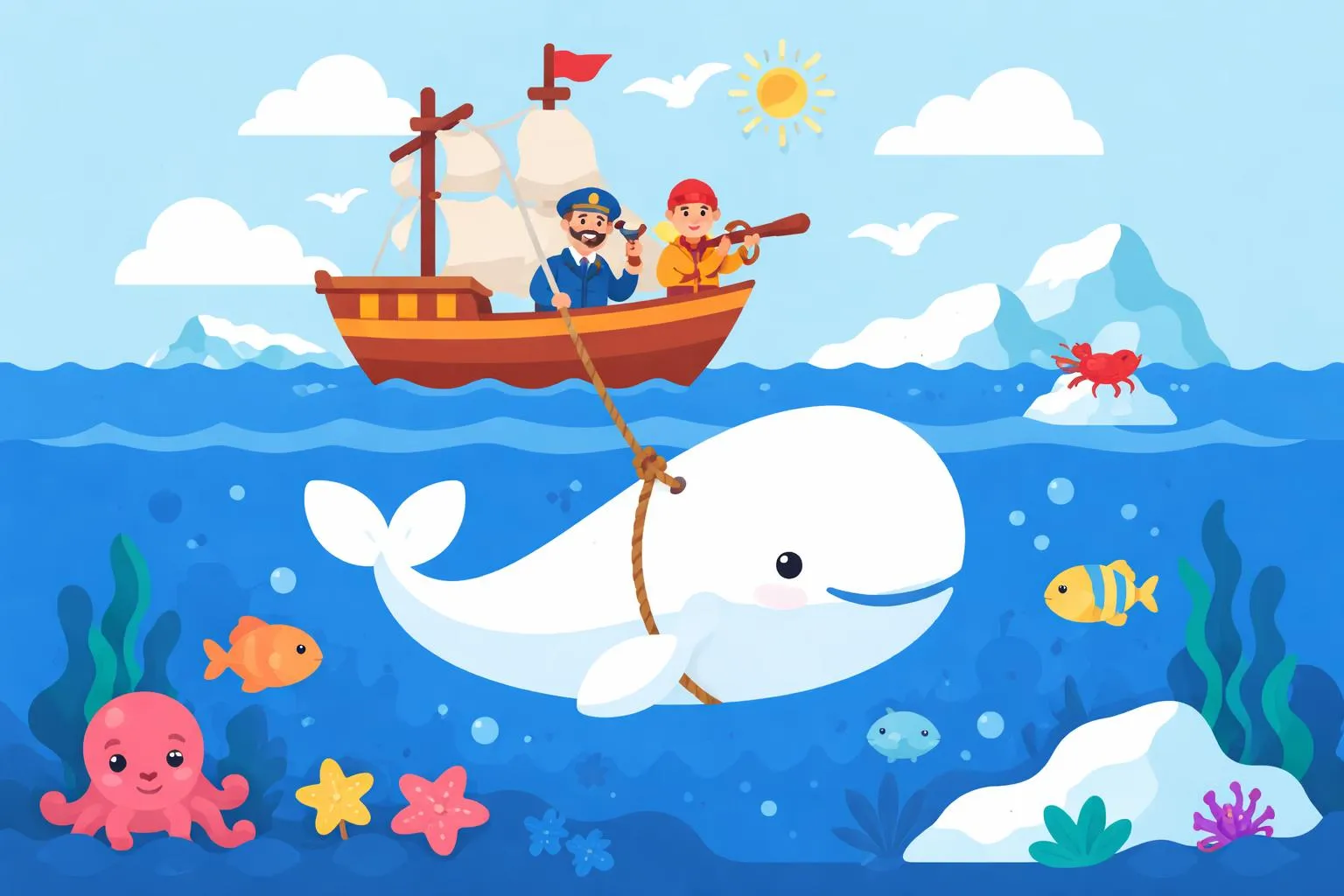
First: What is a Fast-Fish? Alive or dead a fish is technically fast, when it is connected with an occupied ship or boat, by any medium at all controllable by the occupant or occupants,- a mast, an oar, a nine-inch cable, a telegraph wire, or a strand of cobweb, it is all the same. Likewise a fish is technically fast when it bears a waif, or any other recognized symbol of possession; so long as the party wailing it plainly evince their ability at any time to take it alongside, as well as their intention so to do.
These are scientific commentaries; but the commentaries of the whalemen themselves sometimes consist in hard words and harder knocks- the Coke-upon-Littleton of the fist. True, among the more upright and honorable whalemen allowances are always made for peculiar cases, where it would be an outrageous moral injustice for one party to claim possession of a whale previously chased or killed by another party. But others are by no means so scrupulous.
Some fifty years ago there was a curious case of whale-trover litigated in England, wherein the plaintiffs set forth that after a hard chase of a whale in the Northern seas; and when indeed they (the plaintiffs) had succeeded in harpooning the fish; they were at last, through peril of their lives, obliged to forsake not only their lines, but their boat itself. Ultimately the defendants (the crew of another ship) came up with the whale, struck, killed, seized, and finally appropriated it before the very eyes of the plaintiffs. And when those defendants were remonstrated with, their captain snapped his fingers in the plaintiffs’ teeth, and assured them that by way of doxology to the deed he had done, he would now retain their line, harpoons, and boat, which had remained attached to the whale at the time of the seizure. Wherefore the plaintiffs now sued for the recovery of the value of their whale, line, harpoons, and boat.
Mr. Erskine was counsel for the defendants; Lord Ellenborough was the judge. In the course of the defence, the witty Erskine went on to illustrate his position, by alluding to a recent crim. con. case, wherein a gentleman, after in vain trying to bridle his wife’s viciousness, had at last abandoned her upon the seas of life; but in the course of years, repenting of that step, he instituted an action to recover possession of her. Erskine was on the other side; and he then supported it by saying, that though the gentleman had originally harpooned the lady, and had once had her fast, and only by reason of the great stress of her plunging viciousness, had at last abandoned her; yet abandon her he did, so that she became a loose-fish; and therefore when a subsequent gentleman re-harpooned her, the lady then became that subsequent gentleman’s property, along with whatever harpoon might have been found sticking in her.
Now in the present case Erskine contended that the examples of the whale and the lady were reciprocally illustrative to each other.
These pleadings, and the counter pleadings, being duly heard, the very learned Judge in set terms decided, to wit,- That as for the boat, he awarded it to the plaintiffs, because they had merely abandoned it to save their lives; but that with regard to the controverted whale, harpoons, and line, they belonged to the defendants; the whale, because it was a Loose-Fish at the time of the final capture; and the harpoons and line because when the fish made off with them, it (the fish) acquired a property in those articles; and hence anybody who afterwards took the fish had a right to them. Now the defendants afterwards took the fish; ergo, the aforesaid articles were theirs.
A common man looking at this decision of the very learned Judge, might possibly object to it. But ploughed up to the primary rock of the matter, the two great principles laid down in the twin whaling laws previously quoted, and applied and elucidated by Lord Ellenborough in the above cited case; these two laws touching Fast-Fish and Loose-Fish, I say, will on reflection, be found the fundamentals of all human jurisprudence; for notwithstanding its complicated tracery of sculpture, the Temple of the Law, like the Temple of the Philistines, has but two props to stand on.
Is it not a saying in every one’s mouth, Possession is half of the law: that is, regardless of how the thing came into possession? But often possession is the whole of the law. What are the sinews and souls of Russian serfs and Republican slaves but Fast-Fish, whereof possession is the whole of the law? What to the rapacious landlord is the widow’s last mite but a Fast-Fish? What is yonder undetected villain’s marble mansion with a doorplate for a waif; what is that but a Fast-Fish? What is the ruinous discount which Mordecai, the broker, gets from the poor Woebegone, the bankrupt, on a loan to keep Woebegone’s family from starvation; what is that ruinous discount but a Fast-Fish? What is the Archbishop of Savesoul’s income of L100,000 seized from the scant bread and cheese of hundreds of thousands of broken-backed laborers (all sure of heaven without any of Savesoul’s help) what is that globular 100,000 but a Fast-Fish. What are the Duke of Dunder’s hereditary towns and hamlets but Fast-Fish? What to that redoubted harpooneer, John Bull, is poor Ireland, but a Fast-Fish? What to that apostolic lancer, Brother Jonathan, is Texas but a Fast-Fish? And concerning all these, is not Possession the whole of the law?
But if the doctrine of Fast-Fish be pretty generally applicable, the kindred doctrine of Loose-Fish is still more widely so. That is internationally and universally applicable.
What was America in 1492 but a Loose-Fish, in which Columbus struck the Spanish standard by way of wailing it for his royal master and mistress? What was Poland to the Czar? What Greece to the Turk? What India to England? What at last will Mexico be to the United States? All Loose-Fish.
What are the Rights of Man and the Liberties of the World but Loose-Fish? What all men’s minds and opinions but Loose-Fish? What is the principle of religious belief in them but a Loose-Fish? What to the ostentatious smuggling verbalists are the thoughts of thinkers but Loose-Fish? What is the great globe itself but a Loose-Fish? And what are you, reader, but a Loose-Fish and a Fast-Fish, too?
Expansion and Analysis
Summary and Explanation
This story explores the laws and customs of the whale fishery, focusing on the concepts of "Fast-Fish" and "Loose-Fish." These terms symbolize possession and ownership in the whaling industry, but they also serve as metaphors for broader legal and social principles.
- A Fast-Fish is a whale (or any property) that is physically attached or controlled by a person or group, meaning it belongs to them.
- A Loose-Fish is one that is free and can be claimed by whoever captures it first.
The story recounts a famous legal case where a whale was harpooned by one ship but lost during a storm and later captured by another ship. The court ruled that the whale was a Loose-Fish at the time of final capture, so it belonged to the second ship, but the abandoned boat and equipment were returned to the first. This case illustrates the practical application of these simple but profound rules.
The author extends these ideas to human society, comparing possessions, territories, and even human rights to Fast-Fish and Loose-Fish. The story suggests that possession is often the foundation of law and ownership, whether in property, politics, or personal relationships.
Background and Author
This passage is from Moby-Dick by Herman Melville, a classic American novel published in 1851. Melville was a sailor and writer who drew on his own experiences at sea to create a complex narrative about whaling, human nature, and society.
The whale fishery laws described here reflect real maritime customs and legal disputes common in the 18th and 19th centuries. Melville uses these laws as a metaphor to question the nature of ownership, justice, and human conflict.
Literary Significance
Melville's writing combines legal insight, humor, and philosophical reflection. The story’s brevity in stating the laws ("Fast-Fish belongs to the party fast to it" and "Loose-Fish is fair game") contrasts with the complexity of their interpretation, highlighting how simple rules can lead to complicated human disputes.
The witty courtroom analogy involving a wife and her husband adds a layer of satire, showing how human relationships and property rights often overlap in confusing ways.
Lessons for Children and Students
- Understanding Ownership: The story teaches the importance of clear rules about possession and ownership, which are fundamental in society.
- Critical Thinking: Students learn to analyze how simple laws can have complex interpretations and consequences.
- Respect for Rules and Fairness: The narrative encourages respect for agreed-upon laws and fairness in disputes.
- Metaphorical Thinking: It shows how concepts from one area (whaling) can apply to broader human experiences.
Practical Applications
- In School: Students can relate the Fast-Fish and Loose-Fish principles to sharing, borrowing, and respecting others' belongings.
- In Life: Understanding possession and rights helps in resolving conflicts peacefully and legally.
- In History and Civics: The story provides a foundation for discussions about property rights, territorial disputes, and international law.
Key Vocabulary
- Fast-Fish: Something firmly possessed or controlled.
- Loose-Fish: Something unclaimed and available to be taken.
- Waif: A symbol or marker of possession.
- Harpoon: A spear used for hunting whales.
- Trover: A legal action to recover lost or wrongfully taken property.
Reading Comprehension Questions
- What is the difference between a Fast-Fish and a Loose-Fish?
- Why did disputes often arise among whalers?
- How did the court decide the case involving the whale and the two ships?
- What broader human concepts does the story compare to Fast-Fish and Loose-Fish?
- Why is possession considered "half of the law" according to the story?
- How does the story use humor to explain legal principles?
- What can children learn about fairness and ownership from this story?
Answers
- A Fast-Fish is a whale or object attached to a ship and controlled by someone, so it belongs to them. A Loose-Fish is free and can be claimed by whoever catches it first.
- Disputes arose because whales could escape one ship and be caught by another, leading to conflicts over ownership.
- The court ruled the whale belonged to the second ship because it was a Loose-Fish at final capture, but the abandoned boat and equipment were returned to the first ship.
- The story compares ownership, land, human rights, and even thoughts and beliefs to Fast-Fish and Loose-Fish.
- Possession is considered half or even the whole of the law because ownership often depends on who physically controls something.
- The story uses a humorous analogy about a husband and wife to illustrate how legal principles apply in unusual situations.
- Children can learn about the importance of respecting others' possessions, understanding rules, and resolving conflicts fairly.
This story offers rich insights into law, society, and human nature, making it a valuable resource for students to explore both practical and philosophical ideas.