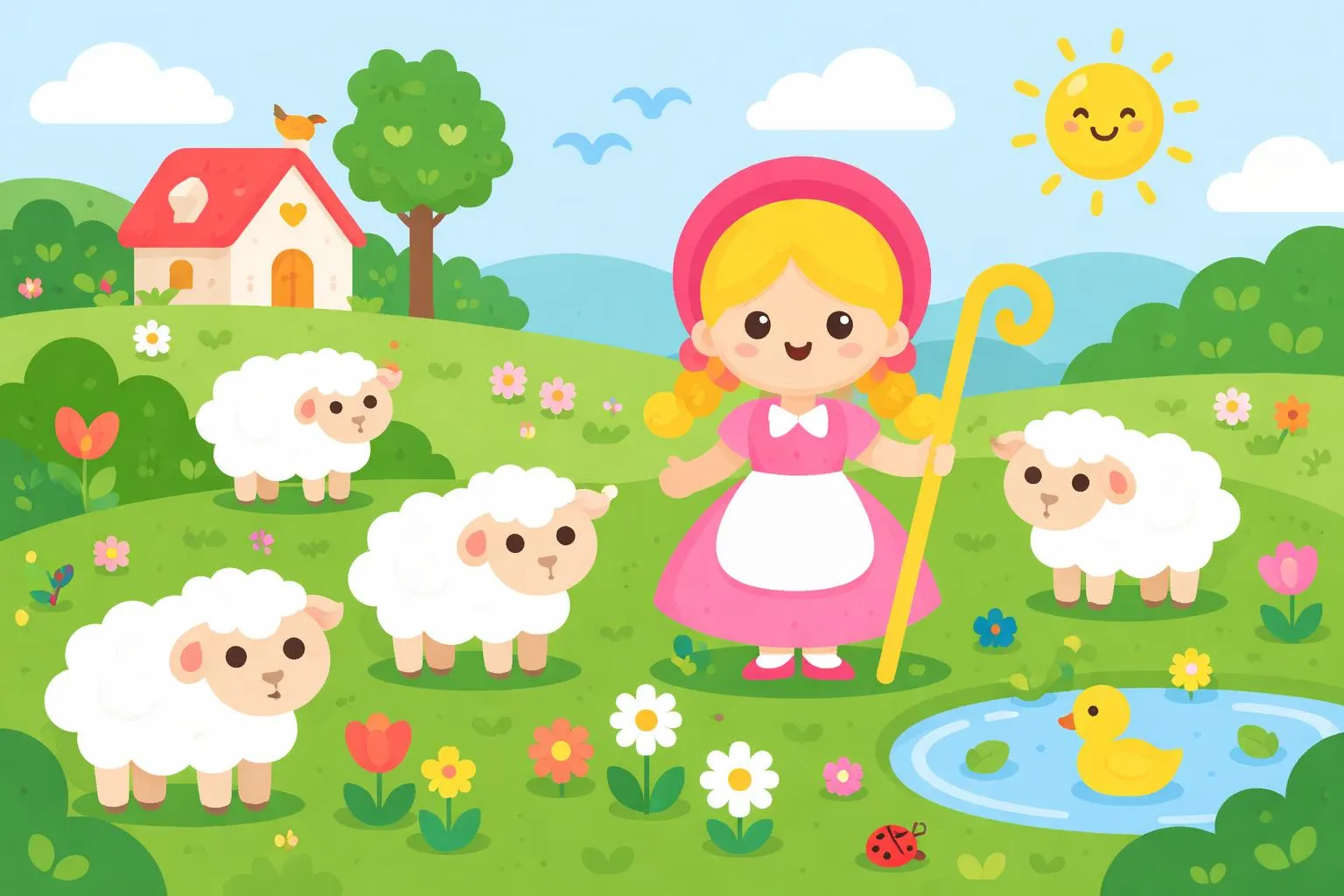

Original Story:
Little Bo-peep
She lost her sheep,
And couldn’t tell where to find them.
“Let them alone
And they’ll come home,
Wagging their tails behind them.”
Little Bo-peep
Fell fast asleep
And dreamt she heard them bleating,
But when she awoke,
She found it a joke,
For still they all were fleeting.
Then up she took
Her little crook,
Determined for to find them.
She found them indeed,
But it made her heart bleed,—
For they’d left their tails behind them.
Expansion and Analysis of "Little Bo-peep"
Summary and Interpretation
The nursery rhyme "Little Bo-peep" tells the story of a young shepherdess who loses her sheep and cannot find them. Despite advice to leave the sheep alone so they would return on their own, her sheep remain missing. She falls asleep, dreaming she hears them, but wakes to find they are still gone. Eventually, she sets out with her shepherd’s crook to find them herself. When she finally locates the sheep, she discovers that they have lost their tails, which causes her great sorrow.
This simple story can be interpreted as a lesson about patience, responsibility, and the consequences of neglect. The sheep symbolize something precious that requires care and attention. The advice to "let them alone" suggests that sometimes patience is necessary, but the ultimate responsibility lies with the caretaker. The loss of the tails might represent the lasting effects of neglect or misfortune.
Background and Author Information
"Little Bo-peep" is a traditional English nursery rhyme dating back to at least the 18th century. Its origins are somewhat unclear, as with many nursery rhymes, but it has been passed down through generations as a popular children’s verse. The rhyme is often used to teach young children about animals, responsibility, and the rhythm of language.
The author of this rhyme is unknown, as it belongs to the oral tradition of folk literature. Nursery rhymes like this one were originally shared orally before being printed in collections of children’s stories and songs.
Literary and Educational Value
This rhyme is valuable for early childhood education because it introduces rhythm, rhyme, and repetition, which are essential for language development. The simple narrative helps children understand cause and effect—losing the sheep leads to a search and eventual discovery of a problem (the missing tails).
The story also encourages empathy by showing the shepherdess’s sadness when she finds her sheep in a harmed state. It can be used to discuss feelings and the importance of caring for others, whether animals or people.
Lessons and Knowledge Points for Children and Students
- Responsibility: Taking care of something or someone requires attention and care.
- Patience: Sometimes, waiting calmly is necessary, but action may be required when things go wrong.
- Empathy and Compassion: Understanding others’ feelings and reacting kindly.
- Problem-solving: When faced with a problem (lost sheep), one must take steps to find a solution.
- Vocabulary and Language: Words like "bleating," "crook," and "fleeting" enrich children’s vocabulary.
- Rhythm and Rhyme: Helps develop phonological awareness, important for reading skills.
Practical Applications and Life Lessons
- In Daily Life: Children learn that pets or belongings need care and attention, and neglect can lead to problems.
- In School: The rhyme can be used to teach sequencing (first she lost the sheep, then she searched, then she found them).
- Emotional Learning: Discussing the shepherdess’s feelings helps children identify and express their own emotions.
- Creative Activities: Children can draw the story, act it out, or create their own endings, fostering creativity and comprehension.
Difficulties and Focus Points for Learning
- Understanding the metaphorical meaning behind the sheep losing their tails might be challenging for younger children.
- Vocabulary such as "crook" (a shepherd’s staff) and "bleating" (the sound sheep make) may need explanation.
- The concept of patience versus action is subtle and can be explored through discussion.
Reading Comprehension Questions
- Who is Little Bo-peep?
- What problem does Little Bo-peep face in the story?
- What advice is given to Little Bo-peep about her lost sheep?
- What does Little Bo-peep dream about?
- What does Little Bo-peep find when she finally locates her sheep?
- How do you think Little Bo-peep feels when she finds her sheep without their tails?
- What lesson can we learn from this story?
- What does the word "crook" mean in the story?
- Why do you think the sheep left their tails behind?
- How can this story help children learn about responsibility?
Answers
- Little Bo-peep is a young shepherdess who takes care of sheep.
- She loses her sheep and cannot find them.
- She is advised to leave the sheep alone and they will come home by themselves.
- She dreams she hears her sheep bleating.
- She finds her sheep, but they have lost their tails.
- She feels sad and heartbroken.
- The story teaches about responsibility, patience, and caring for others.
- A "crook" is a shepherd’s staff used to guide and catch sheep.
- The sheep might have lost their tails because they wandered off and got hurt or neglected.
- It teaches children that taking care of others requires attention and sometimes action.
This expanded article can be used on an educational website to help children and their parents or teachers understand the meaning and value of the classic nursery rhyme "Little Bo-peep," while also providing useful learning activities and insights.