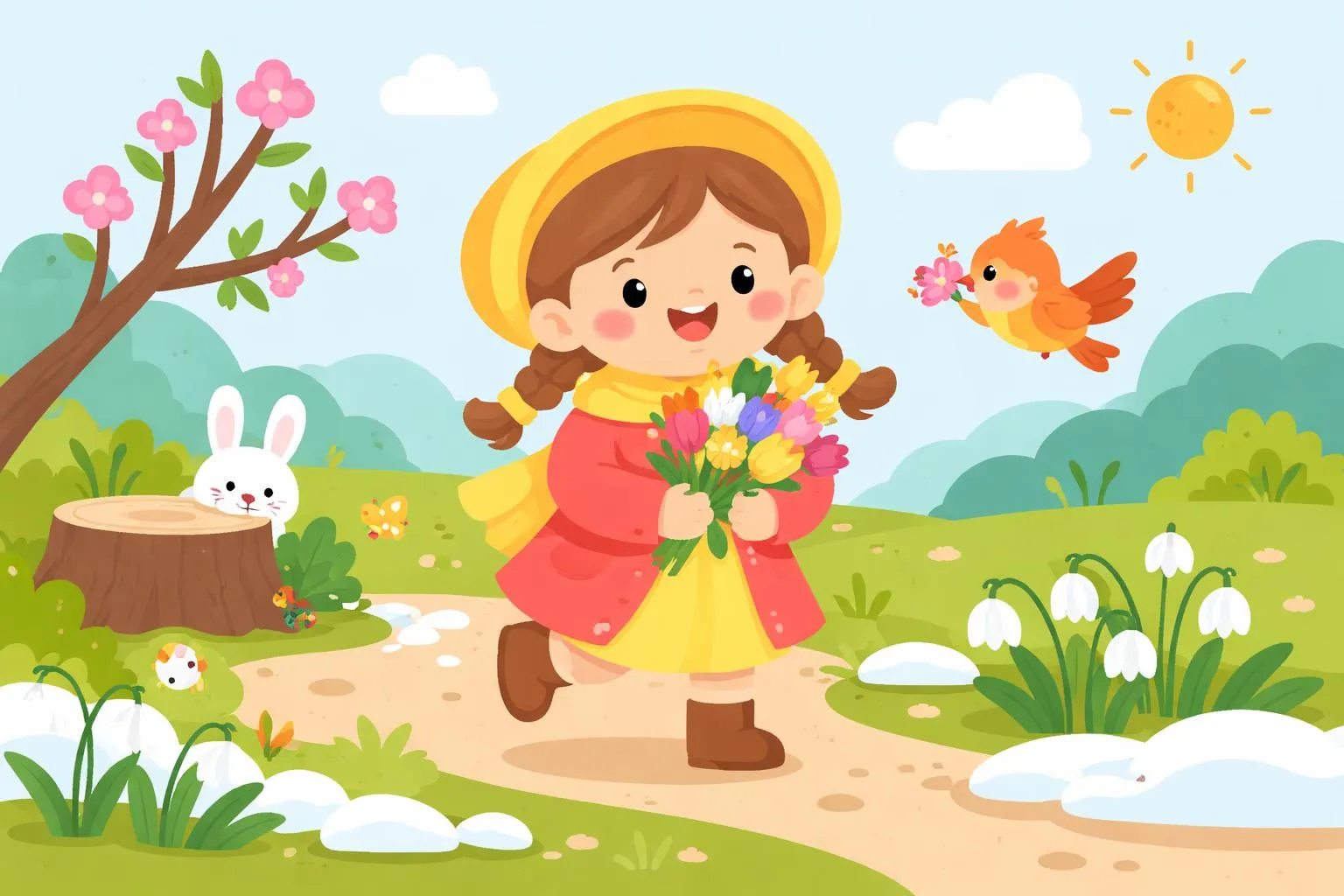

Original Story:
Come to the pane, draw the curtain apart,
There she is passing, the girl of my heart;
See where she walks like a queen in the street,
Weather–defying, calm, placid and sweet.
Tripping along with impetuous grace,
Joy of her life beaming out of her face,
Tresses all truant–like, curl upon curl,
Wind–blown and rosy, my little March girl.
Hint of the violet’s delicate bloom,
Hint of the rose’s pervading perfume!
How can the wind help from kissing her face,—
Wrapping her round in his stormy embrace?
But still serenely she laughs at his rout,
She is the victor who wins in the bout.
So may life’s passions about her soul swirl,
Leaving it placid,—my little March girl.
What self–possession looks out of her eyes!
What are the wild winds, and what are the skies,
Frowning and glooming when, brimming with life,
Cometh the little maid ripe for the strife?
Ah! Wind, and bah! Wind, what might have you now?
What can you do with that innocent brow?
Blow, Wind, and grow, Wind, and eddy and swirl,
But bring her to me, Wind,—my little March girl.
Story Expansion and Analysis
Summary and Interpretation
This beautiful poem depicts a young girl, affectionately called the "little March girl," passing by a window. The narrator watches her with deep admiration and love, describing her as calm, graceful, and full of life despite the harsh weather conditions. The girl is compared to a queen walking confidently through the street, unaffected by the wild winds and storms around her. Her appearance is fresh and vibrant, like the delicate bloom of violets and the scent of roses, symbolizing youth and innocence.
The poem personifies the wind as something that tries to touch and challenge her, but she remains serene and victorious, embodying strength and self-possession. The narrator celebrates her resilience and beauty, suggesting that no matter how fierce life’s challenges (represented by the wind and storm) may be, she will remain calm and unshaken.
Background and Author Introduction
This poem is a classic example of romantic and nature-inspired poetry, often reflecting themes of youth, innocence, and resilience. The "little March girl" symbolizes the arrival of spring and new beginnings, a time when nature awakens after winter’s harshness. The imagery of wind and weather challenges highlights the theme of overcoming adversity with grace and strength.
The author, though not explicitly named here, is likely a poet who draws inspiration from the natural world and human emotions. Such poems often come from the 19th or early 20th century, a period rich in lyrical poetry celebrating nature and human spirit.
Themes and Lessons for Children and Students
- Resilience and Strength: The poem teaches children that like the little March girl, they can face difficulties (symbolized by the wind and storms) with calmness and courage.
- Appreciation of Nature: The vivid descriptions encourage young readers to observe and appreciate the beauty of nature and the changing seasons.
- Self-possession and Confidence: The girl’s serene and confident demeanor provides a model for children to develop inner strength and self-control.
- Imagination and Personification: The poem introduces literary devices such as personification (the wind as a character) and metaphor, which help children understand how language can create vivid images and emotions.
Practical Applications and Learning Points
- In Life: Children can learn to remain calm and positive even when facing challenges, just like the girl who smiles despite the stormy wind.
- In School: The poem can be used to teach literary devices, such as imagery, metaphor, and personification, enhancing students’ reading comprehension and creative writing skills.
- In Art: Students might be inspired to draw or paint scenes from the poem, helping them connect visually with the text.
- Emotional Growth: The story encourages emotional resilience, teaching children to embrace change and difficulties with grace.
Key Vocabulary
- Placid: Calm and peaceful.
- Impetuous: Acting quickly without thought or care.
- Truant: Wandering or roaming.
- Serenely: Calmly and peacefully.
- Self-possession: Confidence and control of oneself.
- Eddy: A circular movement of water or air.
Reading Comprehension Questions
- Who is the "little March girl" in the poem?
- What does the wind symbolize in the poem?
- How does the girl react to the wind and the storm?
- What feelings does the narrator express toward the girl?
- What literary devices are used to describe the girl and the wind?
- What message does the poem convey about facing challenges?
Answers
- The "little March girl" is a young girl who walks confidently and gracefully, symbolizing youth and resilience.
- The wind symbolizes challenges and difficulties that try to affect the girl.
- The girl reacts calmly and confidently, laughing at the wind’s attempts to disturb her.
- The narrator expresses deep admiration, love, and pride for the girl’s strength and beauty.
- The poem uses personification (wind as a character), metaphor (comparing the girl to a queen and flowers), and vivid imagery.
- The poem conveys that one can face life’s challenges with calmness, strength, and grace.
This poem is a wonderful resource for children and students to explore themes of nature, resilience, and literary expression. It encourages them to observe the world around them, understand emotions, and develop confidence in facing their own challenges.