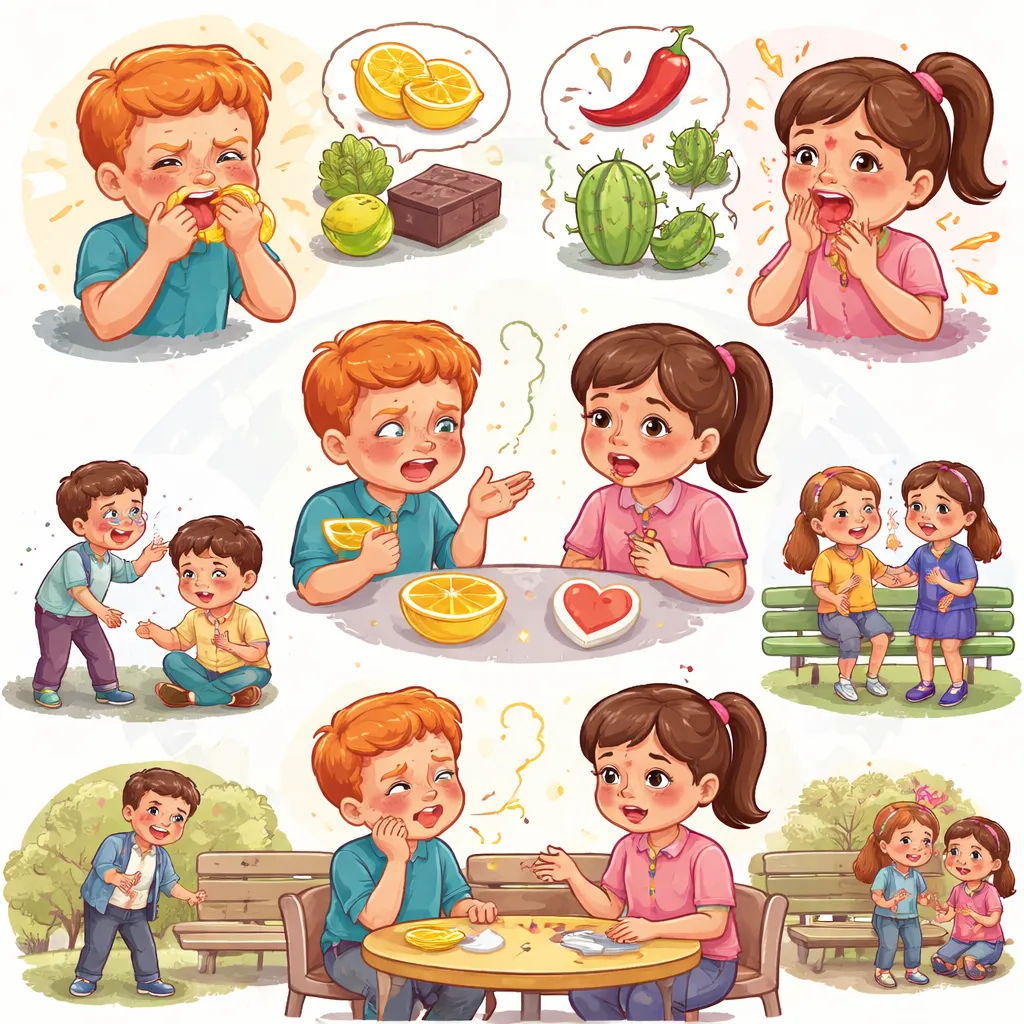

Are Similar Words Really Interchangeable?
Many English words seem close in meaning. This can make learning harder for children. Words like “bitter and sharp” often appear in similar situations. Both can describe taste. Both can also describe feelings or reactions.
However, they are not always interchangeable. Each word carries its own tone and use. Learning these small differences helps children speak more clearly and confidently.
When children understand how words connect to real experiences, learning becomes easier. Taste, emotion, and daily life all offer helpful examples.
Parents can guide this process gently. Clear examples and simple comparisons help children notice how words truly work.
Set 1: bitter vs sharp — Which One Is More Common?
“Sharp” is more common in everyday English. It appears in many contexts. Children hear it in phrases like “a sharp knife” or “a sharp sound.”
“Bitter” is also common, but in a narrower way. It often appears in discussions about taste or feelings.
Children may hear “bitter chocolate” or “bitter cold.” Still, “sharp” appears in more daily situations.
Because of this, children may learn “sharp” earlier. “Bitter” becomes clearer as they gain more experience with taste and emotions.
Parents can introduce both through real-life examples.
Set 2: bitter vs sharp — Same Meaning, Different Contexts
“Bitter” and “sharp” can both describe taste. Yet their meanings differ.
“Bitter” refers to a strong, often unpleasant taste. It appears in foods like dark chocolate or certain vegetables.
“Sharp” describes a strong, clear taste. It often appears in foods like cheese or vinegar. It can feel fresh or intense.
For example:
“This medicine tastes bitter.” “This cheese tastes sharp.”
The first suggests discomfort. The second suggests a strong but not always unpleasant flavor.
This difference helps children describe taste more accurately.
Set 3: bitter vs sharp — Which Word Is “Bigger” or More Emphatic?
“Bitter” often feels stronger in emotion. It can describe deep feelings like anger or disappointment.
“Sharp” feels more immediate and precise. It describes something quick, clear, or intense.
For example:
“A bitter memory” suggests lasting sadness. “A sharp pain” suggests a sudden feeling.
In taste, “bitter” often feels heavier. “Sharp” feels lighter but more sudden.
Understanding this helps children express both physical and emotional experiences.
Set 4: bitter vs sharp — Concrete vs Abstract
Both words work in concrete and abstract ways. However, their focus differs.
“Bitter” often moves from taste to emotion. It describes both physical flavor and emotional states.
“Sharp” begins with physical meaning. It describes edges, sounds, and sensations. Then it extends to ideas like “sharp thinking.”
For example:
“bitter coffee” and “bitter feelings” “sharp knife” and “sharp mind”
This flexibility shows how language grows. Children benefit from seeing these connections.
Set 5: bitter vs sharp — Verb or Noun? First Understand the Role
Both “bitter” and “sharp” are mainly adjectives. They describe nouns.
For example:
“bitter tea” “sharp flavor”
However, “sharp” has more roles. It can also act as an adverb or noun in certain contexts.
“Bitter” can appear in expressions like “to speak bitterly,” where it changes form.
Understanding these roles helps children build stronger sentences.
It also prepares them for more advanced language use.
Set 6: bitter vs sharp — American English vs British English
Both words appear in American and British English. Their meanings remain consistent.
“Bitter” may appear more often in British contexts related to food and drink, such as certain beverages.
“Sharp” appears widely in both regions. It keeps its meaning across different contexts.
Children do not need to worry about major regional differences here. Both words are widely understood.
Still, exposure to different examples helps deepen understanding.
Set 7: bitter vs sharp — Which Fits Formal Situations?
Both words can appear in formal writing. Their use depends on context.
“Bitter” often appears in emotional or descriptive writing. It helps express strong feelings or serious situations.
“Sharp” appears in both descriptive and analytical contexts. It works well in writing about sound, taste, or ideas.
For example:
“a bitter conflict” “a sharp contrast”
“Sharp” often sounds more neutral. “Bitter” can sound more emotional.
Teaching this helps children adjust their tone when writing.
Set 8: bitter vs sharp — Which One Is Easier for Kids to Remember?
“Sharp” is often easier for children. It connects to physical objects like knives or sounds. These are easy to observe.
“Bitter” may be harder. Its taste is less common in children’s daily food. Its emotional meaning is also more complex.
Parents can use simple examples. Let children taste a small piece of dark chocolate. Compare it with other flavors.
Use everyday objects to explain “sharp.” Show a pencil tip or describe a loud sound.
These experiences help children remember both words clearly.
Mini Exercise: Can You Spot the Differences Between These Similar Words?
Try these simple activities.
Choose the correct word: The coffee tastes ______ (bitter / sharp). The knife is very ______ (bitter / sharp). Fill in the blanks: He felt ______ after the argument. The cheese has a ______ taste. Match the words: bitter → taste / emotion sharp → object / sound / taste Create your own sentences: Ask children to use both words in different ways.
These exercises make learning active and enjoyable.
Parent Tips: How to Help Kids Learn and Remember Similar Words
Use real-life examples. Taste, touch, and sound all help children learn.
Encourage children to describe what they feel and experience. Ask simple questions like “Is it bitter or sharp?”
Use comparison often. Present both words together. Highlight differences gently.
Read books that include descriptive language. Pause and discuss new words.
Allow time for practice. Do not rush correction. Confidence grows with repetition.
Create a supportive environment. Celebrate effort and curiosity.
With time and guidance, children will learn to use “bitter and sharp” naturally. They will describe both taste and feelings with greater clarity and confidence.