
Meaning
Hello, word helpers. Today, we are going to learn about a very useful word. We are going to learn about the "it" object pronoun. A pronoun is a word that takes the place of a noun. An object pronoun is a pronoun that receives the action in a sentence. The word "it" is a special object pronoun.
We use "it" to talk about a thing, an animal, or an idea. We do not use "it" for people. "It" replaces a singular noun that is not a person. Look at this. "I see the ball. I like the ball." That sounds funny. Let's use the "it" object pronoun. "I see the ball. I like it." The word "it" takes the place of "the ball." It makes our talking smoother. Let's learn all about this helpful word.
Conjugation
The word "conjugation" here means matching. The "it" object pronoun is very easy. It does not change. It is always "it." We use it for one thing, one animal, or one idea.
Look at the subject pronouns and their object partners. I becomes me. You becomes you. He becomes him. She becomes her. We becomes us. They becomes them. It becomes it. The word "it" is the same for both subject and object. That makes it simple to remember. I see it. You have it. He wants it. She needs it. We like it. They know it. The "it" object pronoun stays the same every time.
Present tense
We use the "it" object pronoun in the present tense a lot. It talks about things we do now or as a habit. The pronoun comes after the action verb.
I see it. You have it. He needs it. She likes it. We use it. They want it. The dog eats it. The cat chases it. In all these sentences, "it" receives the action. "It" is the thing being seen, had, needed, or liked. Using the "it" object pronoun in the present tense is very common and useful.
Past tense
We also use the "it" object pronoun to talk about the past. The pronoun stays "it," but the main verb changes to show past time.
I saw it yesterday. You had it last week. He needed it for school. She liked the movie. We used it already. They wanted a cookie. I found it under the bed. The action (saw, had, needed) is finished, but "it" is still the receiver. The "it" object pronoun helps us tell stories about things that happened.
Future tense
We can use the "it" object pronoun to talk about the future. We use "will" or "going to" with the pronoun.
I will see it tomorrow. You will have it soon. He is going to need it. She will like it. We are going to use it. They will want it. The robot will fix it. The "it" object pronoun receives the future action. It helps us talk about our plans for things.
Questions
We ask questions using the "it" object pronoun. The pronoun often comes at the end of the question.
Do you see it? Can you find it? Did he eat it? Will she buy it? Where did you put it? What can I do with it? How do you open it? The "it" object pronoun is a key part of the question. It tells us what thing the question is about. A very common question is, "Do you like it?"
Other uses
The "it" object pronoun is also used after prepositions. Prepositions are small words like to, for, with, at, of. Please give this to it. This food is for it. Will you play with it? Look at it. I am afraid of it. The preposition introduces the "it" object pronoun.
We also use "it" in common phrases about weather, time, and distance. It is raining. It is 3 o'clock. It is far away. In these sentences, "it" does not replace a clear noun. It is a dummy subject. This is a special use of the word "it."
Learning tips
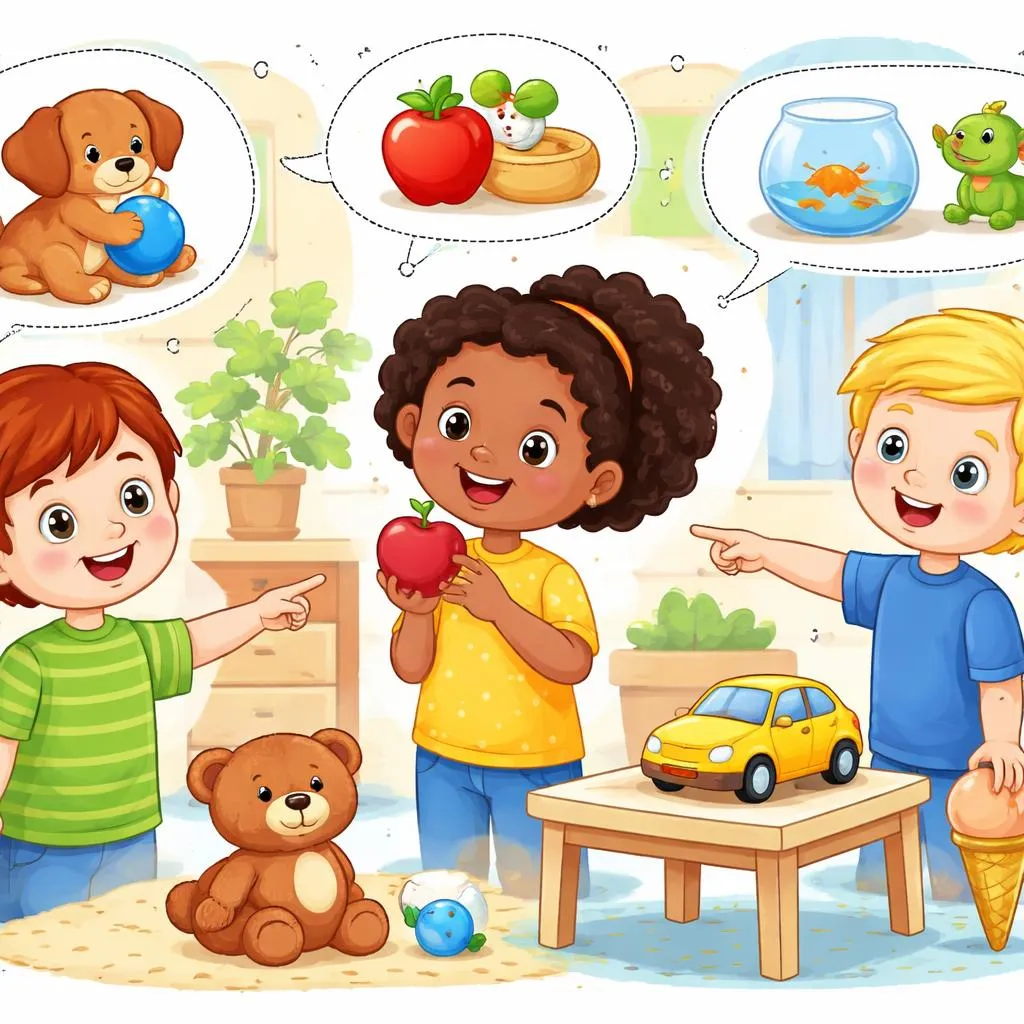
A great tip is to point to a thing and make sentences. Point to a book. Say, "I see the book. I see it." Point to a toy. Say, "You have the toy. You have it." This connects the word directly to real objects.
Make a simple chart. On one side, write nouns: the ball, the cat, the milk, the idea. On the other side, draw an arrow to the word "it." This shows that all these singular things can be called "it."
Play the "Not Him, It!" game. Show pictures of people and things. For a picture of a boy, kids shout "Him!" For a picture of a car, they shout "It!" This game practices choosing the correct object pronoun.
Educational games
Let's play "Find It." Hide a small object. Give clues using the "it" object pronoun. "Is it under the table? No, it is not. Is it near the door? Yes, it is!" The child who finds the object gets to give the next clues. This game makes using "it" natural and fun.
Try the "Sentence Builder" game. Prepare two sets of cards. Set A has sentence starters: "I see...", "She wants...", "We lost...". Set B has picture cards of things: a ball, a cat, a key. A player picks one card from each set and says a full sentence. "I see a ball. I see it." This visually connects the noun to the pronoun.
Create an "It" Story Circle. Sit in a circle. Start a story about a mysterious object. "I found a shiny box." The next person continues, "I opened it." The next says, "A small frog jumped out of it." Keep the story going, making sure to use the "it" object pronoun to refer to the box or the frog. This creative game makes practicing grammar a silly, shared storytelling adventure.