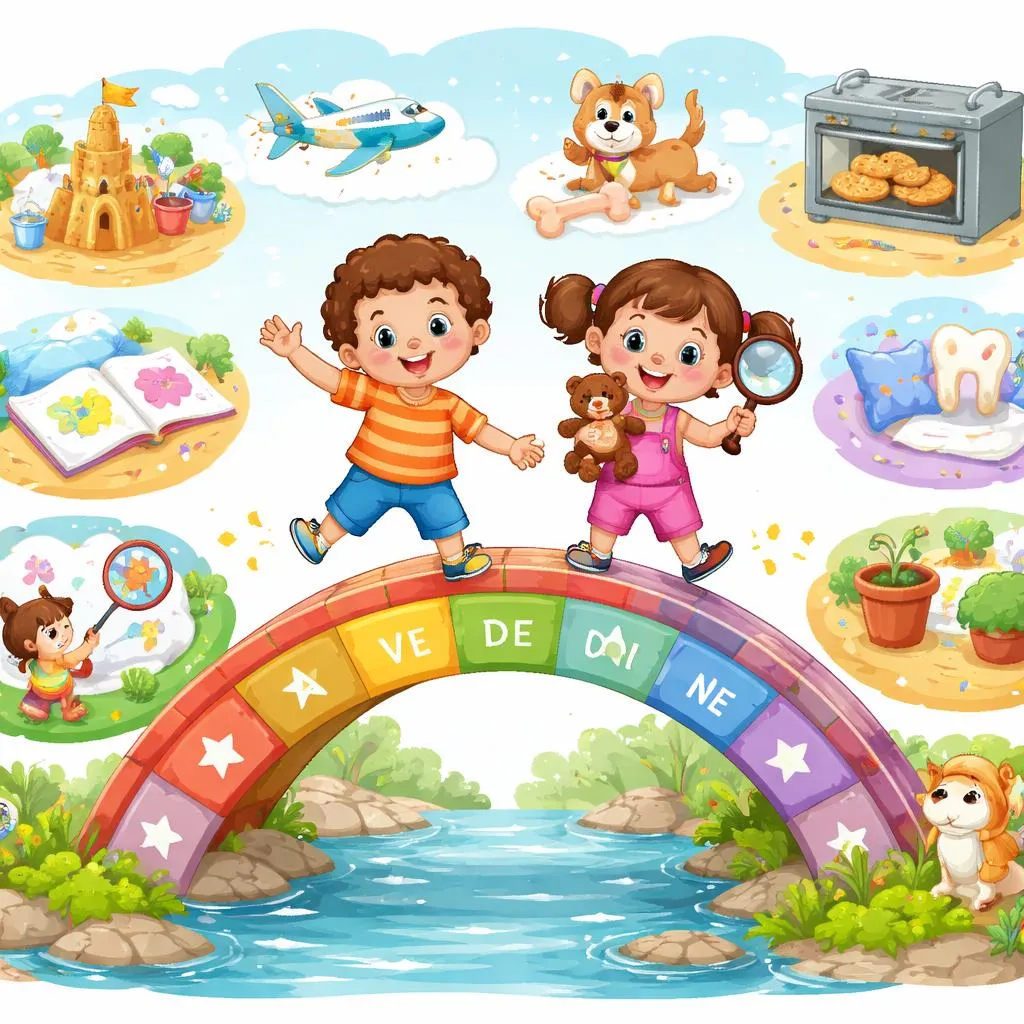

Hello, little time linker! Do you know about bridges? A bridge connects two places. Words can build bridges too! The present perfect tense is a special time bridge. It connects the past to now. It talks about things that happened before, but they are important for this moment. It uses the magic words "have" or "has". It is like saying "I have a done thing!" Today, we will find the must-know present perfect verbs for 3-year-olds. Our guide is Sammy the Squirrel. Sammy collects nuts and has a very good memory! He will show us his bridge of "have done" actions at home, the playground, school, and in the forest. Let's build a bridge!
What Is the Present Perfect? The present perfect tense is a "have done" bridge. It shows an action that happened at some time before now. We do not say exactly when. The important part is the action is finished, and it matters now. At home, you might say "I have washed my hands." It is done. Now my hands are clean. "Have washed" is present perfect. At the playground, you say "I have played on the swing." You are done playing now. At school, you say "I have shared my toy." That action is over, and your friend is happy now. In nature, Sammy says "I have found a nut!" He found it, and now he has it. "Sammy has finished his snack." The snack is gone, and he is full now. Learning this bridge helps you talk about your experiences.
Why Build a "Have Done" Bridge? The present perfect is your experience voice! It helps your ears listen. You understand what people have done in their lives. It helps your mouth speak. You can tell about your achievements. "I have brushed my teeth!" It helps your eyes read. You will see it in simple stories. It helps your hand write. You can write about things you have done. This bridge makes you sound like a big kid who remembers things.
When Do We Use This Bridge? We use the present perfect for a few special reasons.
First, for RECENT PAST actions. Things that just happened. The time is not important, the result is. "I have just eaten. I am full now." "She has lost her toy. She is sad now."
Next, for LIFE EXPERIENCES. Things you have done or never done in your life. "I have seen a real elephant." "I have never been to the moon."
Here, for UNFINISHED TIME. With words like "today", "this week". "I have played outside today." The day is not over, but the playing is done.
Also, for PAST ACTIONS WITH PRESENT RESULTS. This is the main bridge! "I have finished my milk. My cup is empty now." "He has broken the toy. It does not work now."
How Can You Find the Present Perfect? Finding this bridge is about spotting two parts. Part one: the helper "have" or "has". Part two: the main verb in a special form (past participle). For many verbs, it ends in "-ed", just like the simple past. Ask this question: "Has this action happened sometime before now, and does it matter now?" If yes, it might be the bridge. Look for the helpers! I/You/We/They have. He/She/It has. "Sammy has eaten his nuts." There's "has" and "eaten". You found it! Time words like "already", "yet", "just", "ever", "never" often sit on this bridge.
How Do We Build the "Have Done" Bridge? Building it is a two-step job. Here is the formula. Helper (have/has) + Past Participle Verb. The past participle for regular verbs is the same as the simple past: add "-ed". I have played. You have jumped. He has washed. They have called. For irregular verbs, it is a different word. We will learn those! To make it negative, add "not" after the helper. "I have not finished." "She has not seen it." For questions, flip the helper to the front. "Have you eaten?" "Has he come?"
Let's Fix Some Bridge Mix-Ups! Sometimes we use the wrong part. Let's fix it. A common mix-up is using the simple past for a present result. A child might say "I ate my lunch." This is fine. But if you want to focus on the now result (my tummy is full), you can use the bridge: "I have eaten my lunch." Another mix-up is forgetting the past participle. Someone might say "I have eat my lunch." This is missing the special form. The right way is "I have eaten my lunch." Remember: "have" or "has" + the special verb form (like eaten, played, gone).
Can You Be a Bridge Builder? You are a great builder! Let's play a game. Look at your hands. Are they clean? If yes, say "I have washed my hands." Look at your toy box. Is it tidy? If yes, say "I have put my toys away." You are using the bridge! Here is a harder challenge. Think of three things you did today. Say them with "I have ". "I have had breakfast. I have read a book. I have hugged my mom." You are building strong experience bridges with the must-know present perfect.
Your Big List of 40 Must-Know Present Perfect Verbs Ready for the bridge list? Here are forty key verbs in their three forms: present, past, past participle. The last one is for the bridge! Practice with Sammy! (Present - Past - Past Participle) Play - Played - Played. Jump - Jumped - Jumped. Watch - Watched - Watched. Ask - Asked - Asked. Help - Helped - Helped. Share - Shared - Shared. Call - Called - Called. Wash - Washed - Washed. Finish - Finished - Finished. Start - Started - Started. Open - Opened - Opened. Close - Closed - Closed. Clean - Cleaned - Cleaned. Want - Wanted - Wanted. Like - Liked - Liked. Eat - Ate - Eaten. Drink - Drank - Drunk. See - Saw - Seen. Go - Went - Gone. Take - Took - Taken. Come - Came - Come. Do - Did - Done. Have - Had - Had. Say - Said - Said. Make - Made - Made. Find - Found - Found. Get - Got - Gotten. Give - Gave - Given. Sing - Sang - Sung. Read - Read - Read. Write - Wrote - Written. Draw - Drew - Drawn. Break - Broke - Broken. Lose - Lost - Lost. Put - Put - Put. Cut - Cut - Cut. Hurt - Hurt - Hurt. Let - Let - Let. Set - Set - Set. Hit - Hit - Hit. Start with the easy "-ed" ones. These are your must-know verbs for the present perfect bridge.
Linking Your Past to Your Now You did it! You know about the present perfect tense. It is a "have done" bridge from the past to now. It uses "have" or "has" plus a special verb form. You know it is for actions that matter now. You can spot the helpers "have" and "has". You know the building formula. Sammy the Squirrel uses this bridge to talk about the nuts he has collected. Now you can too! You can talk about your little achievements. You can share your life experiences. Your words will connect your yesterday to your today.
Here is what you can learn from our bridge adventure. You will know what the present perfect tense is for. You will understand why we call it a bridge. You can hear the words "have" and "has" that signal it. You can use the correct past participle form of verbs. You have a big list of "have done" actions to use.
Now, let's do some life practice! Your mission is today. At the end of the day, tell your grown-up three things you have done. Say: "Today, I have played. I have eaten my veggies. I have been a good helper." You just used the present perfect bridge three times! Keep building bridges with your words. Have fun, little time linker!