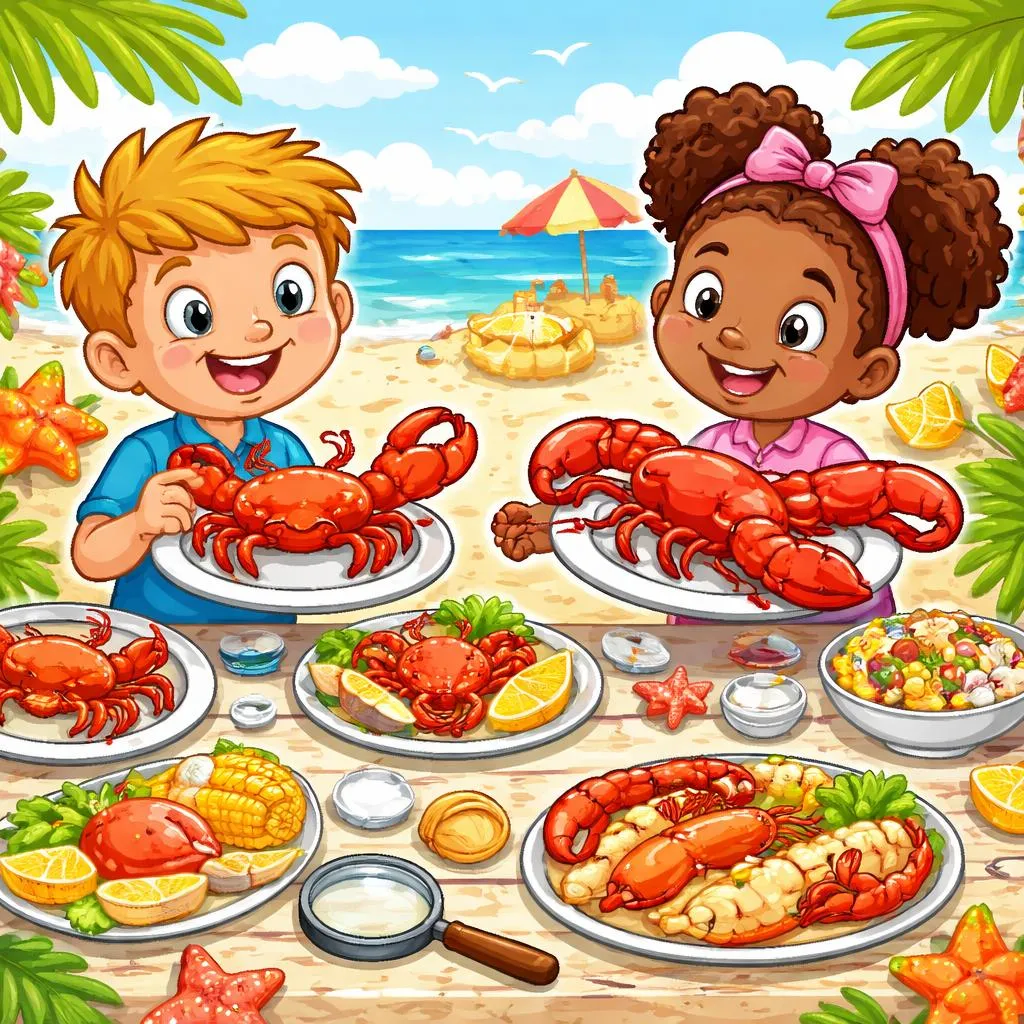

Start! Find a Pair of 'Ocean Twin' Words
Hello, word explorer! Have you ever been to a beach or a seafood restaurant? You see a creature with a hard shell and lots of legs. It might have big claws. What do you call it? You might say "crab." Or maybe you say "lobster." They both have shells and live in the water. Are they the same? This is a fun word puzzle. Today we explore a word pair. We explore crab and lobster. They are like two cousins in armor. They are both crustaceans. But they are built differently! Knowing the difference is a superpower. Your ocean and food talk will be precise. Let us start our word beach adventure!
Be a Language Watcher now. Our first clue is at home. Your family orders a seafood dinner. You get a plate of crab legs to crack open. Then, you see a picture of a red, boiled lobster on a menu. They are both delicious sea creatures. But are they the same word? Let us test with two sentences.
"The crab scuttled sideways into its hole in the sand." This shows a sideways walk. "The lobster hid in a rocky crevice on the ocean floor." This shows a different hiding spot.
They both describe armored ocean animals. But one moves sideways. One hides in rocks. Your watching mission starts. Let us scuttle into their word world.
Adventure! Scuttle Into the Word World
Feel the Word's Movement!
Feel the word crab. It is a quick, sideways word. It feels quirky and sudden. It makes you think of beaches and quick escapes. The word lobster is a heavier, forward word. It feels more lumbering and strong. It makes you think of deep water and big claws. Crab is the quick, sideways dancer. Lobster is the strong, forward march. One is a sidestep. The other is a direct approach. Let us see this at school.
In a biology class, you learn: "The crab has a wide, flattened body for living on the bottom." This is about its shape. In a cooking class, you might learn to boil a lobster. This is about preparing a meal. Saying "crab has a long tail" would be wrong. The movement and shape of the words are different.
Compare Their Bodies and Claws!
Think about a wide, flat shield and a long, heavy rifle. The word crab is the shield. It has a wide, flat body. Its abdomen is tucked underneath. It has two claws, often one bigger. The word lobster is the rifle. It has a long, muscular body with a prominent tail. It has two large, equal-sized claws for crushing and cutting. Their body plans are different. A crab is wide. A lobster is long. Let us test this on the playground.
You play a game. You walk sideways quickly and say, "I am a crab!" Your friend walks forward, snapping his hands like big claws. He says, "I am a lobster!" The word crab means sideways motion. The word lobster means forward motion with big claws. The playground shows the difference.
Meet Their Best Word Friends!
Words have favorite ocean partners. The word crab likes beach and quick words. It teams up with 'crabby', 'cakes', 'legs', 'walk', and 'grass'. You do the crab walk in gym. You eat crab cakes. The word lobster likes deep water and food words. It teams up with 'trap', 'bisque', 'roll', 'tail', and 'red'. You see a lobster trap. You eat a lobster roll. Their partners are different. Let us go back to school.
In a physical education class, you might do the crab walk race. This is an exercise. In a home economics class, you might make lobster bisque. This is a cooking lesson. You would not usually do the "lobster walk" in gym. The word friends set the right activity.
Our Little Discovery!
We explored the word shoreline. We made a clear discovery. The words crab and lobster are different armored animals. The word crab describes a creature with a wide, flat body. It walks sideways. It often lives on beaches or the sea floor. The word lobster describes a creature with a long body and a strong tail. It walks forward. It lives in deeper, rocky waters. Crab is the wide, sideways scuttler. Lobster is the long, clawed swimmer. One is built for the sand. The other is built for the rocks.
Challenge! Become a Seashore Word Expert
"Best Choice" Challenge!
Let us look at the coast. Read each scene. Pick the champion word. Scene one: You are on a sandy beach. You see a small, round shell with legs moving sideways. Your parent says, "Look, a hermit ______!" Is it Crab or Lobster? The champion is Crab! Hermit crabs are common on beaches. Scene two: You are on a fishing boat. The fisherman pulls up a cage from deep water. Inside is a large creature with big claws. He says, "We caught a ______!" Is it crab or lobster? The champion is lobster! Lobsters are often caught in traps. Excellent!
"My Sentence Show"!
Now, create your own sentences. Here is a scene: Imagine a sunny, sandy beach at low tide. Use the word crab in one sentence. Now imagine a dark, rocky underwater reef. Use the word lobster in another. Try it! Here is an example. Sentence one: "A tiny sand crab disappeared into its hole." Sentence two: "A spiny lobster backed into its cave, antennae waving." See the difference? The first is on the sand, quick and small. The second is on a reef, with a focus on its spiny body and antennae.
"Eagle Eyes" Search!
Can you find the word that needs help? Read this sentence: "We went to the pier and saw people catching lobsters with nets in the shallow water." Hmm. This is a bit off. Lobsters are usually caught in traps in deeper water, not with nets in shallow water. People often use nets for crabs. A better sentence is: "We went to the pier and saw people catching crabs with nets in the shallow water." You spotted the habitat and method error!
What a wonderful beachcombing adventure! You started as a curious visitor. Now you are a word marine biologist. You know the secret of crab and lobster. You can feel their different movements. You see their bodies and claws. You know their best word friends. This is a real language superpower.
You can learn amazing things from this article. You now know that a 'crab' has a wide, flat body and walks sideways, often on beaches. You understand that a 'lobster' has a long body with a strong tail and big claws, living in deeper, rocky waters. You can explain that crabs scuttle and lobsters march. You learned that we do the 'crab walk' in gym and eat 'lobster rolls' for a treat. Your vocabulary for ocean life is now more detailed.
How can you use this today? It is easy and fun. Next time you visit a beach or an aquarium, be a detective. Look for the wide, sideways-walking crab. Look at tanks for the long, clawed lobster. Look at a seafood menu. Can you find dishes with crab and lobster? Draw two pictures. Draw a wide crab and a long lobster. Label their different parts. You are using your new skill every day.
Keep your explorer eyes open. The world is full of amazing word pairs. You are learning to spot the details. Great work, word expert. Your English journey is getting more precise and fun with every new word pair you master!