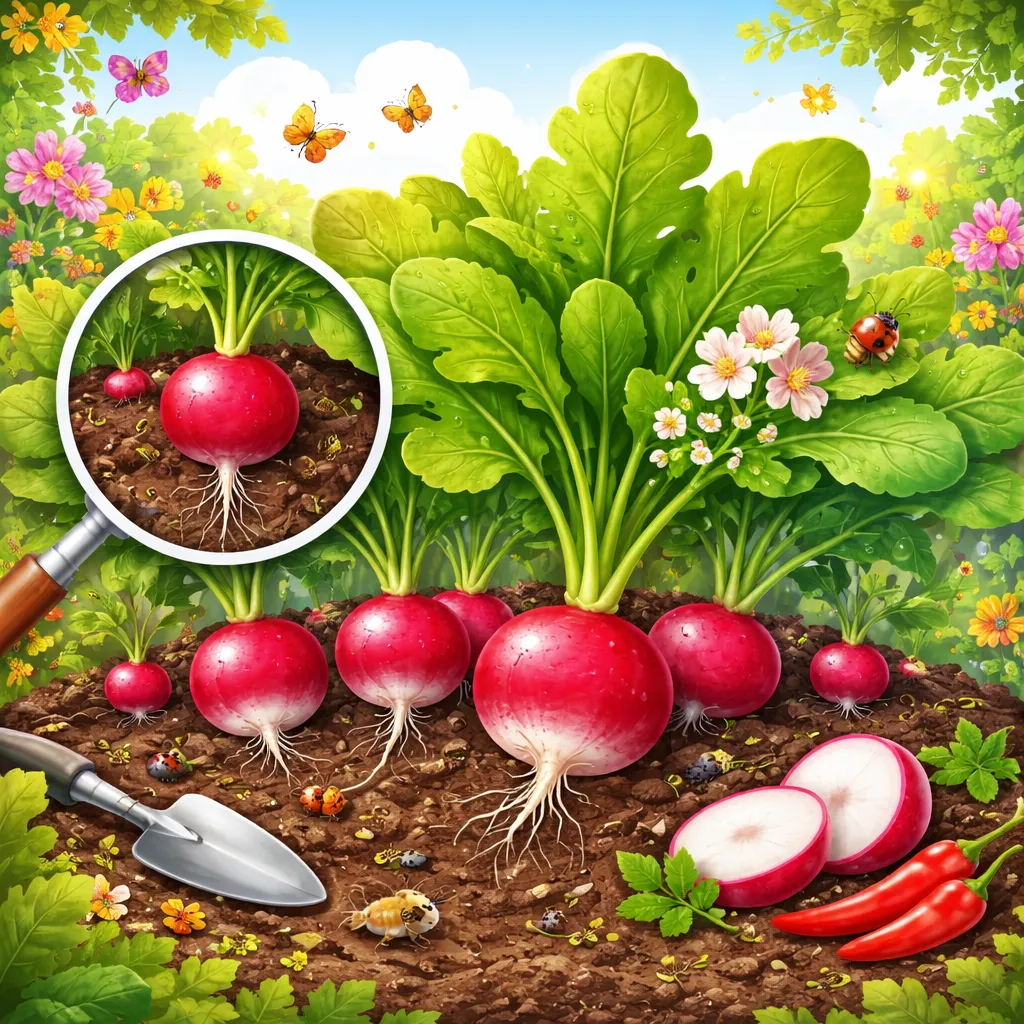

Have you ever planted a seed and wanted to see a result right away? What if you could plant a seed, and in just three or four weeks, pull a bright red, white, or purple vegetable from the soil? This amazing plant is the champion of speedy gardening. Its root is crunchy and has a spicy, peppery kick that makes salads exciting. It grows so fast you can almost watch it! Let’s discover the quick and zesty world of the Radish plant.
Let’s Learn the Word! – Open the Treasure Box of Language
Formal Name and Pronunciation
This speedy root is called a Radish. Its scientific name is Raphanus sativus. You can say it like this: /ˈræd.ɪʃ/ (RAD-ish). The “Rad” rhymes with “bad,” and “ish” is like the end of “finish.” Rad-ish. Say it: Radish. It’s a quick, snappy word.
The Etymology Tale
The word “Radish” is all about its root! It comes from the Latin word “radix,” which simply means “root.” Many languages have a similar word for it. Its scientific name Raphanus comes from a Greek word meaning “quickly appearing.” Its name perfectly describes it: a root that appears quickly!
Nicknames and Friendly Aliases
Radishes are often named for their speed and looks. They are called Spring Radishes for quick crops. The long, white winter type is a Daikon or Mooli. Small, round red ones are Cherry Belles or Breakfast Radishes. Because they grow so fast, gardeners sometimes call them the Quick Crop.
Building Your Word Web: Core Parts
Let’s learn the words for a Radish plant’s speedy body. The Taproot is the main, round or long root we eat. The Leaf is the green, lobed, and sometimes hairy top. The Shoulder is the top of the root that peeks above the soil. The Skin is the red, white, or purple outer layer. The Seed Pod is the long, thin fruit that forms if the plant flowers. A Bunch is many radishes tied together. A Row in the garden is a radish row.
Action and State Words
Radish plants are the fastest growers. You sow the seeds. The taproot swells rapidly. The leaves grow quickly. You thin the seedlings to give them space. The roots are harvested by pulling. They are sliced or eaten whole. A radish plant is crunchy, peppery, fast-maturing, and annual.
Ecosystem Friends Vocabulary
A radish patch is a simple garden helper. The quick-growing leaves can provide light shade for the soil, helping to keep it moist for other seeds. As they grow, they help break up the top layer of soil. If left to flower, the blooms can attract small bees and other pollinators. They are a friendly, undemanding neighbor.
Cultural Imprint in Language
Radishes are symbols of sharpness, quick results, and adding zest. In Mexico, there is a famous “Night of the Radishes” festival where people carve them into intricate sculptures! A saying among gardeners is, “If you want to encourage a child to garden, give them radish seeds,” because they grow so fast. The phrase “spicy as a radish” means something has a sharp, lively quality.
Ready for Discovery
We know its speedy, rooty name. Are you ready to be a garden scientist and discover the secret behind its spicy crunch? Let’s explore the quick secrets of the Radish plant.
Discover the Plant’s Secrets! – A Nature Detective’s Notebook
The Plant Passport
Radishes belong to the Brassicaceae family, the mustard and cabbage family. Its genus is Raphanus. It is an annual plant. The part we eat is the enlarged taproot. The leaves grow in a rosette. The flowers are usually white or pink. It grows best in cool spring or fall weather and loves loose, fertile soil. It is grown all over the world.
Survival Smarts
The radish’s superpower is speed. It germinates (sprouts) in just a few days and makes a harvestable root in weeks. This lets it complete its life cycle quickly in the short, cool seasons it prefers. Its peppery, spicy taste comes from natural chemicals called glucosinolates. In the wild, this sharp taste protects the root from being eaten by many insects and animals, at least until the plant is ready to make seeds.
Its Role and Gifts
In the garden, radishes are often used as a “cover crop” or “trap crop.” Their fast growth covers bare soil. Sometimes, they are planted to attract pests away from other vegetables. Their greatest gift is the root. Radishes add a crunchy, peppery bite to salads, sandwiches, and tacos. The young leaves are also edible. Daikon radishes are used in Asian cooking, often pickled or cooked.
Human History and Cultural Symbol
Radishes are one of the very first cultivated vegetables. They were grown in ancient Egypt before the pyramids were built! The Greeks and Romans prized them. They spread across Europe and Asia and were brought to the Americas by early colonists. Today, they are a global salad staple. They represent ancient agriculture, simplicity, and the instant gratification of gardening.
Fun “Wow!” Facts
Get ready for a space fact! Radishes were chosen to be grown on the International Space Station because they grow so fast and are nutritious! Astronauts harvested the first space radishes in 2020. And here’s a family fact: Radishes are cousins to broccoli, kale, and mustard greens. That’s why their leaves look a bit similar!
From Seed to Crunch in Weeks
The story of the Radish plant is the story of speed. Would you like to grow your own almost-instant crop? You can grow radishes easily in a pot or garden! Let’s see how.
Let’s Grow It Together! – A Little Guardian’s Action Guide
Good for Home Growing?
Perfect! Radishes are the #1 best vegetable for a first-time young gardener. They grow in tiny spaces. You can grow a whole crop in a small, shallow pot on a windowsill, balcony, or step. You will see results faster than any other plant. It’s the definition of garden success.
Little Gardener’s Toolkit
You will need a packet of radish seeds (try ‘Cherry Belle’ or ‘Easter Egg’ mix). Get a wide, shallow pot or window box with drainage holes. Use regular potting soil. Have a watering can, a sunny spot, and your quickest patience ready.
Step-by-Step Growing Guide
Planting Your Speedy Friend
You can plant radish seeds from early spring to fall. They like cool weather. Scatter the seeds on the soil. Cover them with about half an inch of soil. Gently pat the soil and water well. Place the pot in a spot that gets at least 6 hours of sun. You can plant new seeds every two weeks for a continuous harvest.
Care Calendar
Keep the soil moist, not soggy, until the seeds sprout. Once they are growing, water regularly. They love sun. You don’t need to fertilize. The most important job is thinning. When the seedlings are about an inch tall, gently pull out the extra plants so the remaining radishes are about 2 inches apart. This gives the roots room to get round and fat.
Watch and Be Friends
Watch for the first green leaves in just 3-5 days! The plants will grow quickly. In about a week, you must thin them. In two weeks, you might see the colorful shoulder of the root peeking above the soil. In three to four weeks, gently pull one up to check its size. If it’s as big as a marble or a golf ball, it’s ready! Rinse it off and taste your super-fast harvest.
Problem Diagnosis
If the plant makes lots of leaves but a tiny root, the seeds were too crowded—thin them better next time. If the root is tough and too spicy, it was left in the ground too long; harvest earlier. Flea beetles might make tiny holes in leaves; they rarely hurt the root. The most common problem is forgetting to thin the seedlings.
Your Rewards and Gifts
Your gift is the speed of success. You are learning about seed growth, plant care, and the joy of quick results. Caring for radishes teaches daily observation, gentle hands for thinning, and the immediate reward of eating what you grow. You become a grower of instant gratification.
Creative Fun
Start a Speed Garden Journal. Draw your radishes the day they sprout and each week after. Have a “Radish Race” with a friend to see whose grows biggest fastest. Make radish prints by cutting a radish in half, carving a simple shape, dipping it in paint, and stamping. With an adult, make a simple radish and butter sandwich (a French treat!). Research the “Night of the Radishes” festival and design your own radish sculpture with play dough. Write a very short story about “The Radish That Grew Too Fast.”
Growing a Pot of Quick Crunch
By planting radishes, you are not just growing a vegetable. You are growing a lesson in life cycles, a boost of gardening confidence, and a tasty, spicy snack. You are a cultivator of speed and fun.
Conclusion and Forever Curiosity
What a quick, crunchy, and peppery journey from seed to salad! You started to learn about the Radish plant, you discovered its secrets as the glucosinolate-packed, speed-growing sprinter of the vegetable world, and you learned how to grow your own crop in record time. You now know the Radish plant is not just a garnish; it is a lesson in botanical speed, a chemical defender, a piece of ancient farming history, and a symbol of instant garden joy. Remember, its power is in its incredible speed and its sharp, lively flavor. Your curiosity helps you appreciate the fast and simple wonders of nature. Keep planting seeds of all kinds, watching for quick changes, and tasting the sharp, fresh rewards of your care. Your adventure to learn about the Radish plant shows us that sometimes, the most satisfying discoveries are the ones that happen almost overnight.