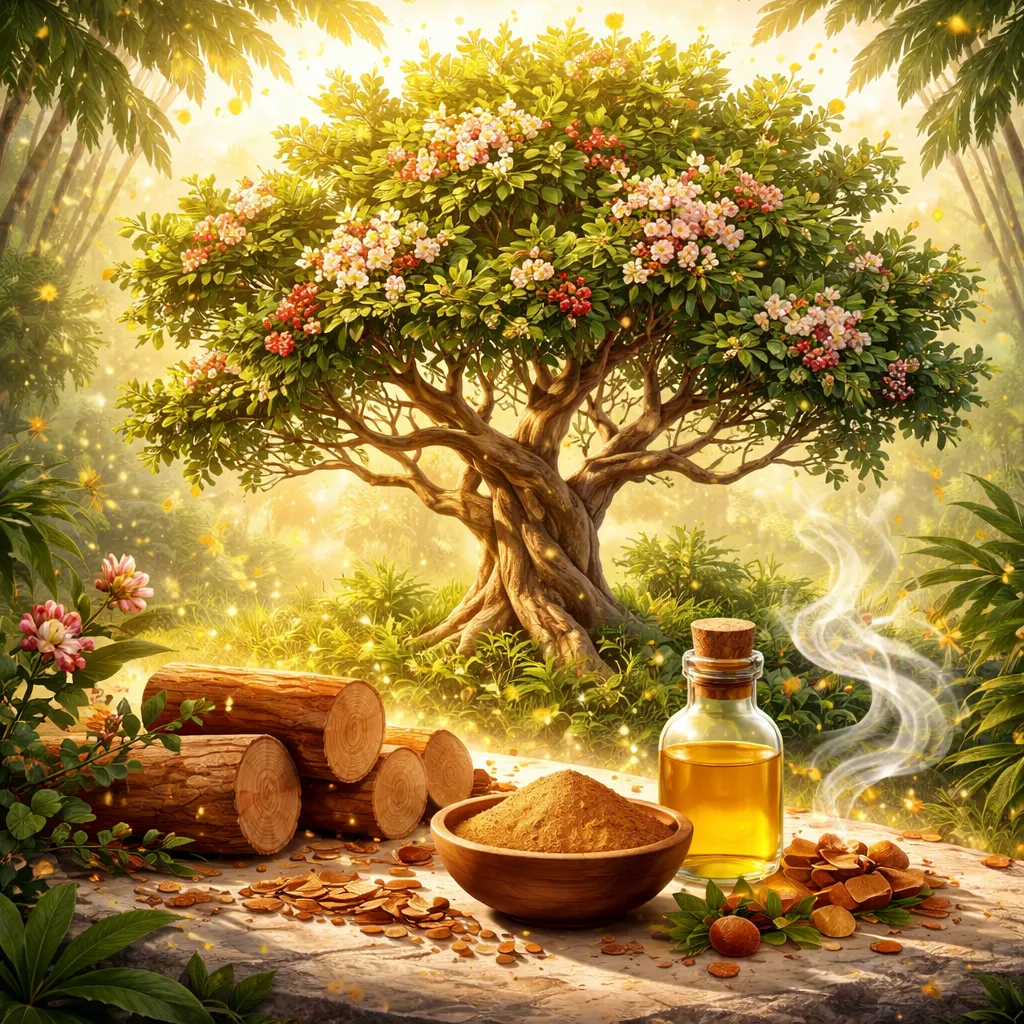

Have you ever smelled a piece of wood that fills the air with a warm, sweet, and deeply calming scent? This precious aroma is one of the oldest and most beloved in the world. It comes from the very heart of a very special tree. This tree is not tall and mighty like an oak, and its flowers are not very showy. Its secret treasure is hidden deep inside its trunk. For thousands of years, people have treasured this fragrant wood for meditation, medicine, and beautiful carvings. Let’s go on a fragrant journey to learn about the precious Sandalwood plant.
Let’s Learn the Word! – Open the Treasure Box of Language
Formal Name and Pronunciation This fragrant treasure is called Sandalwood. Its scientific name is Santalum album. You can say it like this: /ˈsæn.dəl.wʊd/ (SAN-dul-wood). The first part, “San,” rhymes with “fan,” and “dal” rhymes with “pal.” Sandal-wood. Say it slowly: Sandalwood. It’s a smooth, whispering word.
The Etymology Tale The word “Sandalwood” has traveled a long, fragrant path. It comes from the ancient Sanskrit word “chandana,” which means “wood for burning incense.” Over centuries, traders carried the wood and its name along the spice routes. The word passed through Persian, Greek, and Arabic before becoming “sandal” in English. The “wood” part was added to make it clear. Its name tells the story of its most ancient use: as incense.
Nicknames and Friendly Aliases Sandalwood is known by names that reflect its origin and quality. The most famous type is Indian Sandalwood or White Sandalwood (Santalum album). Another type is Australian Sandalwood (Santalum spicatum). Because of its creamy yellow heartwood, it is sometimes called Chandana (its Sanskrit name) or Yellow Sanders. In some cultures, it is poetically called the Perfume Tree.
Building Your Word Web: Core Parts Let’s learn the words for Sandalwood’s precious body. The Heartwood is the superstar. It is the dense, yellow-brown center of the trunk, packed with fragrant oil. The Sapwood is the pale, outer wood that has little scent. The Leaf is thin, oval, and gray-green, looking a bit like a willow leaf. The Root is special because it has haustoria, tiny structures that connect to other plants’ roots to sip water and food. The Flower is small, with a star-like shape, and can be yellow, red, or purple. The Berry is a small, dark fruit that birds love. A Sapling is a young sandalwood tree, which needs a special friend to grow.
Action and State Words Sandalwood has a unique way of living. It is a root parasite or hemiparasite. This means its roots connect to the roots of other plants, called host plants, to take some water and nutrients. The tree grows slowly, taking many years to develop its precious heartwood. It releases its fragrance for decades, even after being cut. Sandalwood is fragrant, slow-growing, precious, and dependent.
Ecosystem Friends Vocabulary The sandalwood tree is part of a quiet partnership. It needs host plants like certain grasses, shrubs, or trees (e.g., Acacia or Casuarina) to survive when young. Birds and bats eat its berries and help spread its seeds. Insects pollinate its small flowers. In a healthy forest, it lives in balance, taking a little but not harming its host. It teaches us about connection and sharing in nature.
Cultural Imprint in Language Sandalwood is deeply sacred in many cultures. In Hindu traditions, a paste made from sandalwood is used in religious ceremonies, and it is said, “Chandanam shitalam chaiva” – meaning “Sandalwood is cooling and pure.” In ancient Sanskrit poetry, the fragrance of sandalwood is often used to describe something supremely beautiful and soothing. The tree symbolizes purity, spirituality, and devotion. Its scent is the smell of temples and peace.
Ready for Discovery We know its name and its special way of life. Are you ready to uncover the secrets of this fragrant, friendly parasite? Let’s put on our detective hats and explore the world of the Sandalwood plant.
Discover the Plant’s Secrets! – A Nature Detective’s Notebook
The Plant Passport Sandalwood belongs to the Santalaceae family. Its group name is Santalum. It is a small to medium-sized evergreen tree, often looking slender and graceful, not giant and grand. Its leaves are thin, opposite, and have a grayish-green color. Its flowers are tiny, tubular, and grow in clusters. The fruit is a small, dark drupe. The tree grows very slowly, and it may take 15 to 20 years for the fragrant heartwood to develop well. It is an evergreen, keeping its leaves all year in its warm, native home.
Survival Smarts Sandalwood’s most amazing secret is that it is a hemiparasite. Its own roots are not strong enough to get all the water and food it needs. So, when it is a young seedling, its roots must find and gently latch onto the roots of a nearby “host” plant. It then shares some nutrients. This lets the sandalwood save energy to make its wonderful fragrant oil instead of growing a huge root system. Another trick is its oil. The sandalwood oil in the heartwood may help protect the tree from fungi and insects.
Its Role and Gifts In its native dry forests of India and Southeast Asia, sandalwood is a part of the ecosystem. Its berries feed birds. It provides light shade. Its most famous gift is to people. For over 4000 years, its heartwood has been valued as the finest natural perfume, a sacred incense, a carving wood, and a source of soothing oil for skin and mind. It is a living treasure that has connected cultures through trade and spirituality.
Human History and Cultural Symbol Sandalwood has a history as rich as its scent. It was a major item on the ancient Silk Road, traded from India to China, the Middle East, and Europe. In Egypt, it was used in embalming. In China, it was carved into intricate boxes and fans. In Hawaii, a related sandalwood (ʻiliahi) was so valuable that it led to a period called the “Sandalwood Era.” It represents luxury, spirituality, and the deep connections between different parts of the world.
Fun “Wow!” Facts Get ready for a patience-testing fact! A sandalwood tree must be at least 15 to 20 years old before its heartwood is rich enough in oil to be harvested for its best fragrance. You have to wait almost as long as you’ve been alive! And here’s a cool one: the fragrant oil doesn’t just sit in the wood; it is released slowly over time, which is why a sandalwood carving or bead can smell wonderful for decades, even centuries.
From Ancient Trade to Tender Care The Sandalwood plant’s story is one of global connection. Would you like to try caring for a piece of this living history? Growing it is a special challenge that teaches us about partnership. Let’s see how.
Let’s Grow It Together! – A Little Guardian’s Action Guide
Good for Home Growing? It is a very challenging and long-term project, mostly for warm, dry climates. You cannot grow it in a pot on a windowsill forever. It needs a large pot or, better, a garden in a warm, frost-free place. Most importantly, it needs a host plant growing right next to it. This is a project for a very patient and curious gardener, perhaps with the help of a botanical garden expert.
Little Gardener’s Toolkit You will need fresh sandalwood seeds (berries cleaned of pulp) from a specialty supplier. You will need seeds or a small plant of a host species, like an acacia or a hardy shrub. Get two large, deep pots or prepare a garden spot. Use a sandy, well-draining potting mix. Have a watering can and a lot of patience ready.
Step-by-Step Growing Guide
Planting Your Fragrant Partnership First, plant your host plant. Let it grow for a few months to get strong. Then, plant the sandalwood seed about half an inch deep in a pot next to the host plant’s pot, or in the same large pot/garden bed, very close by. Water gently. The sandalwood root must find the host root on its own. This is a mystery waiting to happen!
Care Calendar Keep the soil slightly dry rather than wet. Sandalwood hates soggy roots. Both plants need full sunshine. Do not over-fertilize; this is a natural partnership. The sandalwood will grow very, very slowly. Your main job is to make sure the host plant is healthy, as it is feeding your sandalwood friend.
Watch and Be Friends This is a lesson in slow, secret growth. You won’t see the most important action—the root handshake underground! Watch for the sandalwood’s first leaves. Notice if it seems healthy and green. Measure its height every six months, not every week. The greatest excitement is knowing a hidden partnership is at work.
Problem Diagnosis If the sandalwood leaves turn yellow, it might not have successfully connected to a host, or the host might be unhealthy. Try planting a new, vigorous host plant nearby. If growth stops completely, the soil might be too rich or wet. Remember, this tree thrives on a little hardship. Patience is the key.
Your Rewards and Gifts Your gift is witnessing one of nature’s most fascinating relationships. You are growing a tree that teaches interdependence, patience, and the value of hidden treasures. Caring for sandalwood teaches you that the best things often need time, partnership, and a little help from friends. You learn to be a facilitator of nature’s own partnerships.
Creative Fun Start a Partnership Garden Journal. Draw both the sandalwood and its host plant. Write a story from the perspective of the roots meeting underground. Make a simple incense from store-bought sandalwood powder (with adult supervision) to smell its ancient fragrance. Draw a map of the ancient world and trace how sandalwood might have traveled. Create a “scent memory” box by placing a small piece of sandalwood in a box with other natural treasures.
Cultivating Connection By trying to grow sandalwood, you are not just planting a tree. You are nurturing a relationship, understanding a delicate balance, and becoming a guardian of a rare and precious form of natural perfume. You are a grower of connections.
Conclusion and Forever Curiosity What an incredible journey of scent and symbiosis! You started by learning the word “Sandalwood,” you discovered its secrets as a fragrant, friendly parasite, and you learned about the patience and partnership needed to grow it. You now know the Sandalwood is not just a smelly tree; it is a symbol of spiritual connection, a lesson in ecological sharing, a piece of living history, and a treasure that grows in partnership. Remember, its true value is hidden, developing slowly with the help of others. Your curiosity helps you appreciate the invisible networks that make our world wonderful. Keep following your nose to wonderful scents, looking for the hidden partnerships in nature, and wondering about the slow, precious gifts the earth provides. Your adventure to learn about the Sandalwood plant shows us that the sweetest things in life are often the result of patience, care, and connection.