
Opening Introduction
Max has a big plastic box. He looks inside. It is full of dried beans! They are smooth and shiny. He puts his hands in. The beans feel funny. They make a soft, rustling sound. "This is fun!" Max says. He finds a small toy car hiding in the beans. Then he finds a shiny button.
His sister, Lily, comes over. "What are you playing?" she asks. "It's my secret treasure box," Max says. Mom smiles. She has an idea to make it even better. "This is a sensory bin," she says. "You feel, see, and hear things inside. We can use it to learn English words. We need to make special signs for it. We need DIY sensory bin labels for English." Max and Lily are excited. Labels are like name tags for all the treasures. Let's discover how to make them.
Core Knowledge Explanation
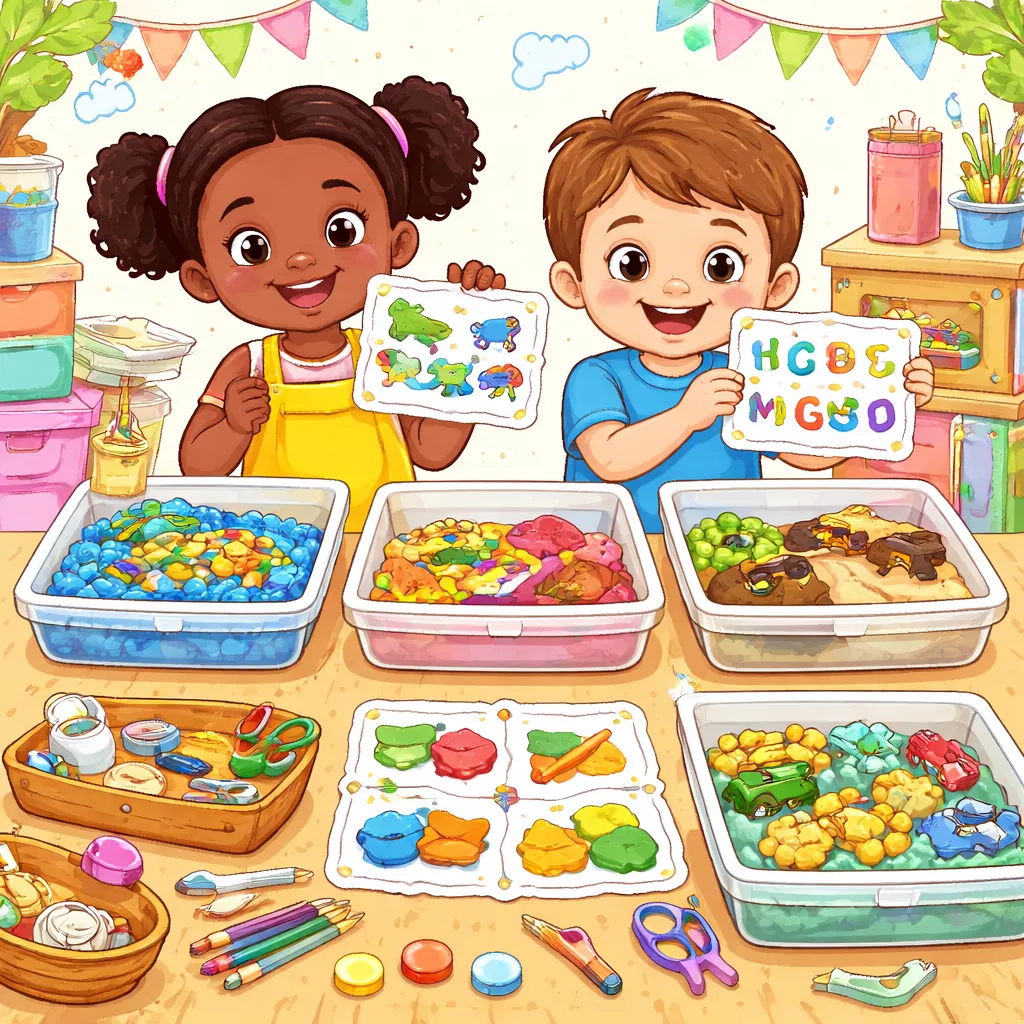
What is a sensory bin? A 'sensory' bin is a special box. 'Sensory' means it is about your senses. You have five senses. You see with your eyes. You hear with your ears. You touch with your hands. You smell with your nose. You taste with your mouth. A sensory bin is for touching, seeing, and hearing. It is filled with different materials. You can have rice, pasta, sand, or water beads in it. You can hide small toys inside. It is wonderful for play.
Now, what are labels? Labels are small signs. They give information. On a jar of jam, the label says "STRAWBERRY JAM". It tells you what is inside. Our DIY sensory bin labels for English are like that. But we make them ourselves. DIY means "Do It Yourself". We do not buy them from a store. We create them. We make labels for the things in our sensory bin. The labels have English words on them.
Why are these labels so good for learning? They connect a word to a real thing. You do not just read the word "SMOOTH". You touch a smooth stone in the bin. Your hand feels it. Your brain remembers it. The word "SMOOTH" has meaning now. It is not just letters on paper. It is a feeling. This helps you remember English words much better. It is a powerful way to learn.
Let's think about what we can label. We can label the materials. Materials are what you fill the bin with. For example, you can have a bin of "DRY RICE". You make a label that says DRY RICE. You can have a bin of "KINETIC SAND". You make a label for that. We can also label the hidden objects. What did you hide in the rice? You hid a "SMALL CAR". You hid a "RED BUTTON". You hid a "FEATHER". You make a label for each thing. This is your vocabulary list.
We can also label the properties. Properties are describing words. How do things feel? Some things are "SOFT". Some things are "HARD". Some are "BUMPY". Some are "SMOOTH". You can make feeling labels. Put a soft cotton ball in the bin. The label says SOFT. Put a rough pinecone in the bin. The label says BUMPY. This teaches you wonderful adjectives. Adjectives are describing words.
Your DIY sensory bin labels for English are your teachers. You play in the bin. You find a toy. You match it to the correct label. You say the word out loud. "I found the SPOON. The spoon is METAL. Metal feels COLD." You are speaking in full sentences. You are learning many words together. It is a game of discovery.
How do you make a label? It is simple. You need some cardstock paper. Cardstock is thick paper. You also need scissors, glue, and markers. You can also use popsicle sticks. First, cut the paper into small rectangles. These are your labels. Make them big enough to write on. Then, think of the word you want. Let's do the word "FEATHER". Write the word in big, clear letters. F-E-A-T-H-E-R. You can draw a small picture of a feather next to it. This helps you remember.
Now, you need to make it strong. You can stick your paper label onto a popsicle stick. The stick helps it stand up in the bin. You can also cover it with clear tape. This makes it waterproof. Now your label is ready. Put it next to the feather in your sensory bin. Every time you see the feather, you see the word. Your brain makes the connection. This is the magic of DIY sensory bin labels for English. You build your own learning world.
Fun Interactive Learning
Let's make a sensory bin together. First, find a big plastic container. A shallow, wide box is perfect. Now, choose your material. Let's use dry, uncooked pasta. Macaroni or penne pasta works well. Pour the pasta into the bin. It makes a fun sound. Now, find small objects to hide. Look around your house. Find a "BUTTON", a "COIN", a "LEGO" brick, a "MARBLE", a "RUBBER BAND", and a "POMPOM". A pompom is a soft, fuzzy ball.
Now, let's make our DIY sensory bin labels for English. Get your supplies. Cut six small rectangles. On the first, write "BUTTON". Draw a button. On the second, write "COIN". Draw a circle. On the third, write "LEGO". You can draw a simple brick. On the fourth, write "MARBLE". Draw a small circle. On the fifth, write "RUBBER BAND". Draw a wiggly line. On the sixth, write "POMPOM". Draw a fluffy ball. Stick each label on a popsicle stick. Great. Your labels are ready.
Hide all the small objects in the pasta. Bury them deep. Now, stick the labels in the pasta. Put them in a row on one side of the bin. Do not put them next to the matching object. Mix them up. Your job is to find each object and match it to its label. Put your hands in the pasta. Feel around. Say what you feel. "I feel something hard and round. Is it the marble? No, it's the coin!" Find the coin. Pick it up. Now look at your labels. Find the label that says "COIN". Put the coin next to that label. Keep going until all objects are found and matched.
We can play another game. This time, make feeling labels. Make labels that say "SMOOTH", "BUMPY", "HARD", "SOFT", "ROUND", and "SQUARE". Find objects in your house that match these feelings. A spoon is smooth and hard. A pinecone is bumpy. A cotton ball is soft. Put all these objects in an empty bin. No pasta this time. Mix the feeling labels. Pick a label. Let's pick "BUMPY". Now, with your eyes closed, put your hand in the bin. Find something that feels bumpy. Pull it out. Is it the pinecone? Yes. Say, "The pinecone is BUMPY." This game is wonderful for your sense of touch and your English words.
Expanded Learning
Our senses are amazing. They help us understand the world. Long ago, before people had books, they learned with their senses. They touched plants to know them. They listened to animal sounds. They tasted berries to see if they were good. Learning with your senses is a very old and smart way to learn. Your sensory bin is a little world for your senses. It helps your brain grow strong.
Words for feelings and textures are very important in every language. In English, we say "soft". In Spanish, people say "suave". In French, people say "doux". The feeling is the same, but the word is different. Your DIY sensory bin labels for English help you learn the English word for that universal feeling. When you know these words, you can describe anything. You can tell a friend, "This blanket is very soft." Your friend will understand perfectly.
Let's make a simple song about our sensory bin. Songs make words stick in our heads. Sing this to the tune of "The Wheels on the Bus".
The things inside my sensory bin, sensory bin, sensory bin. The things inside my sensory bin, have names and feels, you see! The button in the bin is round and smooth, round and smooth, round and smooth. The button in the bin is round and smooth. That's what I feel today! The pompom in the bin is soft and light, soft and light, soft and light. The pompom in the bin is soft and light. Those are the words I say!
You can make a new verse for every object you find. Singing helps you remember the words and how to describe them. It is a happy way to learn.
What You Will Learn
You are learning so many wonderful things. You are learning object words. Words like button, coin, lego, marble, rubber band, pompom, feather, spoon, stone. You are learning material words. Words like rice, pasta, sand, beans, water. You are learning describing words, or adjectives. Words like smooth, rough, bumpy, soft, hard, round, square, cold, warm, shiny, fuzzy.
You are learning useful sentences. You are learning to say what you feel. "It feels bumpy." "This is very soft." You are learning to say what you find. "I found a red button." "I see a shiny coin." You are learning to ask questions. "What does this feel like?" "Can you find the smooth one?" Your speaking is becoming strong and clear.
You are building important skills. You are building fine motor skills. Fine motor skills are about using the small muscles in your hands. You pick up tiny objects. You write labels. You are building cognitive skills. Cognitive means thinking. You are sorting, matching, and categorizing. You are building your vocabulary. Every new word is a new tool for your mind.
You are forming a fantastic habit. The habit is mindful exploration. Mindful means you pay close attention. You do not just play. You notice. You feel the texture. You say the word. You connect the word to the feeling. This habit makes you a great scientist and a great writer. Scientists observe the world. Writers describe the world. You are learning to do both.
Using What You Learned in Life
You can use your new words everywhere. In the kitchen, help with cooking. Touch the flour. Say, "The flour is soft and powdery." Touch the apple. Say, "The apple's skin is smooth." You are using your DIY sensory bin labels for English skills in real life. The kitchen is a big sensory bin.
At the park, explore nature. Find a leaf. How does it feel? "The leaf is dry and crispy." Find a pinecone. "The pinecone is prickly and hard." Find some grass. "The grass is soft and wet." You are labeling the world around you. You are a nature explorer with words.
In your bedroom, organize your toys. Make little labels for your toy boxes. The car box gets a label that says "CARS". The animal box gets a label that says "STUFFED ANIMALS". The building block box gets a label that says "BLOCKS". This is just like your sensory bin. You are sorting and using English words. It makes cleaning up a fun game.
With friends, play a "Mystery Box" game. Get a small box. Cut a hole in the side. Put an object inside. Do not let your friend see it. Your friend puts a hand in the hole. They must feel the object. They must describe it in English. "It is small. It is metal. It is round. It has bumps on the side." Is it a coin? Yes. You are playing a guessing game with your new describing words. It is so much fun.
Closing Encouragement
You did an incredible job today. You built a world of feeling and words. You are a creator. You made your own labels. You are an explorer. You discovered hidden treasures. You are a scientist. You learned new describing words. I am so very proud of you. Your sensory bin is a magical place for learning.
Keep your labels. Use them again. Make new labels for new themes. Make a "Nature" bin with leaves and sticks. Make an "Ocean" bin with blue water beads and shells. Your learning never has to stop. Every time you play, you learn more English. You make more connections.
Remember, the whole world is a sensory bin. Everything you touch, see, and hear has a name in English. Now you know how to find those names. Now you know how to label them. Keep exploring. Keep feeling. Keep naming. You are a wonderful word collector. Great work, my smart sensory scientist.