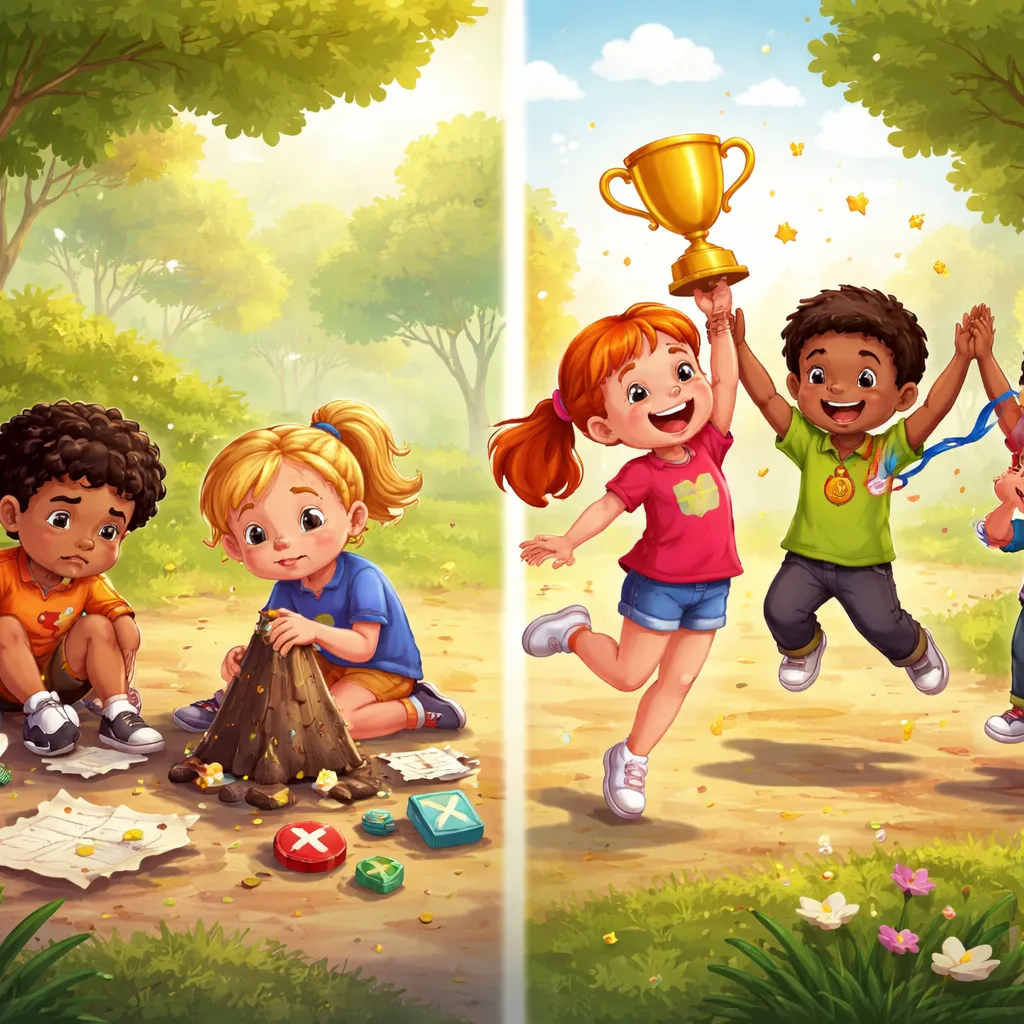

Hello, word explorer! Have you ever not found something you were looking for? Or tried to do something that didn't work out? How do you talk about that? Did you lose your toy? Or did you fail to build the model? They both seem to mean not getting what you wanted. But are they the same? They are like two different kinds of "not getting." One is about something you had slipping away. One is about a goal you couldn't reach. Let's find out! Today, we explore the word friends "lose" and "fail". Knowing their secret is a superpower. It makes you strong and clear about setbacks. Let's start our thoughtful adventure!
First, let's be Setback Detectives. Listen at home. Here are two sentences. "I hope I don't lose my lucky marble in the grass." "I might fail to catch the ball if I don't keep my eyes on it." They both talk about unwanted results. A marble. Catching a ball. Do they sound the same? One feels like something you own is gone. One feels like an action didn't work. Can you sense it? Great observation! Now, let's look at the situation.
Adventure! Inside the World of Setbacks
Welcome to the world of setbacks! "Lose" and "fail" are two different stories. Think of "lose" as a story about a dropped coin. You had it, and now it's gone. Think of "fail" as a story about a rocket that didn't launch. The goal was not reached. Both are about not having a happy ending. But they tell different sad tales. Let's learn about each story.
The Dropped Coin vs. The Rocket That Didn't Launch Think about the word "lose". "Lose" feels like a dropped coin. It means to no longer have something you once had, or to not win. The focus is on something gone or a defeat. I lose my way. Our team might lose the match. Don't lose hope. It is about loss. Now, think about "fail". "Fail" feels like a rocket that didn't launch. It means to not succeed in doing or achieving something. The focus is on an action that didn't work. I fail a test. The engine failed. Words fail me. "Lose" is the dropped coin. "Fail" is the grounded rocket. One is about possession. The other is about performance.
Something Gone vs. A Goal Not Reached Let's compare their focus. "Lose" is about something moving away from you. You can lose a game (you had a chance to win), lose your keys (you had them), or lose a friend (you had the friendship). "Fail" is about an action not meeting a standard or expectation. You can fail to understand, a plan can fail, or a light can fail to turn on. "Lose" is about what you had. "Fail" is about what you tried to do. One is a loss. The other is a lack of success.
Their Special Word Partners and Common Contexts Words have best friends. "Lose" loves to team up with things and contests. Lose your temper. Lose touch. Lose your place. It is about no longer having. "Fail" has its own special teams about attempts and standards. Fail to see. Fail safe. Without fail. Note: We say "lose a game". We say "fail a test". They are different.
Let's visit a school scene. You are in a race on Sports Day. You trip and come last. You lose the race. This is about not winning the competition. You study for a math quiz but get most answers wrong. You fail the quiz. This is about not meeting the passing standard. Using "fail" for the race is not quite right because a race is about winning/losing, not passing/failing. Using "lose" for the quiz is okay, but "fail" is the precise word for a test.
Now, let's go to the playground. Your favorite toy car rolls into a storm drain. You lose it forever. It is gone. You try to do a handstand. You fall over every time. You fail to do a handstand. The action didn't work. The word "lose" paints the disappearance of the toy. The word "fail" paints the unsuccessful attempt at the handstand.
Our Little Discovery So, what did we find? "Lose" and "fail" are both about unwanted outcomes. But they are very different. "Lose" means to no longer have something or to be defeated in a contest. "Fail" means to not succeed in doing or achieving something. You can lose a sock. You can fail to tie your shoe. Knowing this helps you understand and explain setbacks clearly.
Challenge! Become a Resilience Word Champion
Ready for a thoughtful test? Let's try your new skills!
"The Best Choice" Challenge Let's imagine a nature scene. A young bird is learning to fly. It jumps from the nest but doesn't flap in time. It falls to the ground. The bird did not fail to fly; it just hadn't learned yet. But let's adjust: The bird's first attempt to fly was unsuccessful. The bird failed in its first attempt to fly. Now, imagine a squirrel hiding a nut. It forgets where. The squirrel has lost the nut. The nut is gone from its memory. "Fail" wins for the bird's unsuccessful flight attempt. "Lose" is the champion for the squirrel's forgotten nut.
"My Sentence Show" Your turn to create! Here is your scene: Practicing a musical instrument for a recital. Can you make two sentences? Use "lose" in one. Use "fail" in the other. Try it! Here is an example: "I hope I don't lose my place in the music sheet during the performance." This is about no longer knowing where you are. "I worry I might fail to hit the high note correctly." This is about not succeeding in an action. Your sentences will show two kinds of worries!
"Eagle Eyes" Search Look at this sentence. Can you find the word that could be better? Let's check a school context. "I was so nervous that I failed my place in the speech and had to start over." Hmm. The problem is about no longer knowing your place in the speech, not about not succeeding in an action. The word "lost" is the correct choice for this. "I was so nervous that I lost my place in the speech and had to start over." "Failed" would mean you didn't succeed in having a place, which doesn't make sense. Did you spot it? Excellent and thoughtful word work!
Harvest and Action! Turn Knowledge Into Your Superpower
Great exploring! We started thinking "lose" and "fail" were the same. Now we know they are two different stories. We can understand the story of the dropped coin with "lose". We can understand the story of the grounded rocket with "fail". You can now talk about challenges with perfect accuracy. This is a great skill for a strong heart.
What you can learn from this article: You can now feel that "lose" is about no longer having something you once had, or about being defeated in a game or contest. You can feel that "fail" is about not succeeding in doing, achieving, or passing something, like a test or a goal. You know that you can "lose" a tooth, but you might "fail" a spelling test. You learned to match the word to the problem: "lose" for something gone or a defeat, "fail" for an unsuccessful action.
Life practice application: Try your new skill today! If you can't find a book, you might have lost it. If you try to ride a bike and fall, you did not fail; you just haven't succeeded yet. Be kind to yourself. Tell a friend about a time you lost something. Tell them about a time you failed at something but learned. You are now a master of resilience words! Ke