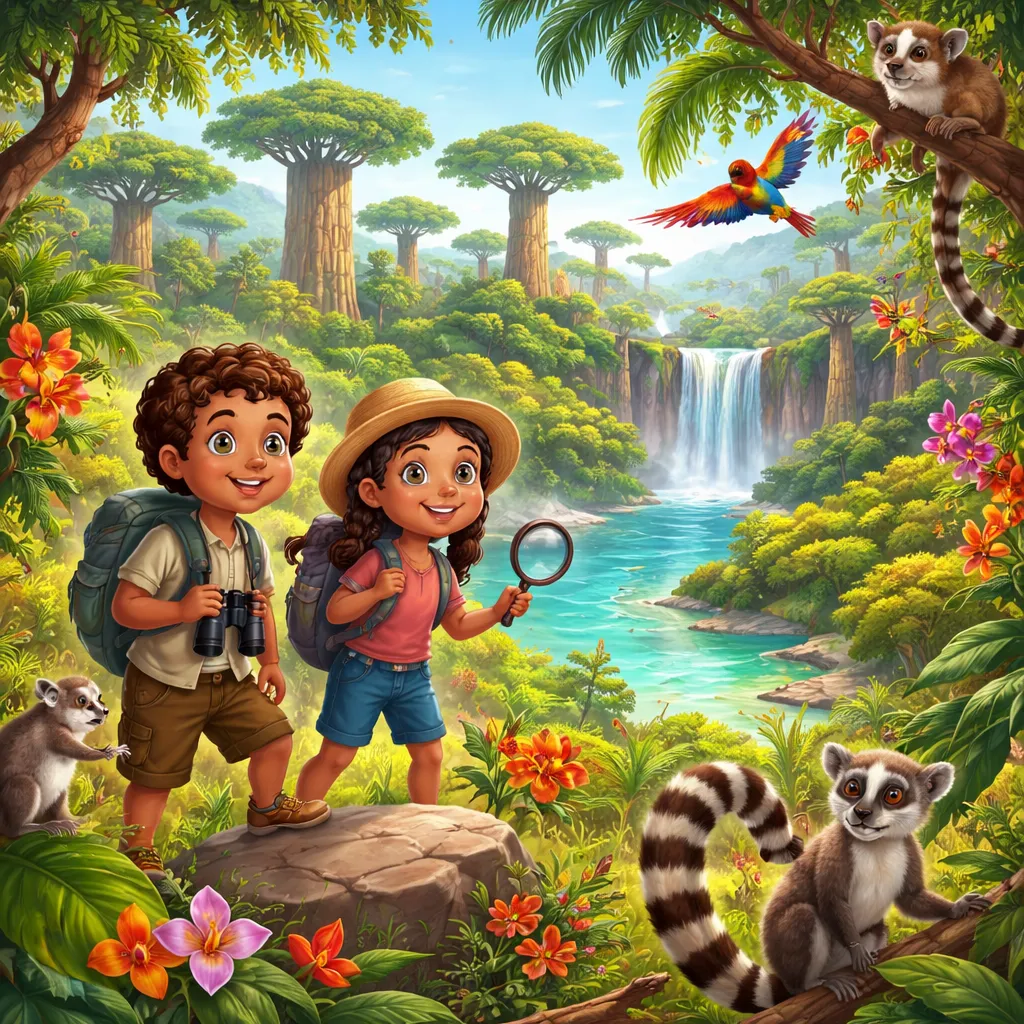

Introduction to Madagascar
Language learning opens doors to places filled with wonder. Today we travel to an island like no other on Earth. This land holds animals and plants found nowhere else. Children will discover a world of lemurs, baobab trees, and colorful chameleons. Exploring Madagascar builds reading skills while feeding curiosity. Every fact reveals something extraordinary. Every word takes them deeper into a unique natural world. Let us begin this remarkable journey together.
Where Is Madagascar?
Madagascar lies in the Indian Ocean off the southeastern coast of Africa. The Mozambique Channel separates it from the African mainland. This large island ranks as the fourth largest island in the world. It stretches over one thousand miles from north to south. The capital city is Antananarivo. People often call it Tana for short. The country has coastlines on both the eastern and western sides. Mountains run down the center of the island. Rainforests cover the eastern slopes. Dry forests and spiny deserts cover the south and west. Finding Madagascar on a map shows its isolation. It drifted away from Africa millions of years ago. That separation allowed unique life to develop. Understanding this geography helps young readers appreciate why Madagascar holds such special creatures.
Interesting Facts About Madagascar
Madagascar offers an astonishing number of fascinating facts. Over ninety percent of its wildlife lives nowhere else on Earth. Lemurs represent the most famous animals. More than one hundred species of lemurs exist only here. Another interesting fact involves the baobab tree. Madagascar has six species of baobabs. These massive trees store water in their thick trunks. Some baobabs live for over one thousand years. The Avenue of the Baobabs shows these giants lined up along a dirt road.
Madagascar also has unique chameleons. The smallest chameleon in the world lives here. It can sit on a matchstick. The country also produces most of the world's vanilla. Farmers hand-pollinate vanilla orchids to create this special flavor. Another fun fact involves the fossa. This cat-like animal is the largest predator on the island. It hunts lemurs in the forests. Madagascar also has spiny forests. Plants there grow sharp spines to protect themselves from animals. These facts show children a land where evolution created its own rules.
Key Vocabulary About Madagascar
Let us build vocabulary for this extraordinary island. These words help children describe what they learn.
Lemur: a primate with large eyes and a long tail, found only in Madagascar.
Baobab: a large tree with a thick trunk that stores water.
Chameleon: a lizard that can change the color of its skin.
Rainforest: a dense forest with high rainfall and many plants.
Vanilla: a flavoring from the pods of a climbing orchid.
Island: land surrounded by water on all sides.
Endemic: native to a particular place and found nowhere else. Introduce these words with pictures and videos. Show lemurs leaping through trees. Show baobabs standing tall against the sky. Let children say each word aloud. These vocabulary words give children the language to explore this unique world.
Simple Sentences for Reading Practice
Short sentences help new readers build confidence. Use these sentences about Madagascar for practice.
Madagascar is a large island near Africa.
The capital city is Antananarivo.
Lemurs live only in Madagascar.
Baobab trees have very thick trunks.
Chameleons can change their color.
Rainforests cover part of the island.
Vanilla grows on farms in Madagascar. Read each sentence together. Let children point to the words. Encourage them to repeat after you. Use pictures to show each fact. These simple sentences prepare young readers for longer passages.
Short Reading Passage About Madagascar
Here is a short passage for children to read together.
“Madagascar sits in the Indian Ocean, separated from Africa by water. Millions of years ago, this island drifted away from the mainland. Animals and plants evolved in isolation. That is why so many creatures live only here. Lemurs swing through the trees. Some lemurs are as small as a mouse. Others leap great distances between branches. The baobab tree grows in the dry regions. Its thick trunk stores water during the dry season. Some baobabs are over one thousand years old. In the rainforests, tiny chameleons creep along leaves. They change color to blend in. Farmers in Madagascar grow vanilla. They carefully pollinate each flower by hand. The spiny forest holds plants with sharp thorns. This strange forest looks like something from another planet. Madagascar offers a world of wonder.”
Read this passage slowly together. Pause to talk about each idea. Ask children to find vocabulary words in the text. This activity builds reading fluency and deepens understanding.
Fun Questions About Madagascar
Questions make reading interactive and engaging. Use these to start conversations with young learners.
What ocean surrounds Madagascar?
What is the capital city of Madagascar?
What animal lives only in Madagascar and has large eyes?
Which tree stores water in its thick trunk?
What flavoring does Madagascar produce for the world?
Why do so many unique animals live only in Madagascar? Let children answer in complete sentences. Encourage them to use new vocabulary. Ask them to imagine visiting the Avenue of the Baobabs. What would they see? How would the trees look at sunrise? Creative questions make the topic personal and memorable.
Tips for Learning English with This Topic
Use Madagascar to create exciting English learning experiences. Start with a map activity. Let children find Madagascar and trace its shape. Talk about how far it lies from Africa. Discuss how isolation created unique wildlife. This connects geography to biology in a meaningful way.
Next, introduce the vocabulary through a matching game. Place pictures of lemurs, baobabs, chameleons, and vanilla on one side. Place word cards on the other. Let children make matches. Add sounds or movements for each animal. Leap like a lemur. Stick out your tongue like a chameleon. Physical movement helps children remember.
Read the passage aloud with wonder in your voice. Let your tone express amazement at the unique creatures. After reading, let children draw their favorite Madagascar animal or plant. One child might draw a ring-tailed lemur. Another might draw a towering baobab. Let them label their drawings with vocabulary words.
Incorporate a science connection. Talk about why animals evolve differently on islands. Use simple terms to explain isolation and adaptation. This shows children that language learning reading connects to real science concepts.
Use videos carefully. Short clips of lemurs leaping or chameleons catching insects bring the topic to life. Watch together and use vocabulary words to describe what you see. This builds listening skills alongside reading.
Encourage children to share their knowledge. Let them tell a family member about the unique animals of Madagascar. They can explain why these animals live nowhere else. Teaching others builds confidence and deepens understanding.
Connect Madagascar to your child's world. Ask, “What animals live only in our area?” Talk about local plants and animals that are special. Compare them to the lemurs and baobabs of Madagascar. This helps children see that every place has unique treasures. By exploring Madagascar together, you give children a rich experience. They learn new words, discover an island of wonders, and grow their love for reading. This extraordinary place becomes a cherished part of their learning journey.