
Opening Introduction
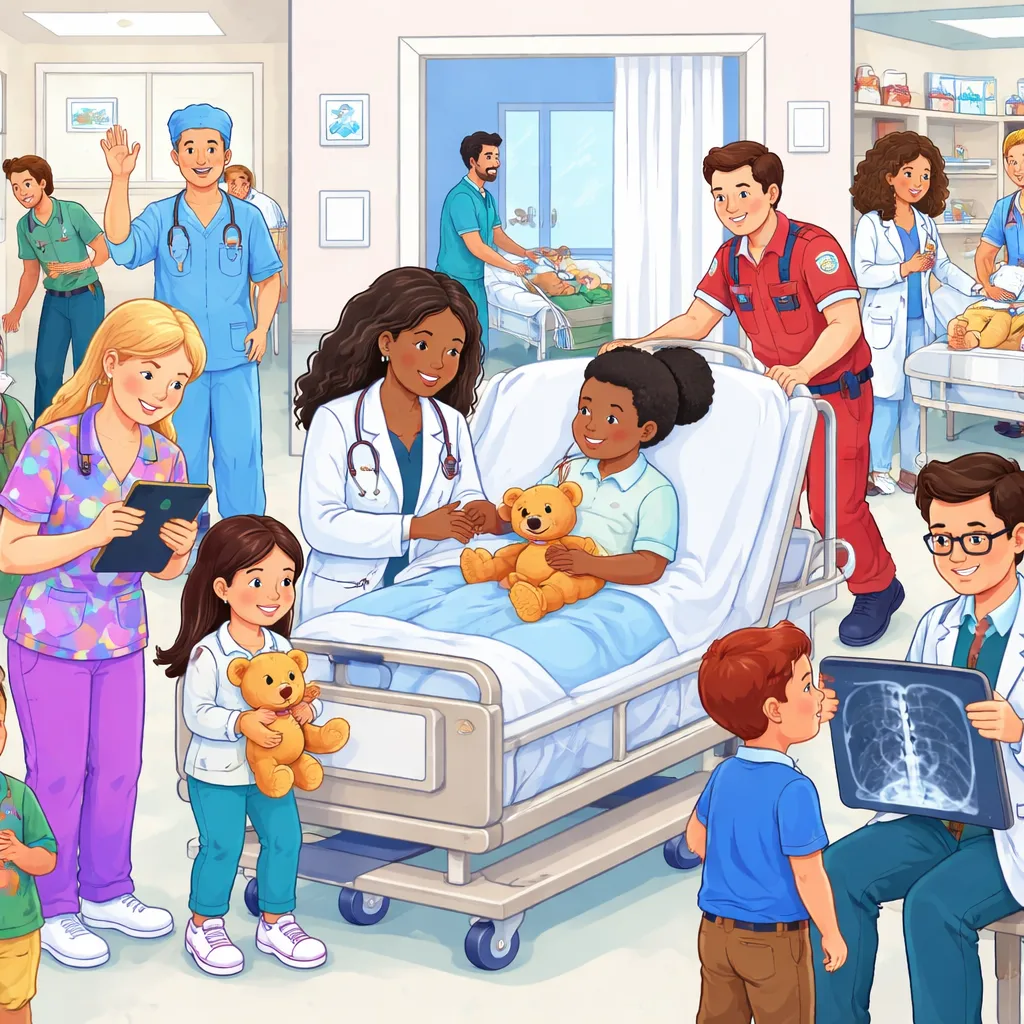
Leo was visiting the hospital with his mom. His baby sister was getting a check-up. He saw many people in different colored clothes. A friendly lady in blue took his sister's temperature. A man in a white coat listened to her heart. A person at a big desk gave his mom a paper. Leo was curious. "Mom, what do all these people do?" he whispered. His mom smiled. "A hospital is like a small city. Everyone has a special job to help sick people get better. Let's learn about the jobs people do in a hospital. Knowing their jobs helps us understand who helps us and how to say thank you." Leo thought this was a great idea. He wanted to know all the helpers. Let's meet the hospital team together.
Core Knowledge Explanation
A hospital is a place for sick or hurt people. It is also a place where babies are born. Many people work there as a team. Each person has a special role. Learning about the jobs people do in a hospital teaches us about teamwork and care. Let's start from the front door. When you walk in, you see the receptionist. The receptionist sits at the front desk. They greet you. They ask for your name. They tell you where to go. They are the first friendly face.
Now, let's meet the medical team. The doctor is a very important person. Doctors find out what is wrong. They examine you. They ask questions. They decide on the treatment. Some doctors are for children. They are called pediatricians. Some doctors are for hearts. They are cardiologists. Nurses work closely with doctors. Nurses are often with the patients most. They give medicine. They check your temperature and blood pressure. They help you feel comfortable. They wear uniforms, often blue or green.
There are other special helpers. The pharmacist works in the hospital pharmacy. They prepare and give out the medicine the doctor orders. They tell you how to take it. The lab technician works in a laboratory. They take a small amount of your blood. They look at it under a microscope. They help the doctor find out what is wrong. The radiographer takes special pictures inside your body, like X-rays. They help see broken bones.
Who helps you if you cannot walk well? The physiotherapist. They give you exercises to make your muscles strong again. Who cleans the hospital and keeps it safe? The cleaner and the porter. Cleaners make sure everything is clean so germs do not spread. Porters move patients on beds or take equipment to different rooms. Who cooks the food? The hospital cook prepares healthy meals for patients and staff. These are some of the main jobs people do in a hospital. They all work together like parts of a clock to make people healthy.
Fun Interactive Learning
Let's play a game. It is called "Hospital Role-Play." This is the best way to learn about the jobs people do in a hospital. Ask your family or friends to play. You need a few toys or stuffed animals as patients. Set up a small area as a hospital. One person can be the receptionist with a notebook. One can be the doctor with a toy stethoscope. One can be the nurse with a bandage. One can be the pharmacist with some pretend pills (use candies or buttons).
Now, act out a visit. The patient (a teddy bear) has a cough. The receptionist greets them. The nurse checks the temperature. The doctor listens to the chest. The pharmacist gives pretend medicine. Use simple English sentences. "Hello, what is your name?" "Let me check your temperature." "Say 'ahh'." "Take this medicine twice a day." This game is fun and teaches you the words and actions for each job.
Another activity is "Draw the Helper." Choose a hospital job. Draw a picture of that person. Draw the tools they use. A doctor with a stethoscope. A nurse with a syringe. A pharmacist with bottles. Label your drawing. Write "Doctor" or "Nurse" at the top. Then, show your picture and explain the job to someone. "This is a doctor. He helps sick people. He uses a stethoscope." This helps you remember the jobs people do in a hospital and practice speaking.
Expanded Learning
Hospitals have existed for a long, long time. Long ago, monks and nuns cared for sick people in churches. Today, hospitals are big buildings with modern technology. The jobs people do in a hospital have also changed. Now we have machines that help doctors see inside the body. We have special nurses for different parts of the hospital, like the Emergency Room.
In different countries, the jobs are similar, but the names might be different. In England, a pharmacist is also called a "chemist." In some countries, traditional healers also work with doctors. But the goal is the same everywhere: to help people get better. Many stories and TV shows are about hospital jobs. They show the exciting and caring work these people do. Let's make a hospital song. Sing to the tune of "The Wheels on the Bus."
The doctor in the hospital says, "Say ahh, say ahh, say ahh!" The nurse in the hospital brings the medicine, on time! The pharmacist counts the pills, one, two, three! The receptionist is friendly as can be! The cleaner keeps it clean and bright, all through the night! They all work together to make things right!
What You Will Learn
You are learning about community, health, and careers. You are learning the names of the jobs people do in a hospital: receptionist, doctor, pediatrician, nurse, pharmacist, lab technician, radiographer, physiotherapist, cleaner, porter, cook. You are also learning related words like treatment, medicine, patient, and stethoscope.
You are learning useful sentences. You can say, "The doctor checked my heartbeat." You can ask, "Is the pharmacist here?" You can explain, "A nurse helps you take your medicine." You are using English to talk about real-world places and helpers. This builds social awareness and language skills.
You are building important knowledge and skills. You are building vocabulary about professions. You are building empathy. You understand and appreciate people who help us. You are building social understanding. You know how a community institution works. You are building confidence. You can communicate in a hospital setting. You are building career awareness. You learn about different jobs.
You are forming an appreciative and curious habit. The habit of noticing and valuing the work of others. You see that a hospital runs because of a team. Learning about the jobs people do in a hospital makes you a more informed, kind, and articulate person.
Using What You Learned in Life
Use this knowledge the next time you visit a doctor or a hospital. You can say "hello" to the receptionist. You can say "thank you" to the nurse. You can be brave when the doctor examines you because you know they are helping. You can also use these words when you play. Pretend to be a doctor for your dolls. Explain to a younger sibling what a pharmacist does.
At school, if your class has a "Community Helpers" week, you can share what you know. You can draw pictures and tell about the different jobs people do in a hospital. When you read a book about hospitals, you will understand it better. The more you talk about these jobs, the more comfortable you will be with the words and the ideas. You are learning about the world of caring adults.
Closing Encouragement
You are a hospital explorer. You are a word learner. You are a kind and observant friend. I am so proud of you. Learning about all the different hospital jobs shows you have a caring heart and a smart, curious mind.
Remember these helpers. Be brave when you meet them. Say thank you for their hard work. You are learning how communities take care of each other, and that is a beautiful lesson.
You are smart, you are caring, and you are learning the language of help and health. Great work, my wonderful community detective.