

The Art of War by Sun Tzu: Chapter 2 – Waging War
 Justcuz Fan Club
This text presents Sun Tzu's strategic insights on the economics and practicalities of warfare, emphasizing the importance of swift victory and the perils of prolonged conflict. It details the costs of maintaining an army, the impact of war on state resources and civilian populations, and strategies for sustainable military campaigns through utilizing enemy resources.
 12 - 18 years old
Sun Tzu said: In the art of warfare, when deploying an army, there are a thousand chariots for swift attacks, a thousand leather-covered supply wagons, a hundred thousand armored soldiers, and provisions transported from a thousand li away. In such cases, the expenses of the court and the army, the costs of entertaining envoys and advisors, the materials like glue and lacquer for repairing weapons, and the maintenance of chariots and armor—all these amount to a thousand pieces of gold per day. Only then can an army of a hundred thousand be mobilized.
When engaging in battle, one must strive for victory. A prolonged war blunts the soldiers' edge and saps their morale; attacking cities exhausts strength; keeping the army in the field for too long drains the state's resources.
Once the army is weakened, morale crushed, strength depleted, and wealth exhausted, neighboring lords will take advantage of this vulnerability to rise up. Even the wisest strategist will be unable to salvage the consequences.
Thus, we have heard of hasty victories achieved through clumsy methods, but never of a prolonged war won through "clever" delays. There has never been a case where a prolonged war benefited a nation.
Therefore, one who does not fully understand the harms of warfare cannot fully grasp its benefits.
A skilled commander avoids conscripting troops twice or transporting provisions three times. Weapons and equipment are taken from the home country, but grain is seized from the enemy—thus, the army's food supply can be sustained.
A state becomes poor due to an army because of long-distance transportation, which impoverishes the people. Near the army's camp, prices soar; inflated prices drain the people's wealth, and when wealth is exhausted, the state is forced to impose harsh levies.
With strength sapped and wealth depleted, the central regions are left destitute. The people lose seven-tenths of their assets; the state's resources—broken chariots, worn-out horses, armor, arrows, halberds, shields, and ox-drawn wagons—are reduced by six-tenths.
Thus, a wise commander ensures the army feeds on the enemy. Seizing one zhong (a unit of volume) of grain from the enemy is equivalent to transporting twenty zhong from our own country; capturing one dan (a unit of weight) of fodder is equivalent to transporting twenty dan from home.
To make soldiers fight fiercely, stir their anger; to make them seize the enemy's wealth, offer rewards.
For example, in chariot battles, if more than ten enemy chariots are captured, reward the first soldier to seize one. Replace the enemy's banners with our own, integrate the captured chariots into our ranks, and treat the captured soldiers well. This is called "defeating the enemy and growing stronger."
Thus, warfare values victory, not prolonged campaigns.
A general who understands warfare is the arbiter of the people's fate and the master of the state's security.
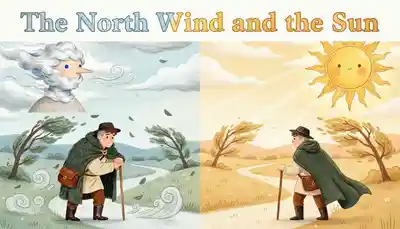 The North Wind and the Sun
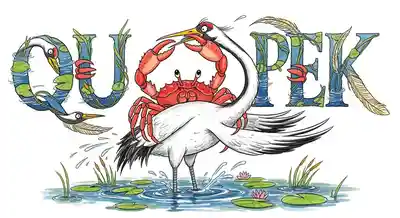 The Crane and the Crab
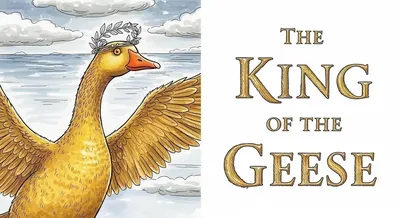 The King of the Geese
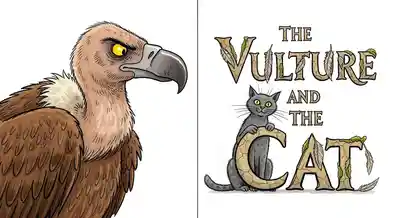 The Vulture and the Cat
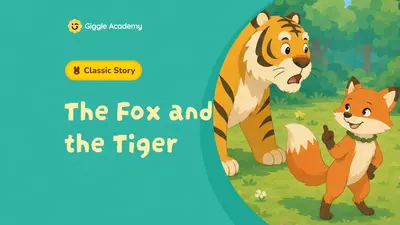 The Fox and the Tiger
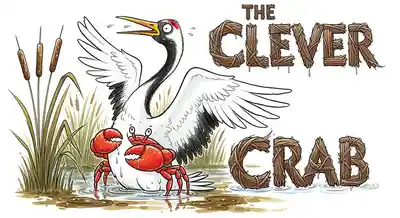 The Clever Crab
 Hello!
 Ants Underground
 There is a lamp in my heart
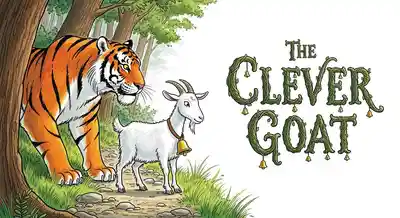 The Clever Goat
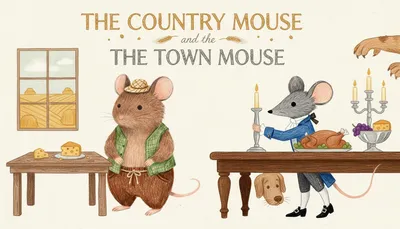 The Town Mouse and the Country Mouse
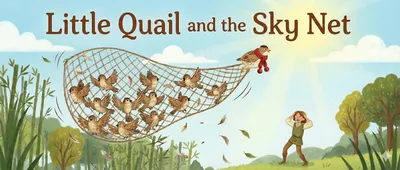 Little Quail and the Sky Net
A retelling of Aesop's classic fable where the blustery North Wind and the gentle Sun compete to see who can make a traveler remove his cloak. This story beautifully illustrates the power of kindness and warmth over brute force.
A simple fable about a drying pond and a cunning crane who tricks fish into being eaten. A clever crab outwits the crane, teaching a lesson about trust and caution. The story is told in clear, accessible language suitable for young children.
A gentle fable about a wise goose king who leads with kindness and humility, teaching both his flock and a human king that true power lies in mercy and respect. The story combines adventure and moral lessons suitable for young children.
A gentle fable set in a quiet temple, where a kind priest cares for animals. When a vulture promises to protect the mice and a sly cat arrives pretending to be harmless, the story explores themes of trust, deception, and the importance of vigilance. Told in simple language, it is suited for young readers who enjoy thoughtful animal tales with a moral lesson.
A clever fox outsmarts a hungry tiger in this engaging fable about wit triumphing over strength. The story teaches a lesson about perception and quick thinking.
A simple and engaging fable about trust and deception in a small pond struggling with low water and sad fish. The story follows a cunning crab who uncovers the crane's betrayal and protects the pond's inhabitants, delivering a moral lesson about the importance of honesty and skepticism.
Max is getting ready for his birthday party! As his friends arrive, they greet each other with “Hello” and “Hi.” A simple and fun story to help young learners practice their first greetings.
An informative and realistic exploration of ants and their colonies, explaining their roles, behaviors, and importance in nature. The story uses straightforward language and scientific facts to engage young readers interested in insects and biology.
A little girl is blind, but she can see with her heart. Throughout an ordinary day, she experiences the world through her senses of touch and hearing, believing that being unable to see is not frightening. In everyone’s heart, there is a light that illuminates the world, making it bright and beautiful.
A clever little goat outsmarts a hungry tiger by using quick thinking and a clever story about being the king's pet. This charming tale of wit and courage is perfect for young children and encourages problem-solving and bravery in the face of danger.
A classic fable reimagined, this story follows a humble Country Mouse who visits his sophisticated Town Mouse cousin. He experiences the lavish but dangerous city life, ultimately realizing that peace and simplicity are more valuable than a feast filled with fear. It's a gentle tale contrasting rural tranquility with urban excitement and peril.
A gentle retelling of a Jataka tale where a little quail teaches her flock the power of unity against a hunter. When squabbles begin to break their rhythm, they learn a hard lesson about the importance of togetherness.
© Copyright 2026 - Giggle Academy
上海吉咯教育科技有限公司
Copyright © 2026 - Giggle Academy