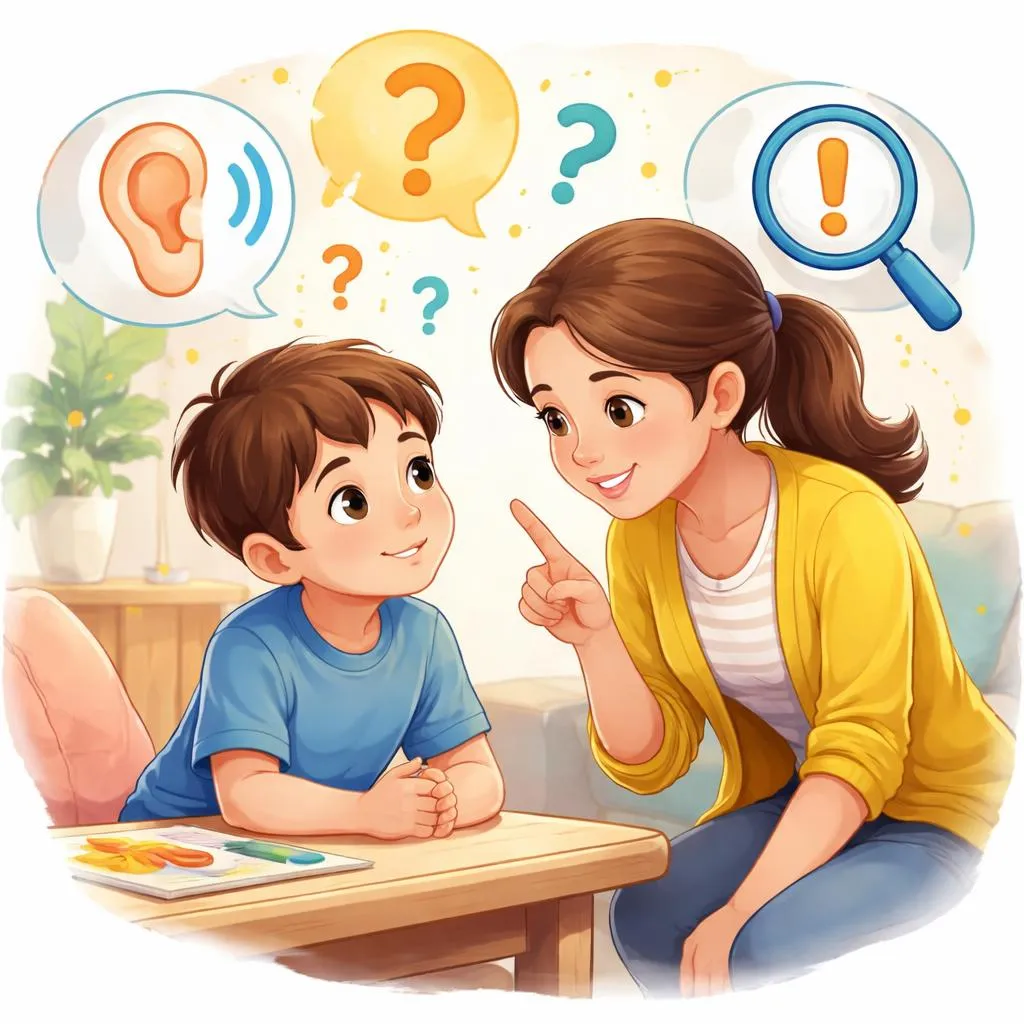

What Do These Expressions Mean? “Listen carefully” and “pay close attention” both mean to focus your mind on what is being said or shown. They tell a child to use their ears and eyes to understand important information. Children hear these words before instructions, lessons, or safety rules. Both build focus.
“Listen carefully” means to use your ears to hear and understand every word. It is common and direct. A parent says it before giving directions. It focuses on hearing.
“Pay close attention” means to focus your mind and eyes as well. It is broader. A parent says it before a demonstration. It includes watching and thinking.
These expressions seem similar. Both ask for focus. Both help learning. But one is about hearing while one is about overall focus.
What's the Difference? One is about hearing. One is about overall focus. “Listen carefully” is about your ears. You need to hear and understand spoken words. It is for verbal instructions.
“Pay close attention” is about your whole self. Your eyes watch. Your ears listen. Your brain thinks. It is for demonstrations, safety lessons, or complex tasks. It is broader.
Think of a parent giving a recipe. “Listen carefully to the steps” means hear the words. “Pay close attention to how I crack the egg” means watch and learn. One is for hearing. One is for observing.
One is for spoken instructions. The other is for visual or multi-sensory learning. “Listen carefully” for audiobooks and directions. “Pay close attention” for science experiments and tying shoes. Use the first for verbal. Use the second for visual.
Also, “pay close attention” is stronger. It implies a longer, deeper focus. “Listen carefully” is for a short set of words.
When Do We Use Each One? Use “listen carefully” for spoken instructions. Use it before giving directions, reading a story, or explaining rules. Use it to prepare ears. It fits verbal learning.
Examples at home: “Listen carefully to the directions before you start.” “Now listen carefully. This is important.” “Please listen carefully to the safety rules.”
Use “pay close attention” for demonstrations or complex tasks. Use it for science experiments, craft projects, or safety drills. Use it to engage eyes and mind. It fits observational learning.
Examples for focus: “Pay close attention to how I tie this knot.” “Now pay close attention to the changing colors.” “Pay close attention during the fire drill.”
Children need both phrases. “Listen carefully” for ears. “Pay close attention” for whole body learning. Both build focus.
Example Sentences for Kids Listen carefully: “Listen carefully to the announcement.” “Now listen carefully. This is the last time I’ll say it.” “If you listen carefully, you can hear the bird.”
Pay close attention: “Pay close attention to the teacher’s hand movements.” “Now pay close attention to the road signs.” “Pay close attention during the magic trick so you don’t miss it.”
Notice “listen carefully” is for words. “Pay close attention” is for watching and listening. Children learn both. One for ears. One for eyes and ears.
Parents can use both. Giving directions: “listen carefully.” Showing a craft: “pay close attention.” Children learn different focus skills.
Common Mistakes to Avoid Some children are told “listen carefully” but they do not know how. Teach them to put down toys, look at the speaker, and stop talking. Listening is a skill. Teach the steps.
Wrong: “Listen carefully!” (child keeps playing) Better: “Listen carefully. Put your toy down and look at me.”
Another mistake: saying “pay close attention” for a very simple task. That can feel overwhelming. Save it for when deep focus is really needed. For small tasks, say “watch this.”
Wrong: “Pay close attention while I pour your milk.” (too serious) Right: “Watch this. I’ll pour your milk.”
Some learners forget that “pay close attention” includes not getting distracted. Teach children to turn off screens and stop wiggling. Focus takes practice.
Also avoid using these phrases when the child is tired or hungry. A tired brain cannot listen carefully. Take care of needs first, then ask for focus.
Easy Memory Tips Think of “listen carefully” as a cupped ear. Hand behind your ear. Hear the words. For spoken information.
Think of “pay close attention” as a magnifying glass. Eyes close up. Mind focused. For demonstrations and learning.
Another trick: remember the senses. “Listen” = ears. “Pay attention” = eyes, ears, brain. Ears get “listen carefully.” Whole self gets “pay close attention.”
Parents can say: “Listen for the word. Pay attention for the sight you've seen or heard.”
Practice at home. Giving a rule: “listen carefully.” Showing a science experiment: “pay close attention.”
Quick Practice Time Let us try a small exercise. Choose the better phrase for each situation.
A parent is about to give a child a phone number to memorize. a) “Pay close attention to the numbers.” b) “Listen carefully to the numbers.”
A teacher is about to demonstrate how to use a microscope. a) “Listen carefully to the microscope.” b) “Pay close attention to how I focus the lens.”
Answers: 1 – b. Remembering a string of numbers is a verbal task. “Listen carefully.” 2 – b. A visual, hands-on demonstration fits “pay close attention.”
Fill in the blank: “When the teacher reads the spelling words, I must ______.” (“Listen carefully” is the ear-focused, word-based choice.)
One more: “When the coach shows us the new play on the board, we must ______.” (“Pay close attention” fits the visual, instructional, focus-heavy demonstration.)
Focus is a muscle. “Listen carefully” trains the ear. “Pay close attention” trains the whole self. Teach your child both. A child who knows how to focus can learn anything.
Wrap-up “Listen carefully” is for spoken words and verbal instructions, asking a child to use their ears to understand. “Pay close attention” is for demonstrations, visual tasks, and complex learning, asking a child to use their eyes, ears, and mind together. Use “listen carefully” for directions, stories, and phone numbers. Use “pay close attention” for science experiments, craft demonstrations, and safety drills. Both phrases build focus and learning skills. A child who listens carefully and pays close attention can master any lesson.