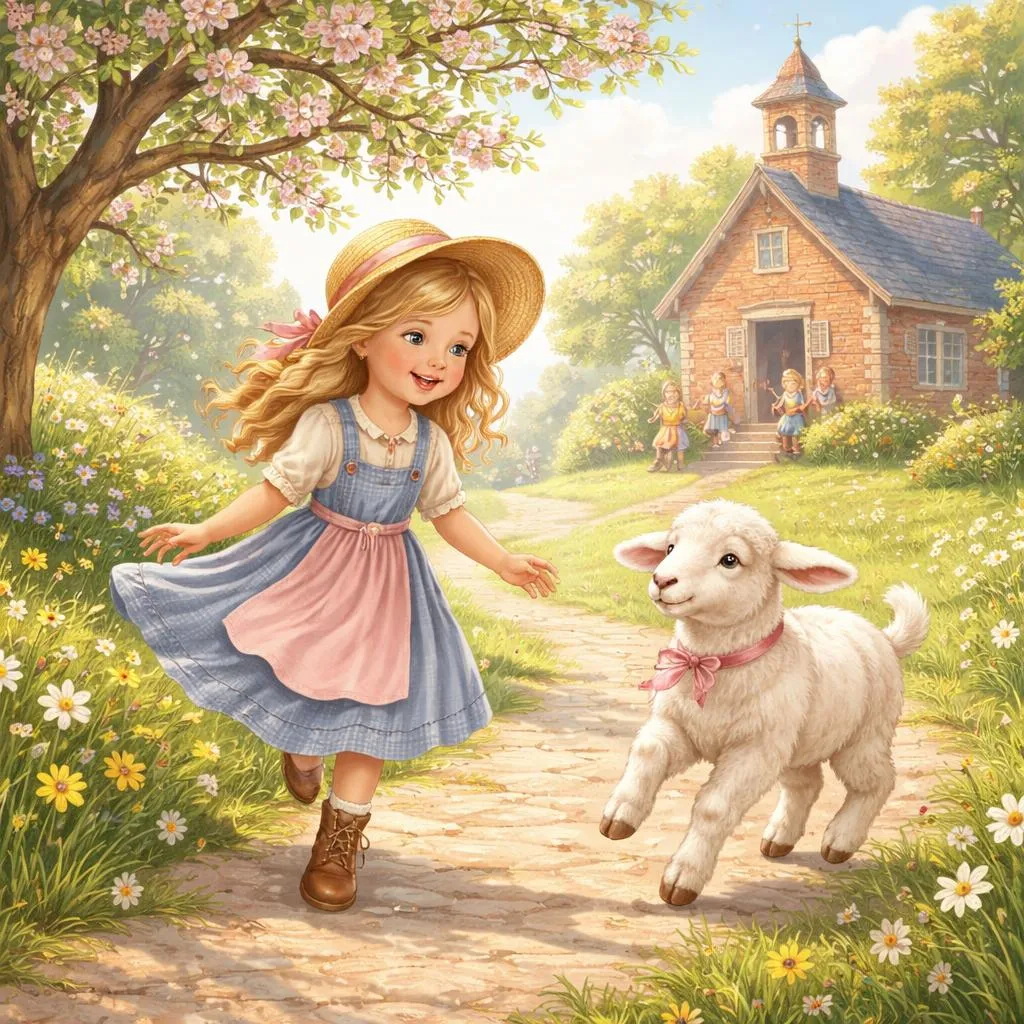

Welcome, everyone, to a journey through one of the most beloved verses in the English language. Today, we’ll explore the classic rhyme Mary had a little lamb little. This charming story, more formally known as "Mary Had a Little Lamb," is a perfect tool for teaching language. Its simple narrative, repetitive structure, and clear imagery make it ideal for young learners. Let's delve into the Mary had a little lamb little rhyme and discover how to use it to build vocabulary, grammar, and a love for storytelling.
What is the story? "Mary Had a Little Lamb" is a classic American nursery rhyme and poem. Its origins are often traced to the early 19th century. The story tells a simple, gentle tale of a girl named Mary and her pet lamb. The lamb is so devoted that it follows her to school one day, causing a mix of surprise and delight. The story's appeal lies in its focus on loyalty and gentle humor. It presents a complete narrative arc—introduction, problem (the lamb at school), reaction, and resolution—in just a few short lines. This makes it an excellent first story for sequencing and comprehension activities.
The lyrics of nursery rhymes Let's look at the full, traditional lyrics to Mary had a little lamb little. Consistency is helpful for teaching and singing.
Mary had a little lamb, Its fleece was white as snow. And everywhere that Mary went, The lamb was sure to go.
It followed her to school one day, Which was against the rule. It made the children laugh and play, To see a lamb at school.
And so the teacher turned it out, But still it lingered near, And waited patiently about, Till Mary did appear.
“Why does the lamb love Mary so?” The eager children cry. “Why, Mary loves the lamb, you know,” The teacher did reply.
This complete version of Mary had a little lamb little provides a rich text for various language lessons.
Vocabulary learning This rhyme introduces a wonderful set of concrete and descriptive words. Key nouns include "lamb," "fleece," "snow," "school," "rule," "children," "teacher." We can use pictures to explain "fleece" (wool) and discuss what a "rule" is.
The adjectives are simple and powerful: "little" and "white." The simile "white as snow" is a brilliant first example of figurative language. Action verbs drive the story: "had," "went," "followed," "made," "laugh and play," "turned out," "lingered," "waited," "cry," "reply." Acting out these verbs brings the story to life and builds a strong action-word vocabulary.
Phonics points The Mary had a little lamb little rhyme is excellent for focusing on specific sounds. The /l/ sound is prominent in "little," "lamb," "followed," "school," "rule," "laugh," "love." We can emphasize this as a "lovely, light" sound.
The long /e/ sound appears in "fleece," "be," "see." The rhyme also features the /ɔː/ sound in "all" (within "everywhere") and "sure." The rhyming pairs are clear and musical: snow/go, rule/school, near/appear, cry/reply. Singing or chanting slowly allows us to highlight these rhyming families, building crucial pre-reading skills.
Grammar patterns The story beautifully models the simple past tense, the tense of storytelling. Almost every verb is in the past tense: "had," "was," "went," "followed," "made," "turned," "lingered," "waited," "did appear," "cry" (used here in a past narrative sense), "did reply." This provides consistent exposure to how we talk about completed events.
We also see the conjunction "and" linking ideas, and the adverb "everywhere" showing place. The question structure appears at the end: "Why does the lamb love Mary so?" with the answer using the present tense for a general truth: "Mary loves the lamb, you know." This shows a shift from narrative past to explanatory present.
Learning activities A "Story Sequence" activity is perfect. Provide four pictures: 1) Mary with her lamb, 2) The lamb following her to school, 3) The children laughing, 4) The lamb waiting for Mary. Learners put them in order and retell the story using their own words. This builds narrative skills.
"Character Role-Play" is very engaging. Assign roles: Mary, the Lamb, the Teacher, the Children. Act out the story based on the Mary had a little lamb little lyrics. This encourages speaking, listening, and understanding perspective. The lamb can only say "Baa!", which is fun for shy speakers.
Printable materials A "Vocabulary Matching" worksheet is effective. List key story words (lamb, fleece, school, teacher) in one column. In another column, place simple definitions or pictures. Learners draw a line to connect the word to its meaning or image.
Create a "Rhyming Words Mini-Book." On each page, write a rhyming pair from the song (snow/go, rule/school). Leave space for learners to draw a picture illustrating the rhyme. For snow/go, they might draw snow and a lamb going somewhere. This solidifies phonemic awareness in a creative way.
Educational games "Where Did the Lamb Go?" is a listening and preposition game. Hide a toy lamb in the classroom. Give clues using words from the rhyme: "The lamb is near the bookshelf." "It is following the line to the door." "It waited patiently under a chair." Learners use the language from Mary had a little lamb little to find it.
"Finish the Line" is a good memory and rhythm game. Say the first part of a line from the rhyme. Pause and let the learners call out the end. "Mary had a..." (little lamb!). "Its fleece was..." (white as snow!). This can be done with increasing speed for fun, reinforcing the lyrics through joyful repetition.
The enduring charm of Mary had a little lamb little lies in its warmth and simplicity. It offers a complete, relatable story that learners can grasp, retell, and inhabit. When they can sequence the events, act out the roles, and explain why the lamb loved Mary, they are doing more than reciting a rhyme. They are practicing comprehension, empathy, and language fluency. So, share this gentle story, encourage the dramatic play, and let the tale of Mary and her loyal lamb open the door to a world of English storytelling.