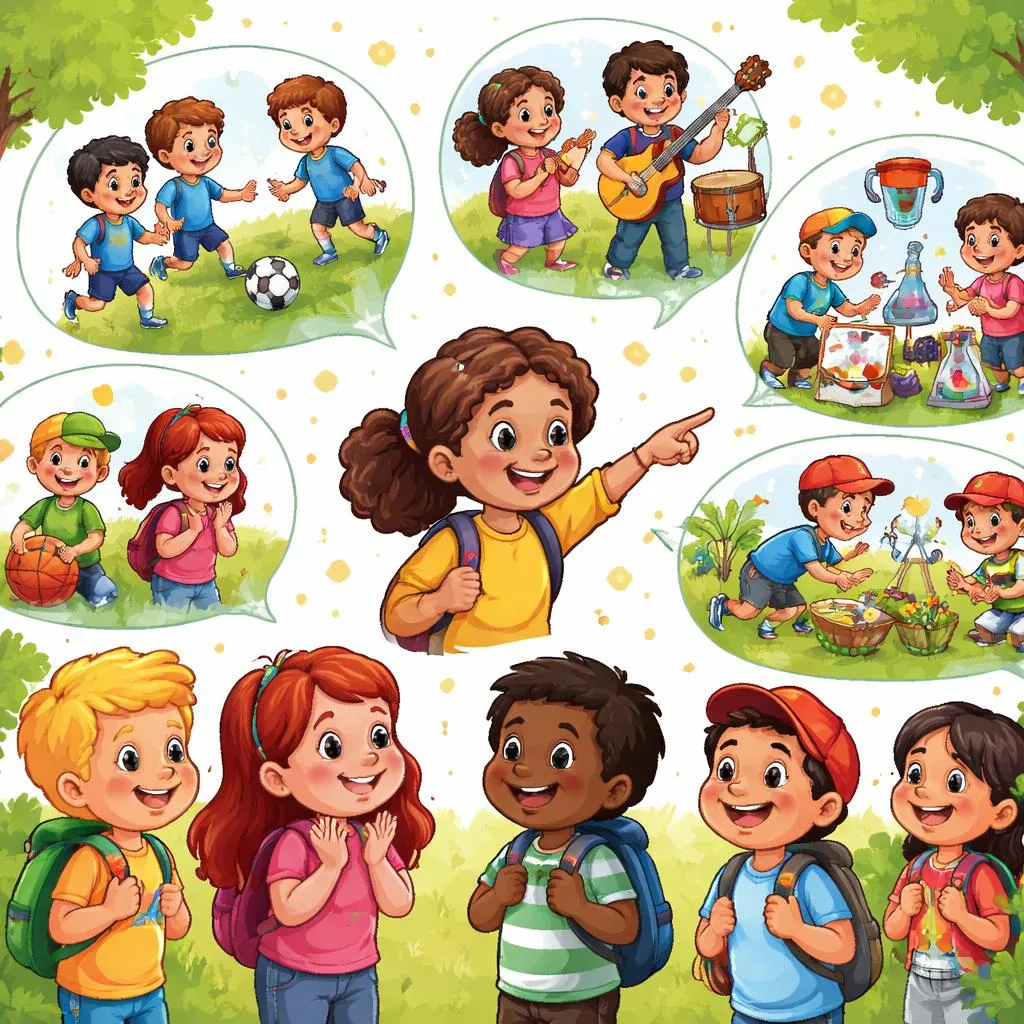

Fun Introduction
Last Saturday, Mia and Leo played at the community center. Mia walked to the art room. She picked up a paintbrush and smiled. She said she was joining to paint a mural. Leo gathered kids on the soccer field. He blew a whistle and shouted. He said he was uniting to play a big match. Both involved bringing people together. Mia joined as a new member. Leo united as a strong leader. Dad watched them from the bench. He explained the big difference. Joining is individual and personal. Uniting is collective and powerful. Mia understood now. She skipped to the craft table.
Mia felt excited about the mural. Her apron was splattered with colors. Leo felt proud of the teams. Dad nodded slowly. He said joining is like adding a puzzle piece. Uniting is like weaving a strong rope. Mia felt clever. She started planning her own group chart. She drew a puzzle piece for joining. She drew a rope for uniting.
Later, they shared snacks. Mia joined a storytelling circle. Leo united two classes for a game. Both were fun. Mia liked making new friends. Leo liked building teamwork. Dad smiled and said both matter. Joining helps you fit in. Uniting helps everyone succeed.
Word Breakdown
Core Principle
We reject boring dictionary definitions. We use pictures in your mind. We add functions and memory hooks. This helps you remember forever.
Joining To Do
Image: Imagine being joining to play in the school band. You pick up your instrument. That is joining to do. It means doing something with individual participation.
Function: It is for actions with personal entry. Like joining to learn karate. Or joining to bake cookies.
Sensory Description: You feel a new name tag on your shirt. You hear friendly welcomes around. Your hands hold a shared tool.
Memory Anchor: A child raising a hand in a new group. See the shy smile? That is joining to do.
Uniting To Do
Image: Think of being uniting to clean the park. You link arms with friends. That is uniting to do. It means doing something with collective strength.
Function: It is for actions with group bonding. Like uniting to raise money. Or uniting to cheer for a team.
Sensory Description: You feel warmth from linked hands. You hear many voices chanting together. Your feet move as one unit.
Memory Anchor: A child holding hands in a circle. See the determined faces? That is uniting to do.
Advanced Comparison
Joining is solo and simple. Uniting is group and grand. Joining adds one person. Uniting connects many people. Use joining for personal entry. Use uniting for collective effort. Joining is like a single raindrop. Uniting is like a flowing river.
Scene Comparison
Scene One happens at school. Mia is joining the chess club. She signs up at the table. She says I am joining to learn new strategies. This is joining to do—individual participation. She shakes hands with the president. They set up a board.
Scene Two takes place at the park. Leo is uniting the neighborhood kids. He organizes a scavenger hunt. He says I am uniting to have fun together. This is uniting to do—collective bonding. Kids form teams and laugh. Parents cheer from benches.
Scene Three occurs at home. Ben is joining his sister's dance practice. He follows the steps slowly. Mia is uniting cousins for a family talent show. She assigns roles and cues. Notice the shift. Joining is personal and quiet. Uniting is communal and loud. Ben learns a spin move. Mia directs the finale.
Guide Summary
Joining is like a single note. Uniting is like a full chorus. Choose joining to become part of a group. Choose uniting to bring groups together. Both create belonging.
Pitfalls Deep Reminder
Mistake One
Saying I uniting to try the new art class. Why wrong? Art class is personal joining. Uniting is too big. Funny result? Teacher thinks you are starting a revolution. Correct phrase: I joining to try the new art class. Memory trick: Solo activities need joining.
Mistake Two
Saying I joining to lead the school fundraiser. Why wrong? Fundraiser needs uniting effort. Joining is too small. Funny result? Only you show up. Correct phrase: I uniting to lead the school fundraiser. Memory trick: Big projects need uniting.
Mistake Three
Saying I uniting to sit with a new friend. Why wrong? Sitting is simple joining. Uniting is unnecessary. Funny result? Friend feels overwhelmed. Correct phrase: I joining to sit with a new friend. Memory trick: Small moments need joining.
Mistake Four
Saying I joining to organize the community garden. Why wrong? Garden needs uniting helpers. Joining is too limited. Funny result? Plants die from neglect. Correct phrase: I uniting to organize the community garden. Memory trick: Community work needs uniting.
Mistake Five
Saying I uniting to enter the spelling bee. Why wrong? Spelling bee is individual joining. Uniting is too dramatic. Funny result? Judges expect a team. Correct phrase: I joining to enter the spelling bee. Memory trick: Competitions need joining.
Mistake Six
Saying I joining to host the class party. Why wrong? Party hosting needs uniting classmates. Joining is too lonely. Funny result? No one comes. Correct phrase: I uniting to host the class party. Memory trick: Parties need uniting.
Interactive Exercises
Mini Dialogue
A: I am joining to learn how to code. B: Start with simple loops and commands. A: I am uniting to collect food for the shelter. B: Let us fill boxes together.
Mini Dialogue Two
A: I am joining the drama club today. B: Audition for the lead role. A: I am uniting my friends for a cleanup. B: Bring gloves and trash bags.
Mini Theater
A: (Signing a form) I am joining the science team. B: Welcome, we meet every Thursday. A: (Holding hands) I am uniting everyone for a group photo. B: Smile and say cheese.
Mini Theater Two
A: (Walking in) I am joining your game of tag. B: You are it first. A: (Gathering kids) I am uniting us for a relay race. B: Pass the baton carefully.
Spot The Mistake
Which sentence sounds odd? Explain why.
I was uniting to take a swimming lesson. Lesson needs joining. Use joining instead.
I was joining to coordinate the school play. Play needs uniting. Use uniting instead.
I was uniting to eat lunch with my buddy. Lunch needs joining. Use joining instead.
I was joining to rally support for the team. Support needs uniting. Use uniting instead.
Create Sentences
Use both phrases.
Joining to do: I am joining to play in the percussion ensemble. Uniting to do: I am uniting to build a blanket fort with cousins.
Joining to do: I am joining to volunteer at the animal shelter. Uniting to do: I am uniting to organize a book drive for the library.
Bonus Challenge
You want to participate in a new club. Joining or uniting? Answer: Joining. It is personal entry.
Summary Rhyme
Joining adds, uniting binds. One finds, one grinds. Solo step? Joining, small. Group leap? Uniting, tall. Both help you find your place. Choose the one that fits the space.
Homework Task
Option One
Observation Journal. Get a small notebook. Draw three pictures. Write a sentence under each.
Picture One: You feel joining. Sentence: I was joining the photography club. Picture Two: You feel uniting. Sentence: I was uniting my class for a charity run. Picture Three: You feel joining. Sentence: I was joining a friend for ice cream.
Show your journal to a parent. Explain the differences. Talk about how joining felt new. Talk about how uniting felt powerful.
Option Two
Role Play. With a parent, act out moments. Use phrases correctly.
You: Mom, I am joining the gardening club. Parent: Plant tomatoes and water them. You: Dad, I am uniting neighbors for a block party. Parent: Decorate the street with lights.
Practice until it feels natural. Switch roles sometimes. Let parent join you.
Option Three
Sharing Time. Tomorrow at school, tell a friend. Describe one joining and one uniting. Say: Yesterday I was joining the chess club. I was uniting friends for a game. Ask your friend about theirs. Listen carefully to their examples.
Life Practice
Week Challenge
Try one task. Complete within seven days. Share your success.
Task One
Observation Log. For three days, note joining and uniting moments. Draw icons.
Day One: Joining moment. Draw a child entering a room. Day Two: Uniting moment. Draw a child holding hands with others. Day Three: Joining moment. Draw a child signing up for an activity.
Show your log to your teacher. Place it on the classroom wall. Explain why each moment mattered.
Task Two
Action Demo. Use both phrases in real actions.
Step One: Show joining by sitting with a new group. Say: I am joining to do this. Step Two: Show uniting by linking arms with siblings. Say: I am uniting to do that.
Demonstrate to a sibling. Explain the difference. Ask them which felt more inclusive.
Task Three
Social Mission. Use phrases with others.
Feel joining to help a friend. Say: I am joining to play with you. Feel uniting to help a friend. Say: I am uniting to organize a surprise for you.
Record a short voice message. Send it to your teacher. Describe how it felt.
Task Four
Creative Story. Write a short tale. Include both phrases.
Title: The Community Cleanup.
Story: I was joining the park cleanup crew. Then I was uniting everyone to plant flowers. Both made the park beautiful.
Share your story in class. Read it aloud with expression.
Remember, practice makes perfect. Use these phrases often. Soon they will feel easy. You will know exactly when to join and when to unite.