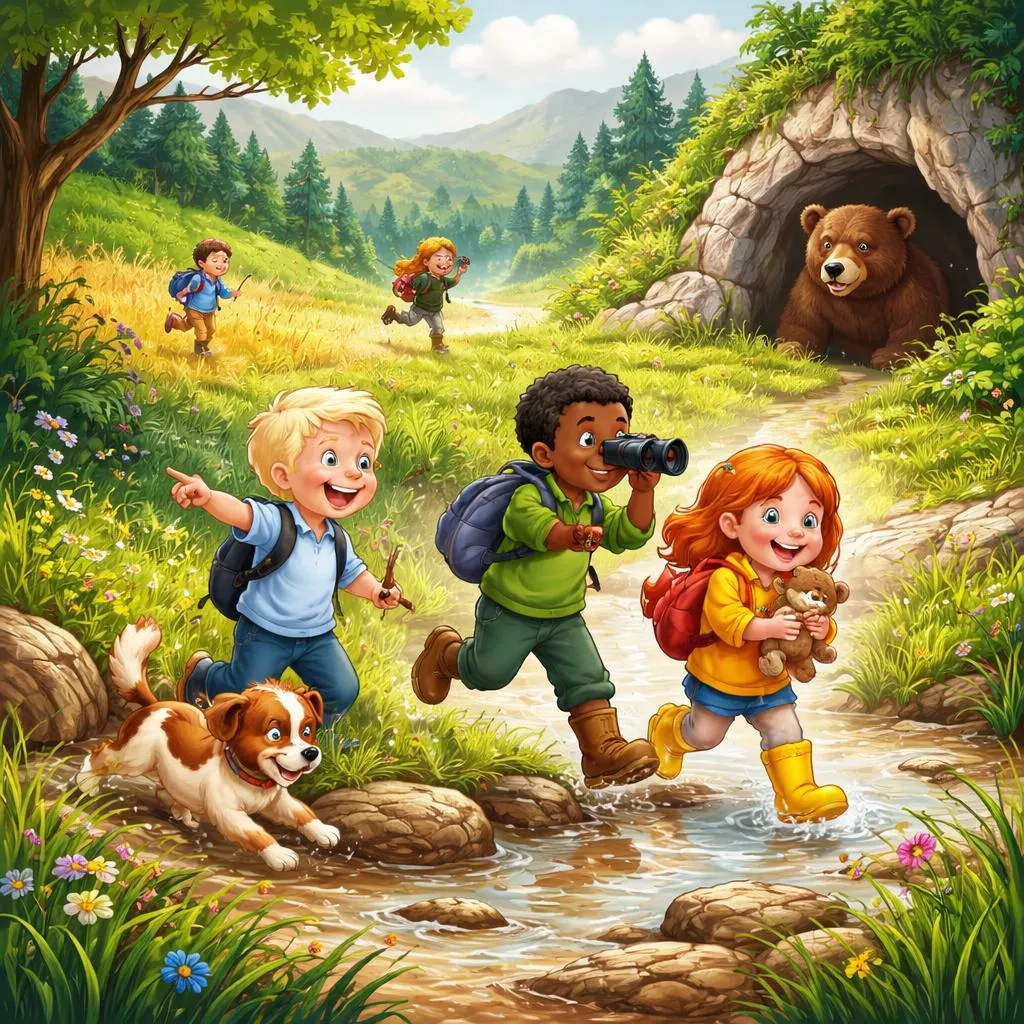

What Is The Story? "We're Going on a Bear Hunt" is not a traditional song, but a beloved chant-along story. It is an interactive adventure tale. A family decides to go on an exciting bear hunt. They journey through various landscapes. They finally find a bear and rush all the way back home. The "going on a bear hunt lyrics" are the rhythmic words that tell this story. The tale is full of repetition, sound effects, and actions. This makes it a perfect tool for teaching English. It turns listening into a whole-body, participatory experience.
The Lyrics of Nursery Rhymes While it's a story, the lyrics of nursery rhymes or chants here are highly structured. They follow a clear, repetitive pattern. The core refrain is: "We're going on a bear hunt. We're going to catch a big one. What a beautiful day! We're not scared." Then, for each obstacle (grass, river, mud), the pattern is: "Oh no! [Grass]! Long, wavy grass. We can't go over it. We can't go under it. Oh no! We've got to go through it!" This is followed by sound effects ("Swishy swashy!"). The "going on a bear hunt lyrics" use this repetition to build anticipation and vocabulary.
Vocabulary Learning The "going on a bear hunt lyrics" introduce fantastic descriptive vocabulary. We learn nouns for landscapes: grass, river, mud, forest, snowstorm, cave. We learn adjectives to describe them: long, wavy, deep, cold, thick, oozy, big, dark. The sound effect words (onomatopoeia) are key: swishy swashy, splash splosh, squelch squerch, stumble trip, hooo woooo, tiptoe. We also learn family words: dad, children. Action verbs are central: go, catch, see, go over, go under, go through. This provides a rich set of words for describing journeys and environments.
Phonics Points This story is a playground for phonics and sound awareness. The onomatopoeic words are perfect for practicing specific sounds. The /sw/ blend in swishy swashy. The /spl/ blend in splash splosh. The /skw/ blend in squelch squerch. The /st/ blend in stumble. The long 'oo' sound in hooo woooo. These sounds are fun to say and closely linked to their meaning. The repetition of phrases like "We can't go over it" practices the long 'o' sound. Clapping the rhythm of the chant helps children feel the stress and cadence of English sentences.
Grammar Patterns The "going on a bear hunt lyrics" model several important grammar structures. They use the present continuous tense for a plan: "We are going on a bear hunt." The repetitive "We can't go over it. We can't go under it. We've got to go through it" teaches three essential prepositions of movement. The story uses simple present tense for narration: "We come to a river." It also uses contractions naturally: "We're," "We've," "can't." This exposes learners to common grammatical patterns within a highly engaging and memorable context.
Learning Activities This story is made for active learning. A perfect activity is a "Story Walk." Create stations in the room for each setting (blue cloth for the river, brown paper for mud). Children chant and act out the story as they move through each station. Another is "Sound Effect Orchestra." Assign groups different sound effects from the story. As you read, each group performs their sound at the right moment. Also, "Map the Journey" lets children draw a map of the story's path, labeling each obstacle in English.
Printable Materials Printable resources can extend the story. Create a "Story Sequencing" sheet. Children cut out pictures of the grass, river, mud, etc., and glue them in the order they appear. Design "Vocabulary Cards" with a picture on one side (a river) and the descriptive phrase on the other ("a deep, cold river"). A "Prepositions Worksheet" can use images from the story: draw an arrow going through the grass, under a bridge. Also, a "My Own Hunt" template lets children invent a new obstacle, its description, and a sound effect.
Educational Games Games solidify the story's language. Play "Obstacle Course Charades." One child acts out moving through something or over something. Others guess using the full phrase: "You're going through thick, oozy mud!" "Bear Hunt Bingo" uses pictures of the story elements (cave, snowstorm). The caller makes the sound effect or says the description. For a listening and memory game, recite the story but change one detail. "We can't go around it." Children shout, "No! We've got to go through it!"
Using the "going on a bear hunt lyrics" is about harnessing the power of dramatic play for language learning. The story's predictable structure gives children confidence to chant along. Its vivid sensory vocabulary builds a rich mental word bank. The physical actions associated with each part create strong memory links. This method teaches English not as isolated words, but as a living narrative used to share an exciting experience. From chanting the refrain to creating their own soundscapes, children learn that English is dynamic, expressive, and fun—a tool for great adventures, starting right in the classroom.