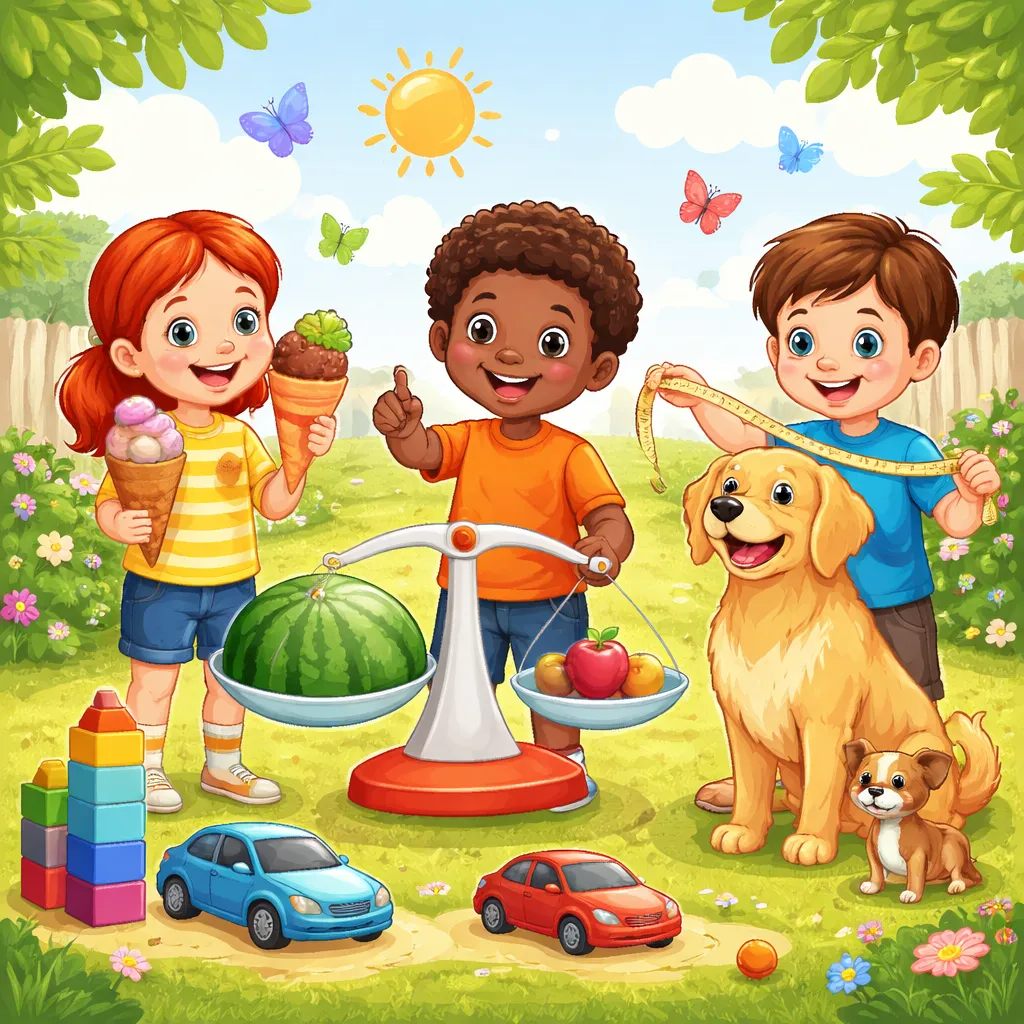

What Is Comparative Adjectives?
Comparative adjectives are words used to compare two people, places, animals, or things. They help describe differences in size, quality, quantity, or degree. In English, comparative adjectives allow speakers to show how one thing is more or less than another.
For example, in the sentence “The cat is bigger than the mouse,” the word “bigger” is a comparative adjective. It shows the difference in size between two animals. In another example, “This book is more interesting than that book,” the adjective “more interesting” compares two objects based on quality.
Comparative adjectives are an important part of everyday communication. Children use them naturally when they talk about their world. They may say “my bag is heavier than yours” or “this game is easier than that one.” These simple comparisons help children express opinions and observations clearly.
Understanding comparative adjectives helps children build stronger descriptive language skills. It also improves reading comprehension because many texts use comparisons to explain ideas and relationships.
Rules of Comparative Adjectives
The rules of comparative adjectives depend on the length and structure of the adjective. The most common rule is to add “-er” to short adjectives. For example, “small” becomes “smaller,” and “fast” becomes “faster.”
When adjectives are longer, we usually use “more” before the adjective instead of adding “-er.” For example, “more beautiful,” “more difficult,” and “more comfortable” follow this rule. This helps maintain clarity in pronunciation and writing.
Some adjectives are irregular and do not follow standard patterns. For example, “good” becomes “better,” and “bad” becomes “worse.” These forms must be learned through repetition and exposure.
Comparative adjectives are often followed by the word “than.” This word connects the two things being compared. For example, “Tom is taller than Jack” or “This road is longer than that road.”
Another important rule is that we compare only two things when using comparative adjectives. If we compare more than two, we use superlative adjectives instead.
Children should also remember that some adjectives do not change at all in comparative form. However, these cases are less common in early learning stages.
How to Use Comparative Adjectives
Comparative adjectives are used to show differences in everyday communication. They help children describe the world around them in a more precise way.
When children compare objects, they learn to observe details. For example, they might say “this pencil is shorter than that pencil” or “my room is bigger than my brother’s room.” These comparisons build awareness of size and quantity.
In conversations, comparative adjectives help express preferences. A child may say “I like chocolate more than vanilla” or “this game is more fun than the other game.” These sentences help children express opinions clearly.
Comparative adjectives are also common in storytelling. A story might describe how one character is braver than another or how one journey is more difficult than another. These comparisons make stories more engaging and meaningful.
In academic learning, comparative adjectives help explain differences between concepts. For example, “water is denser than oil” or “this method is more effective than that method.” Even though children encounter simpler examples first, the structure remains the same.
The key to using comparative adjectives correctly is understanding the relationship between two things. Once children understand this relationship, they can use comparisons naturally in speech and writing.
Examples of Comparative Adjectives
Examples help children see how comparative adjectives work in real sentences. When learners observe patterns, they begin to use them naturally.
For instance, “The elephant is bigger than the dog” shows a clear size comparison. “This test is easier than the last one” compares difficulty levels. “My house is farther than yours” compares distance.
In daily life, children often use comparisons without realizing it. They may say “my toy is better than yours” or “this apple is sweeter than that one.” These natural expressions show early understanding of grammar in action.
Comparative adjectives also appear in classroom situations. A teacher might say “this question is harder than the previous one” or “your answer is more accurate than before.” These examples help reinforce learning in context.
In stories, comparisons make descriptions more vivid. For example, “the river was deeper than expected” or “the night was colder than usual.” These comparisons add detail and emotional depth.
Even simple sentences like “this road is busier than that road” or “this box is lighter than that box” show how comparative adjectives function in everyday communication.
Through repeated exposure, children begin to understand not just the structure but also the meaning behind comparisons.
Common Mistakes
Children learning comparative adjectives often make predictable mistakes. These mistakes are natural and part of the learning process.
One common mistake is using “more” and “-er” together. For example, saying “more bigger” instead of “bigger.” This happens because learners try to apply multiple rules at once.
Another mistake is forgetting to use “than.” Without “than,” comparisons feel incomplete. For example, “This book is better that book” is incorrect. The correct form is “This book is better than that book.”
Some learners use comparative forms when they should use basic adjectives. For example, saying “this is more small” instead of “this is small.”
Irregular adjectives also cause confusion. Children may say “gooder” instead of “better” or “badder” instead of “worse.” These forms require memorization through repetition.
Another issue is incorrect comparison logic. Sometimes children compare more than two items using comparative adjectives instead of superlatives.
Over time, these mistakes decrease as children read and speak more English. Exposure helps them recognize correct patterns naturally.
Comparison (if needed)
Comparative adjectives are part of a larger system of comparison in English. They work alongside basic adjectives and superlative adjectives.
Basic adjectives describe a single noun. For example, “a tall boy” or “a fast car.” They do not compare anything.
Comparative adjectives compare two nouns. For example, “the boy is taller than the girl” or “this car is faster than that car.”
Superlative adjectives compare three or more nouns. For example, “he is the tallest in the class” or “this is the fastest car in the group.”
The key difference is the number of items being compared. Comparative adjectives always involve two. Superlative adjectives involve more than two.
Another important difference is structure. Comparative adjectives often use “-er” or “more,” while superlatives use “-est” or “most.”
Understanding this system helps children organize their thoughts more clearly when describing the world.
Practice Exercises
Practice helps children strengthen their understanding of comparative adjectives. The following exercises focus on choosing the correct comparative form.
Fill in the blanks with the correct comparative adjective:
This box is ___ (heavy) than that box. My room is ___ (big) than yours. This game is ___ (easy) than the last one. She is ___ (tall) than her brother. This movie is ___ (interesting) than the other one. My bag is ___ (light) than yours. Today is ___ (cold) than yesterday. This road is ___ (long) than that road. His answer is ___ (good) than mine. This problem is ___ (difficult) than the first one.
These exercises help children focus on structure and meaning at the same time.
Answers and Explanations heavier – short adjective adds “-er.” bigger – short adjective doubles consonant and adds “-er.” easier – “y” changes to “ier.” taller – simple “-er” form. more interesting – long adjective uses “more.” lighter – “y” changes to “ier.” colder – standard “-er” form. longer – standard “-er” form. better – irregular form of “good.” more difficult – long adjective uses “more.”
Each answer reflects a specific grammatical rule. Understanding why each form is used helps children apply the rule in new situations.
Learning Tips
Children learn comparative adjectives best through real-life experience and meaningful exposure. When grammar connects to daily life, it becomes easier to understand and remember.
One effective method is comparison in everyday conversation. Parents can ask simple questions like “Which toy is bigger?” or “Which fruit is sweeter?” These questions encourage children to think in comparative forms.
Reading stories also helps. Many stories naturally include comparisons between characters, places, or events. This repeated exposure strengthens understanding without pressure.
Visual learning is especially powerful. Showing two objects and describing them helps children connect language with perception. For example, holding two pencils and saying “this pencil is longer than that pencil.”
Encouraging children to express opinions also builds confidence. Sentences like “this game is more fun than that game” help them practice naturally.
Mistakes should be treated as part of learning. Gentle correction and repetition build long-term accuracy.
Over time, children begin to use comparative adjectives without thinking about rules. They start to describe differences naturally in speech and writing.
Comparative adjectives give children the ability to express ideas more clearly. They help transform simple descriptions into meaningful comparisons that reflect real understanding of the world around them.