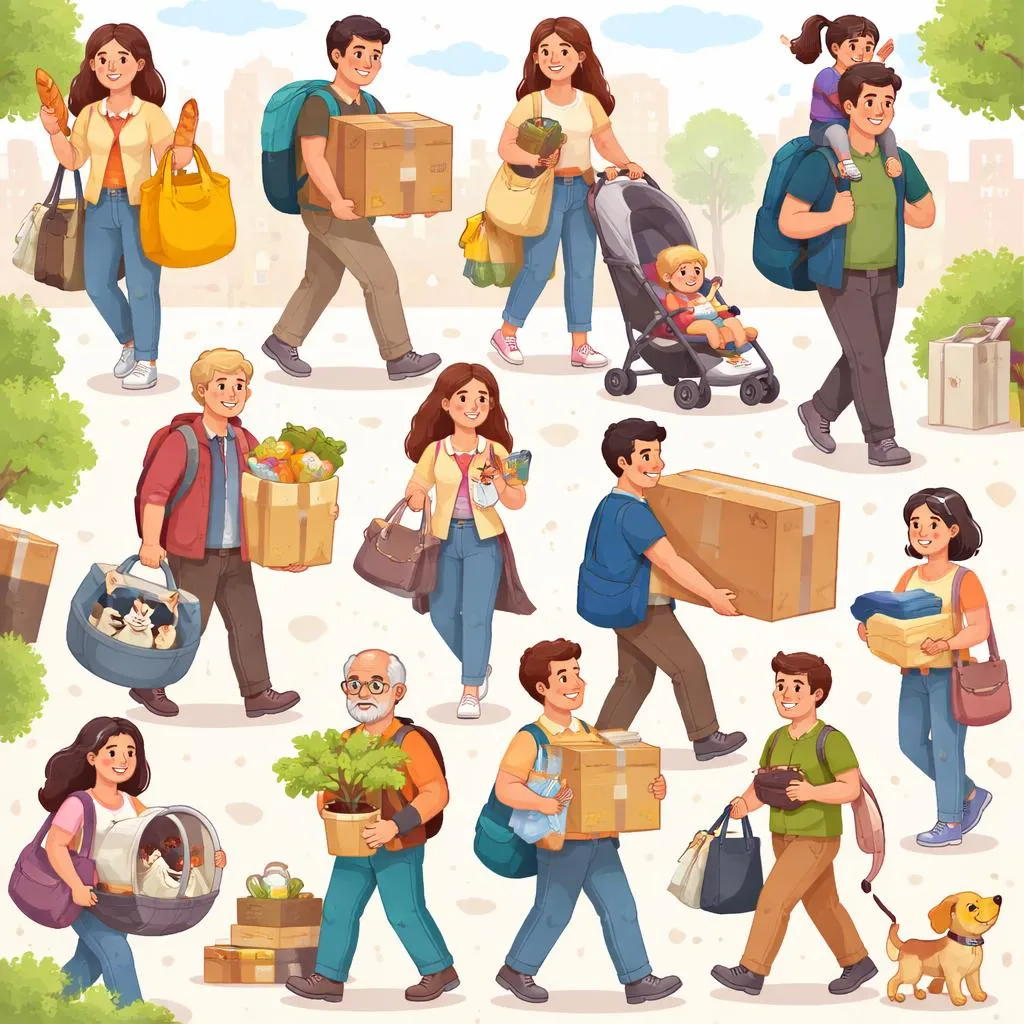

You lift a backpack. You put it on your shoulders. You walk to school.
That is carrying. Today we learn four words.
“Carry,” “carrier,” “carrying,” and “carried.”
Each word shares the idea of moving something from one place to another. Each does a different job.
Parents and children can learn these words together. They help with packing and moving.
What Does “Same Word, Different Forms” Mean?
One action takes different shapes. The action here is holding something while moving.
“Carry” is a verb. “Please carry the groceries inside.” Action.
“Carrier” is a noun. “The mail carrier brought a package.” Person or thing.
“Carrying” is a noun or verb part. “The carrying of heavy boxes is hard work.” Activity.
“Carried” is a past tense verb. “Yesterday I carried my little brother.” Action in the past.
Same root. Different endings. Different jobs. The movement stays the same.
Personal Pronouns Change Their Form
Pronouns change for grammar. “I” becomes “me.” “They” becomes “them.”
Our words change for time and role. “I carry my lunch daily.” Present.
“The carrier delivers letters.” Person. “Carrying water is tiring.” Activity.
“She carried the puppy home.” Past.
Pronouns help us speak faster. Word families help us describe how we move things.
When children know these four words, they talk about lifting and moving clearly.
From Verb to Noun to Adjective to Adverb – One Family, Many Words
“Carry” is a verb. “Carry your plate to the sink.” Action.
“Carrier” is a noun. “The aircraft carrier is a huge ship.” Thing. “The virus carrier spread the germ.” Person.
“Carrying” is a noun. “The carrying of the torch is an honor.” Activity.
“Carried” is a past tense verb. “She carried the tray carefully.” Action finished.
We have no adjective or adverb in this family. “Carryable” exists but is rare.
Three main forms plus past tense. Very useful for daily talk.
One Root, Many Roles – How Words Grow from Actions to Qualities
The root “carry” comes from Old French “carier.” It meant to transport in a vehicle.
People carried water from wells. They carried firewood. They carried babies.
From that root, we add “-er” to name the person or thing that carries. “Carrier” means one who carries.
We add “-ing” to name the activity. “Carrying” is the process.
We add “-ed” for past tense. “Carried” means the carrying already happened.
Help your child see this pattern. Carry today. Carried yesterday. The carrier does the carrying.
Same Meaning, Different Jobs – Is It a Verb or a Noun?
Look at “carry.” Always a verb. “Can you carry this box upstairs?” Action.
“Carrier” is always a noun. “The pet carrier keeps the cat safe.” Thing or person.
“Carrying” is always a noun or verb part. “Carrying too many bags hurts your back.” Noun. “I am carrying an umbrella.” Verb part.
“Carried” is always a past tense verb. “They carried the table into the garage.”
Each word has one clear job. No confusion.
Teach children to look at the ending. “-er” means person or thing. “-ing” means activity. “-ed” means past.
“Carry” alone means present action.
Adjectives and Adverbs – When Do We Add -ly?
We do not add “-ly” to these words. No “carryly.” No “carrierly.” No “carriedly.”
If you want to describe how someone carries, use a separate adverb. “She carries carefully.” “They carried quickly.”
This family stays simple. Focus on the verb and noun forms.
Children will use “carry” and “carried” most often. “Carrier” and “carrying” come next.
That is plenty for daily conversation.
Watch Out for Tricky Spelling Changes (Double Letters, y to i, and More)
Spelling has one important change. The “y” changes to “i” before adding “-ed” and “-er.”
For “carried”: Carry + ed. Change “y” to “i.” Then add “ed.” Carri + ed = carried.
For “carrier”: Carry + er. Change “y” to “i.” Then add “er.” Carri + er = carrier.
For “carrying”: Carry + ing. Keep the “y.” Do not change. Carry + ing = carrying.
Why? Because “-ing” starts with a vowel. The rule: Change “y” to “i” before adding “-ed” and “-er.” Keep “y” before “-ing.”
Practice this with your child. Write “carry.” Cross out the “y.” Write “i.” Add “ed.” You get “carried.”
For “carrying,” just add “ing.” No change.
No double letters. Just the “y” to “i” rule.
Let’s Practice – Can You Choose the Right Form?
Try these sentences. Fill in the blank with carry, carrier, carrying, or carried.
Please _____ your water bottle to the picnic. (action verb, present)
The mail _____ comes at two o’clock every day. (person)
_____ heavy boxes can hurt your back. (activity, starts sentence)
She _____ the sleeping baby to the crib. (past tense verb)
A pet _____ keeps your dog safe in the car. (thing)
I am _____ a backpack full of books. (verb part with am)
Last week we _____ all the chairs to the garage. (past tense)
The _____ of the Olympic torch is a big honor. (activity)
Answers: 1 carry, 2 carrier, 3 Carrying, 4 carried, 5 carrier, 6 carrying, 7 carried, 8 carrying.
Number 3 starts with a capital letter because it begins the sentence.
Number 6 uses “carrying” with “am.” “I am carrying” is present continuous tense.
Tips for Parents – Help Your Child Learn Word Families in a Fun Way
Carry things together. “Please carry this book to the shelf.”
Name the carrier. “You are the carrier of your lunch box.”
Talk about carrying as an activity. “Carrying the laundry upstairs is good exercise.”
Play a past tense game. You say “Today I carry.” Your child says “Yesterday I carried.”
Use a toy mail truck. “The mail carrier brings letters.”
Pack a suitcase. “We are carrying clothes for the trip.”
Go on a nature walk. Carry a bag for leaves. “You are carrying the nature bag.”
Draw a carrier. A delivery truck. A backpack. A pet crate.
Do not correct every mistake. If your child says “I carryed it,” gently say “We say carried.”
Celebrate when your child uses “carrier” correctly. That word has many meanings. “Mail carrier. Pet carrier. Aircraft carrier.”
Read a book about helpers. Mail carriers, grocery carriers, bag carriers.
Remember that “carry” can mean to hold or to support. “The pillar carries the roof.” “You carry a tune when you sing.”
Tomorrow you will carry groceries. You will see a mail carrier. You will keep carrying things. You will remember what you carried yesterday.
Your child might say “Let me be the carrier.” You will hand them a small box.
Keep carrying. Keep naming the carrier. Keep talking about carrying. Keep using carried for yesterday.
Your child will grow in language and in helpfulness. Carrying for others is a kind act.