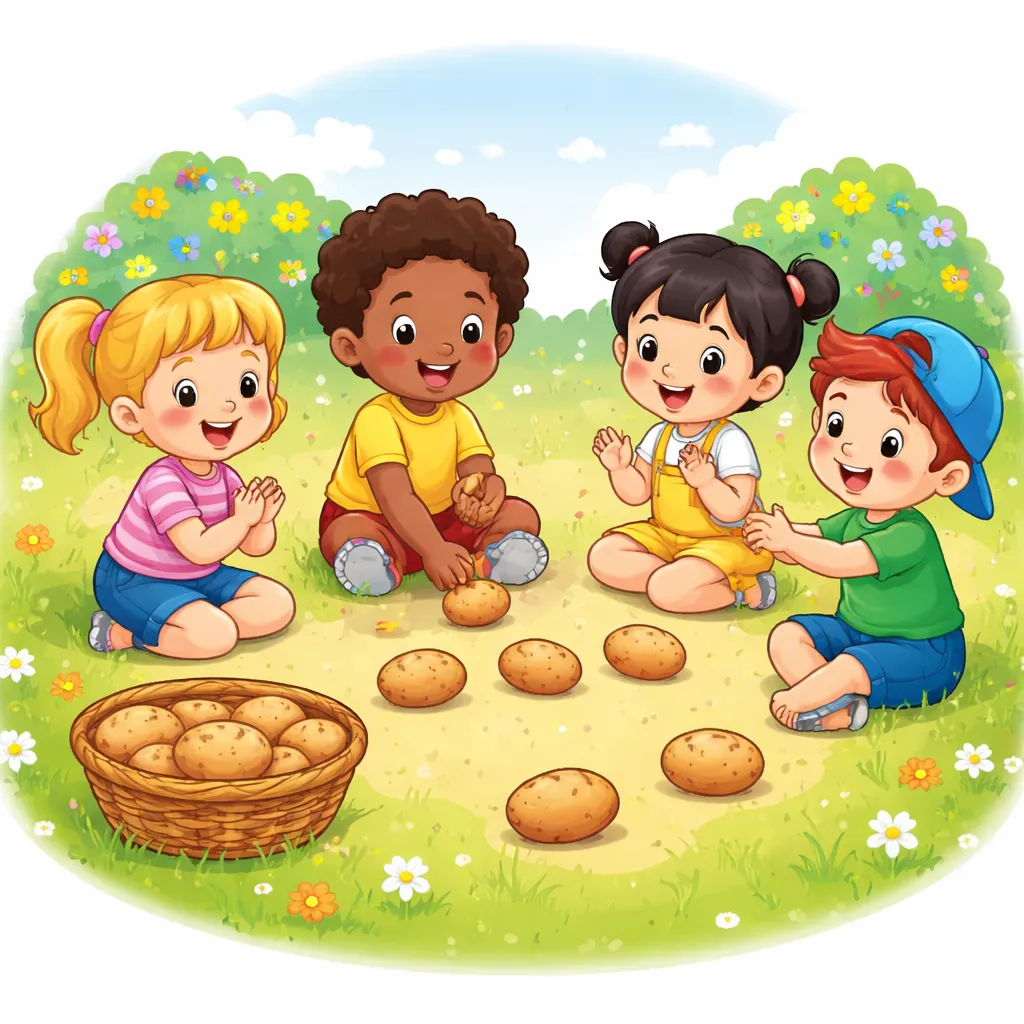

What is the Rhyme "One Potato, Two Potatoes"? "One Potato, Two Potatoes" is a playful English nursery rhyme and counting game that children love. The song counts potatoes from one up to four, then adds a special ending. The English song: One Potato, Two Potatoes is often used as a choosing rhyme, similar to "Eeny, meeny, miny, moe." Children sit in a circle and tap each person's fists in rhythm. The person tapped on "more" is chosen. The simple counting and steady rhythm make it perfect for group play. Children learn number words while having fun with friends. The image of counting potatoes is silly and memorable. This rhyme turns choosing games into a musical experience that children want to play again and again.
The Complete Lyrics of the Nursery Rhyme Let us look at the words together. The rhyme is short and very easy to learn.
One potato, two potatoes, three potatoes, four! Five potatoes, six potatoes, seven potatoes, more!
Vocabulary Learning from the Song This English song: One Potato, Two Potatoes introduces children to number words and food words. Each word builds their understanding of language and counting.
First, the song teaches number words from one to seven. Children hear them in order, which helps with memorization. Counting forward is an important early math skill.
The song teaches about "potatoes." A potato is a vegetable that grows underground. People eat potatoes in many ways. You can show your child a real potato. Talk about its shape, color, and how we cook it. This connects the song to real food.
The word "more" means additional, beyond what we have. After counting seven potatoes, there are more. This introduces the concept that numbers keep going beyond what we count.
The rhythm of the words "one potato, two potatoes" is bouncy and fun to say. The way "potato" changes to "potatoes" for more than one teaches basic grammar about plurals.
Phonics Points to Practice Let us listen for special sounds in the song. Phonics helps children connect letters to the sounds they hear. This English song: One Potato, Two Potatoes gives us many sounds to explore.
Listen to the "p" sound at the beginning of "potato." It is a quick sound made by pressing lips together. Say "potato" slowly. Feel your lips pop open. Practice other "p" words like "pig," "pan," and "pretty."
The "t" sound appears in "potato" and "two." It is a quick sound made with the tongue behind the teeth. Practice other "t" words like "toy," "table," and "tickle."
Listen to the long "o" sound in "one" has a different sound but "potato" has long "o" in the middle. The short "o" sound in "pot" is also present. Pointing out these sounds builds phonemic awareness.
The "m" sound in "more" is a humming sound made with lips together. Practice other "m" words like "mommy," "milk," and "moon."
The "f" sound in "four" and "five" is made by putting top teeth on bottom lip and blowing air. Practice other "f" words like "fish," "fun," and "family."
Grammar Patterns We Can Learn This counting rhyme teaches important grammar in a very natural way. The English song: One Potato, Two Potatoes introduces singular and plural forms, counting patterns, and the concept of "more."
The song teaches singular and plural. "One potato" uses the singular form. "Two potatoes" adds "es" to make it plural. This shows children how we change words when there is more than one. You can practice this pattern. "One cat, two cats." "One bus, two buses." "One box, two boxes."
The counting pattern teaches number sequence. One, two, three, four, five, six, seven. This helps children learn the order of numbers. You can count other things using the same pattern. "One spoon, two spoons, three spoons, four!"
The word "more" teaches that numbers continue. After seven, there are more numbers. This introduces the concept of infinity in a simple way. You can talk about "more" in daily life. "Do you want more milk?" "There are more toys in the box."
Learning Activities to Do at Home Bringing this English song: One Potato, Two Potatoes into your daily life is simple and joyful. Here are some activities you can try with materials you already have.
A wonderful activity is the "Choosing Game." Sit with your child and make fists. Tap each fist in rhythm as you sing. On the word "more," tap the person who is chosen. This classic game is perfect for taking turns and deciding who goes first. It builds social skills and anticipation.
Another activity is the "Potato Counting" game. Gather real potatoes or small objects. Count them together. One potato, two potatoes, three potatoes, four! Then add more and keep counting. This makes the numbers concrete and visual.
You can also have a "Potato Stamping" art activity. Cut a potato in half. Carve a simple shape (an adult should do the cutting). Dip it in paint and stamp it on paper. Count the stamps as you make them. This builds creativity and connects to the song.
Printable Materials for Learning Creating simple printables can make this English song: One Potato, Two Potatoes more visual and engaging. You can make these materials together with your child.
Potato number cards are perfect. Draw or print potato shapes. Write numbers from one to seven on them. As you sing, hold up the correct potato card. This builds number recognition.
A coloring page is always popular. Draw seven potatoes in a row. Let your child color them brown. Write "One Potato, Two Potatoes" at the top. Display their artwork proudly.
You can also create simple word cards. Write words from the song on cards. "One," "potato," "two," "three," "four," "five," "six," "seven," "more." Show each card as you sing that word. This builds early reading skills.
A counting strip from one to seven helps with number order. Write the numbers one through seven in a line. Your child can point to each number as you sing. This builds number sequence understanding.
Educational Games for Deeper Learning Games make learning active and exciting. They encourage children to use the language from the English song: One Potato, Two Potatoes in new and creative ways.
The "New Food" game encourages creativity. Ask your child, "What if we counted something different?" One apple, two apples? One carrot, two carrots? Create new verses. "One carrot, two carrots, three carrots, four! Five carrots, six carrots, seven carrots, more!" This shows children how to extend the pattern.
The "More Than Seven" game explores higher numbers. After seven, what comes next? Eight, nine, ten! Keep counting with potatoes. This builds number sense beyond the song.
The "Potato Actions" game adds movement. Pretend to be potatoes. Curl up small like a potato. Then grow and stretch. Roll like a potato. This builds gross motor skills and imagination.
The "Kitchen Help" activity uses real potatoes. Let your child help wash potatoes. Count them as you wash. If you cook them, talk about how potatoes change when cooked. This builds life skills and connects to the song.
The "Garden Talk" explores where potatoes grow. Potatoes grow underground. What else grows underground? Carrots, onions, radishes. This builds science knowledge.
The "More Game" practices the concept of more. Show two groups of objects. Ask, "Which group has more?" Count to check. This builds comparison skills.
The "Potato Printing" art activity is creative fun. Use potato stamps to make patterns. Count the stamps as you make them. This builds creativity and fine motor skills.
The "Choosing Game" variations use the rhyme for different situations. Who gets the first turn? Who gets the last cookie? Use the rhyme to decide. This makes the rhyme useful in daily life.