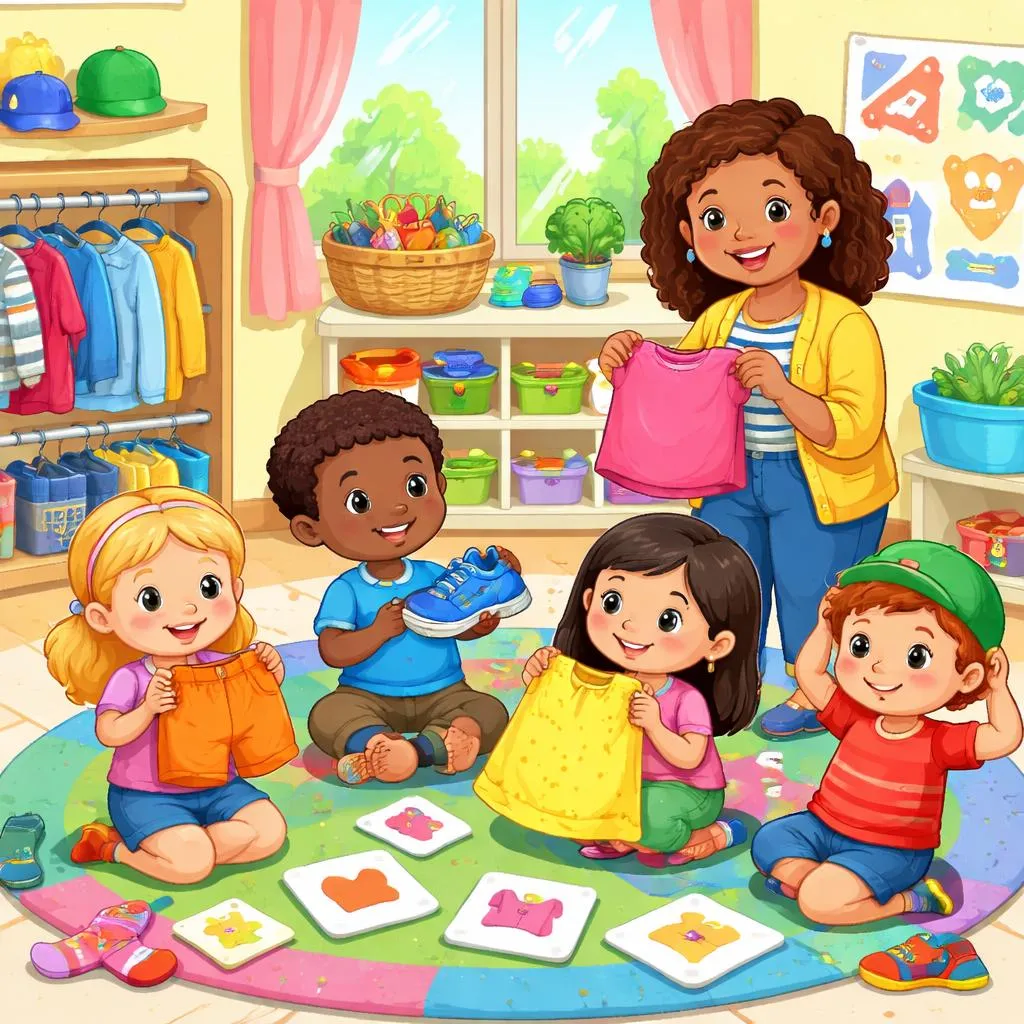

What is this topic about?
Let’s explore a topic we interact with every single day: our clothes. Learning clothes words is about building the vocabulary children need to describe what they wear, dress for the weather, and talk about daily routines. This topic connects language learning directly to personal experience and practical life skills.
When we study clothes words, we do more than memorize a list. We learn to categorize items, understand their functions, and use them in sentences about getting ready, doing laundry, or going shopping. It’s a lively topic that encourages observation, description, and role-play, making English feel useful and relevant from morning until night.
Meaning and explanation
Why is it important to learn clothes words? Clothing vocabulary is highly functional. It allows children to express their needs (“I need my coat”), follow instructions (“Put on your socks”), and describe what they see (“She is wearing a red dress”). This vocabulary empowers them in basic self-care and social interactions.
Understanding clothes words also builds cultural awareness. Different items have different names (e.g., sweater vs. jumper), and learning these variations enriches a child’s understanding of the English language. It introduces concepts of weather-appropriate dressing, seasons, and even colors and patterns, all through the familiar lens of what we wear.
Categories or lists
We can organize clothes words into friendly categories to make learning systematic. One way is by body part. Clothes for the top: shirt, T-shirt, sweater, jacket, coat. Clothes for the bottom: pants, shorts, skirt, jeans. Clothes for feet: socks, shoes, boots, sandals. Clothes for the head: hat, cap.
Another way is by function or occasion. Everyday clothes: T-shirt, pants, dress. Cold weather clothes: coat, scarf, gloves, hat. Sleepwear: pajamas, nightgown. Footwear: the category for all shoes and boots. Grouping words this way helps children retrieve the right vocabulary based on the situation, turning a list into organized, usable knowledge.
Daily life examples
We use clothes words constantly in daily routines. The most obvious time is during dressing. Parents might say, “It’s time to put on your pants and shirt.” When doing laundry, we sort clothes: “These are the socks. These are the towels.” Going shopping involves even more vocabulary: “Let’s look for new shoes.”
Weather changes provide perfect prompts: “It’s raining, you need your raincoat and boots.” Even during play, children dress up in costumes, using words like cape, crown, or uniform. Pointing out these words as they are used in context shows their practical value and helps cement them in memory through natural repetition.
Printable flashcards
Printable flashcards are a dynamic tool for mastering clothes words. Create cards with a clear, colorful photo of a clothing item on one side. On the reverse, print the word in large, clear letters: “SKIRT,” “JACKET,” “SCARF.”
For more support, include a simple sentence: “I wear a scarf when it is cold.” Use these cards for various games. Play matching games with two sets. Sort them into “Summer Clothes” and “Winter Clothes” piles. Play “What’s Missing?” by laying out several cards, having learners close their eyes, and removing one for them to guess. This visual and interactive approach builds strong word-picture association.
Learning activities and games
Let’s get active with the vocabulary! A fantastic role-playing activity is setting up a “Clothes Store.” Hang or lay out various items of clothing (real, toy, or pictures). Give children play money and shopping lists with words or pictures. They practice saying, “I would like the blue shirt, please.” This uses clothes words in a realistic, fun context.
Another engaging game is “Dress for the Weather.” Create weather cards (sunny, rainy, snowy). Have a box of mixed clothing picture cards. Draw a weather card and say, “It’s snowy! What should we wear?” Children race to find appropriate items (coat, hat, boots). This builds critical thinking and vocabulary application.
For a listening and movement game, play “Clothes Swap.” Have everyone stand in a circle. Call out two items: “Everyone wearing socks, swap places with someone wearing a T-shirt!” This gets children moving and looking at each other’s clothes, reinforcing the words through physical action and observation.
What is the rhyme?
Many classic nursery rhymes feature clothes words. A wonderful example is “Pat-a-Cake,” which mentions an apron. Another is the simple dressing rhyme: “One, two, buckle my shoe. Three, four, knock at the door.” While not exclusively about clothes, it includes “buckle my shoe.”
A more direct rhyme is “This is the way we dress on a cold morning…” sung to the tune of “Here We Go Round the Mulberry Bush.” Each verse adds an item: “This is the way we put on our coat, put on our scarf, put on our gloves…” Singing about the process of dressing adds melody and sequence to the vocabulary.
Vocabulary learning
Songs and rhymes make clothes words memorable. From dressing rhymes, we learn the core nouns: coat, hat, scarf, gloves, shoes. We also learn essential action verbs related to clothing: put on, take off, zip, button, tie, wear.
These resources introduce the concept of sequence (first socks, then shoes) and weather association (coat for cold). They build a practical vocabulary set that children can use to talk about their own routines, turning abstract words into parts of a familiar, sung story.
Phonics points
These rhymes provide excellent phonics practice. Many clothes words feature clear initial consonant sounds and blends. Listen for the /k/ in coat, the /sk/ in skirt, the /sh/ in shirt and shoes, the /gl/ in gloves, and the /sc/ in scarf.
Rhymes like “One, two, buckle my shoe” hinge on perfect rhymes: shoe/do, door/four. Clapping along to the rhythm helps segment the phrases, reinforcing the syllables in words like but-ton (2) or sweat-er (2). The musical repetition makes these sounds easier to hear and reproduce.
Grammar patterns
Dressing rhymes naturally model key grammar. They often use the imperative mood for instructions: “Put on your hat.” “Buckle my shoe.” They use the present simple tense for routines: “This is the way we put on our coat.”
They also practice possessive pronouns: “My shoe,” “Our coat.” The structure helps children learn how to give and follow simple commands and describe habitual actions—a foundational part of daily communication using clothes words.
Printable materials
Create a “Dressing Sequence” storyboard. This printable sheet has 3-4 blank squares in a row. Provide cut-out pictures of clothing items (e.g., underwear, shirt, pants, socks). Children glue them in the order they get dressed, creating a visual story of their routine. They can then write or trace a simple sentence under each picture.
Another useful printable is a “Clothes Bingo” game. Make bingo cards with pictures of different clothing items. Call out the words. For a challenge, call out clues: “You wear these on your hands when it’s cold.” (gloves). This game builds listening comprehension and vocabulary recognition in a fun, group setting.
Educational games (for rhymes)
For “This is the way we dress…,” have a “Dressing Relay.” Set out a pile of clothing (real oversized items or paper cut-outs). Divide into teams. Call out an item from the song. The first player runs, puts on (or holds up) the item, says “I put on my [item],” runs back, and tags the next player. This combines song, vocabulary, and energetic play.
Play “Rhyming Wardrobe.” For a rhyme like “One, two, buckle my shoe,” have picture cards of items that rhyme with words in the song (e.g., a glue bottle for shoe, a picture of a boar for door). As you sing, children hold up the rhyming picture when they hear its matching word. This sharpens phonemic awareness.
Mastering clothes words equips children with language for independence, self-expression, and understanding the world. By using categories, songs, games, and daily conversation, we transform this essential vocabulary from a simple list into a toolkit for life. This approach ensures that learning is connected, joyful, and immediately useful, building confidence one word—and one outfit—at a time.