
What is the rhyme?
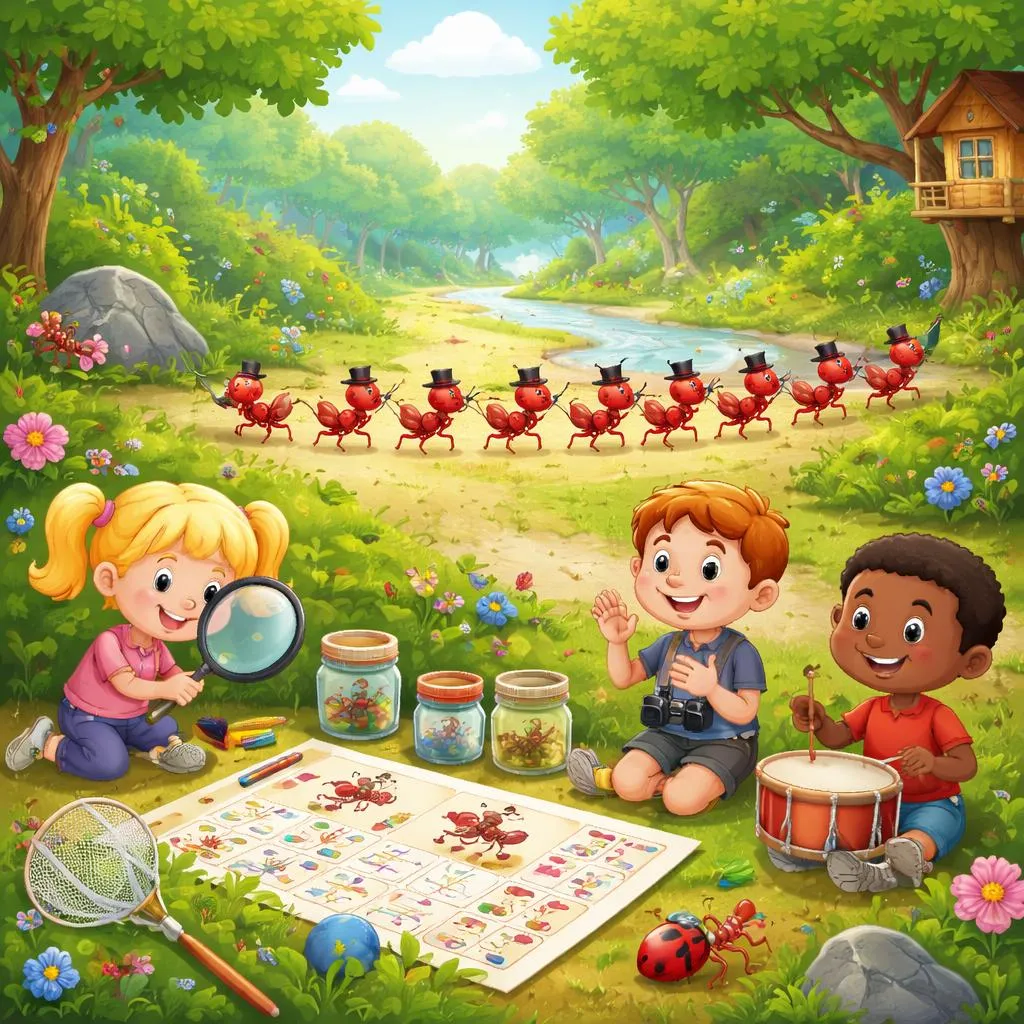
Let's get ready for a musical parade! The song lyrics the ants go marching belong to a classic, cumulative counting folk song. It tells the cheerful, rhythmic story of a line of ants marching one by one to escape the rain and get down into the ground. Each verse adds a new ant and a new, silly action that the little ant does.
This song is a powerhouse of early learning. Its repetitive, predictable structure makes it easy to memorize and sing along. The song lyrics the ants go marching are perfect for teaching numbers, sequencing, and action vocabulary through pure, energetic fun. It invites physical movement, making it an ideal tool for engaging whole bodies and minds.
The lyrics of nursery rhymes
The song lyrics the ants go marching follow a very clear and expanding pattern. The song establishes its catchy refrain: "The ants go marching one by one, hurrah, hurrah! The ants go marching one by one, hurrah, hurrah! The ants go marching one by one, the little one stops to suck his thumb, and they all go marching down to the ground to get out of the rain. Boom! Boom! Boom!"
Each subsequent verse increases the number (two by two, three by three...) and introduces a new rhyming action for the "little one" to perform. For "two by two," the action is often "tie his shoe." For "three by three," it might be "climb a tree." The lyrics use perfect, simple rhymes that children can anticipate, which is key to the song's participatory joy and educational value.
Vocabulary learning
The song lyrics the ants go marching introduce a wealth of practical vocabulary. First, we have the core nouns: ants, ground, rain. Then, we learn the numbers from one to ten (or beyond!) in a meaningful context: one, two, three, four, five...
Most enriching are the numerous compound action verbs that describe what each ant does. These are fantastic for expanding a child's verb bank: suck his thumb, tie his shoe, climb a tree, shut the door, take a dive. These phrases are vivid, easy to act out, and taught within the safety of repetition. The song also includes exclamations like "hurrah!" and onomatopoeia like "Boom!"
Phonics points
These lyrics are excellent for exploring specific sounds. The most prominent feature is the use of rhyming couples in each verse: one/thumb, two/shoe, three/tree, four/door, five/dive. This consistent pattern reinforces phonemic awareness—the understanding that words can share ending sounds.
We can also focus on initial consonant blends. Listen for the /m/ sound in marching, the /st/ blend in stops, and the /gr/ blend in ground. The repetitive phrase "down to the ground" highlights the /ow/ diphthong and the /d/ sound. Clapping or stomping along with the "Boom! Boom! Boom!" helps children feel the rhythm and stress of syllables, a key pre-reading skill.
Grammar patterns
The song lyrics the ants go marching demonstrate several useful grammar structures through relentless, musical repetition. The entire song is a series of statements in the simple present tense, used for habitual actions: "The ants go marching..." "The little one stops..." This tense is foundational for describing routines.
The lyrics also model the structure "stop to + verb" (e.g., "stops to suck his thumb"), which expresses pausing one action to do another. Furthermore, the final line, "to get out of the rain," introduces the infinitive "to get" expressing purpose. Children absorb these patterns naturally, learning how to construct sentences about interrupting an activity for a specific reason.
Learning activities
Bring the song to life with interactive activities. The most obvious is a "Marching Parade." Have children line up and march around the room while singing. Pause during each verse for the "little one" (a designated child or all children) to perform the action (pretend to tie a shoe, climb a tree, etc.). This connects language directly to physical movement and sequencing.
A fantastic cognitive extension is "What Comes Next?" Once familiar with the first few verses, stop singing before the action rhyme. Ask learners to predict it. "The ants go marching four by four, the little one stops to...?" This builds memory, predictive skills, and reinforces those crucial rhyming patterns from the song lyrics the ants go marching.
Printable materials
Printable resources can solidify the numerical and rhyming concepts. Create a "Number & Rhyme Matching Sheet." On one side, have columns with numbers 1-5 and the beginning of the action: "stops to suck his..." On the other side, in a jumbled order, have the rhyming words: thumb, shoe, tree, door, dive. Children draw a line to match the number to the correct rhyming action completion.
Another helpful printable is a "Story Sequence Wheel." Create a circular dial with a window. Around the wheel, draw or paste pictures for verses 1 through 5 (e.g., an ant with a thumb, an ant with a shoe, etc.). Children can turn the wheel to reveal each picture in order as they sing, providing a visual guide to the song's cumulative structure.
Educational games
Turn this into structured play. Play "Ant Hill Number Hunt." Hide cards numbered 1-10 around the room. These are the "ants." Children march to find them and bring them back to the "ant hill" (a central basket). They must place them in the correct numerical order, singing the corresponding verse from the song lyrics the ants go marching for each number they place.
For a focused phonics and listening game, try "Rhyming Ants." Give each child a picture card. Some cards show items from the song that rhyme (e.g., a thumb, a drum). Others show non-rhyming items. As you sing a verse, children holding cards that rhyme with the number's action (e.g., thumb when singing "one by one") stand up and march in place. This sharpens the ability to identify rhyming pairs.
The genius of the song lyrics the ants go marching is their perfect blend of simplicity, repetition, and escalating challenge. They teach counting not as a rote task, but as a narrative. They teach verbs not as a list, but as part of a story. They teach rhyme not as an abstract concept, but as a predictable, joyful game. This song doesn't just fill time; it builds foundational literacy and numeracy skills through a community experience of music and movement. So, line up, start counting, and let the joyful, educational parade begin