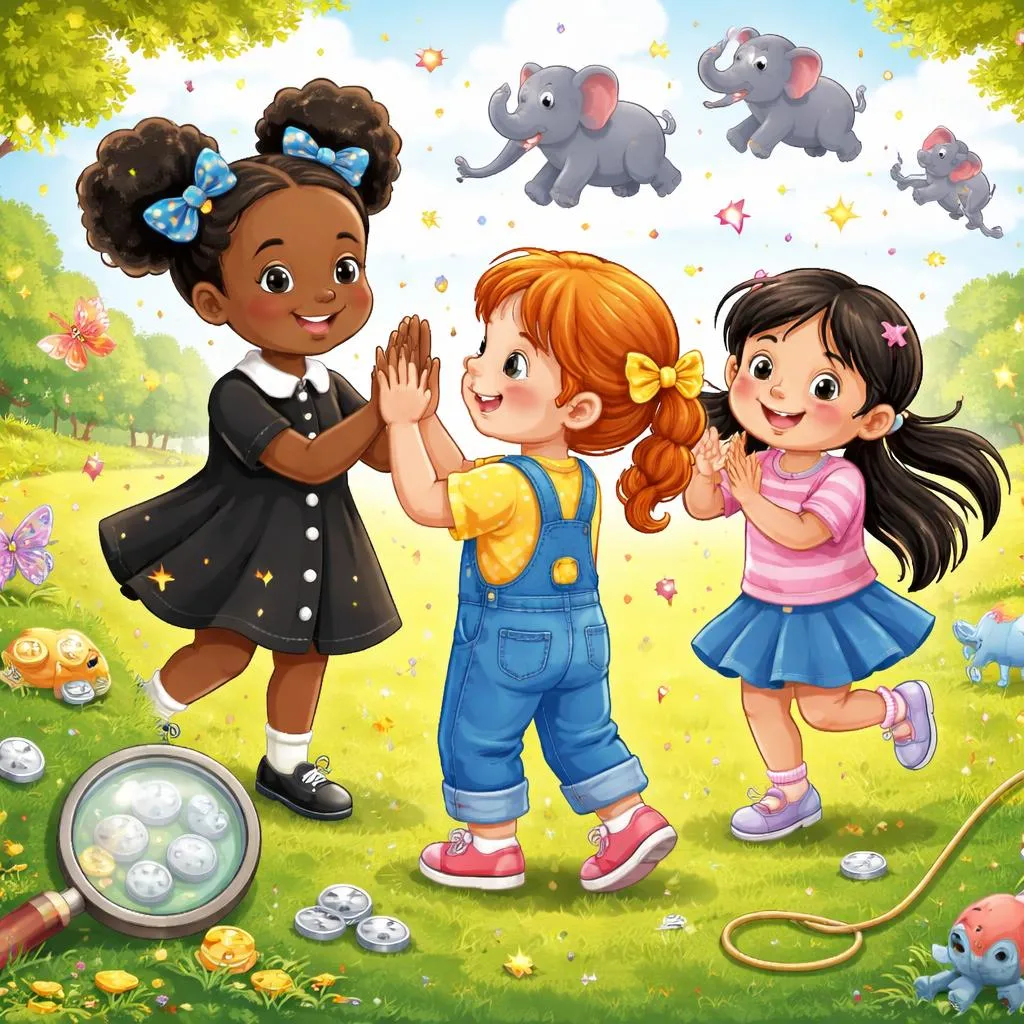

What is the rhyme?
Let's put our hands together for a classic today. The chant about Mrs Mary Mack is a beloved American clapping game and jump-rope rhyme. It’s not a quiet lullaby but a lively, rhythmic call-and-response piece. Children often sing it while performing a coordinated hand-clapping sequence with a partner.
The story within the Mrs Mary Mack words is wonderfully silly and exaggerated. It tells the tale of a lady named Mary Mack and her encounter with some elephants. The rhyme is famous for its catchy rhythm, repetitive structure, and the fun challenge of keeping the clapping pattern going. This makes it a perfect tool for developing timing, memory, and of course, practicing English sounds and words.
The lyrics of nursery rhymes
The most common version of the Mrs Mary Mack words follows a very set pattern. The lyrics are cumulative, meaning each verse adds a new, often absurd, detail. It usually begins:
Mrs. Mary Mack, Mack, Mack, All dressed in black, black, black, With silver buttons, buttons, buttons, All down her back, back, back.
The story then continues with her asking her mother for a specific sum of money to see the elephants jump. Each verse repeats the key phrases with added actions, like the elephants jumping so high they reach the sky, or so low they touch the ground. The heavy repetition of words and sounds is the heart of its appeal and its educational value.
Vocabulary learning
While the Mrs Mary Mack words tell a fantastical story, they introduce some excellent, concrete vocabulary. We learn common nouns like buttons, back, money, cents, elephants, sky, ground. The rhyme also uses simple but effective adjectives to paint a picture: black, silver, fifty, high, low.
More importantly, it is rich with action verbs that are fun to act out: dressed (in), ask, see, jump, reach, touch. The repetitive nature ensures these words are heard and said multiple times. This repetition helps move the words from passive recognition to active use, all within a playful, non-pressured context.
Phonics points
The Mrs Mary Mack words are a goldmine for specific phonics practice. The most prominent feature is the rhyming couplets. Each pair of lines rhymes perfectly: Mack/black/back, money/funny, high/sky, low/ground (in some versions). This reinforces the concept of word families and ending sounds.
The rhyme also heavily features consonant blends and alliteration. Listen to the strong /m/ sound in Mrs. Mary Mack, the /b/ in black and back, and the /s/ in silver buttons. The repetition of words with “-ack” (Mack, black, back) highlights a common word chunk. Clapping along with each syllable builds a strong sense of word rhythm and segmentation.
Grammar patterns
The structure of the Mrs Mary Mack words demonstrates several useful grammatical patterns through sheer repetition. A clear pattern is the use of the past tense to tell a simple story: “She asked her mother…” “...to see the elephants jump.” This exposes learners to common irregular past tense forms like “asked.”
We also see the structure for making a request: “She asked her mother for fifty cents…” Furthermore, the rhyme uses the comparative form of adjectives: “jump so high” and “so low.” The repetitive phrasing “All down her back, back, back” models how repetition can be used for emphasis in a fun, non-standard way.
Learning activities
The most obvious and best activity is to learn the clapping game! The coordinated hand movements—clapping own hands, clapping partner’s hands, cross-clapping—develop motor skills and bilateral coordination. The challenge of doing the actions while reciting the Mrs Mary Mack words builds focus, timing, and working memory. It’s a full-body language experience.
A great follow-up creative activity is “Draw the Story.” After learning the rhyme, illustrate the sequence. What does Mrs. Mary Mack look like with her silver buttons? How high are the elephants jumping? This visual representation helps with comprehension and sequencing. Learners can then use their drawings to retell the story in their own words.
Printable materials
Printable resources can help solidify the patterns in the Mrs Mary Mack words. A “Rhyming Word Match” worksheet is very effective. List words from the rhyme in one column (Mack, black, back, high, sky). In a jumbled column nearby, place their rhyming partners. Learners draw lines to connect the rhyming pairs, reinforcing that critical phonics skill.
Another useful printable is a “Fill-in-the-Blank” lyric sheet. Provide the first verse completely, then leave key vocabulary words blank in the subsequent verses. For example: “She asked her mother for ______ cents…” With a word bank at the top, learners can practice reading and recalling the specific Mrs Mary Mack words to complete the familiar rhyme.
Educational games
Beyond clapping, we can create other playful games. Try “Rhyme Time Freeze Dance.” Write several pairs of rhyming words from the rhyme on cards (Mack/black, high/sky, etc.). Play music. When the music stops, hold up a card. Learners must quickly find a partner and say a sentence using both rhyming words (e.g., “Mrs. Mack wears black!”). This encourages quick thinking and application.
For a listening and sequencing game, create “Story Card Scramble.” Print or draw six pictures that represent key events from the rhyme (e.g., 1. Mrs. Mary Mack, 2. Silver buttons, 3. Asking mother, 4. Fifty cents, 5. Elephants jumping high, 6. Elephants jumping low). Cut them out and mix them up. Working in pairs, learners must put the cards in the correct order as told by the Mrs Mary Mack words.
The enduring charm of the Mrs Mary Mack words lies in their perfect blend of rhythm, repetition, and ridiculousness. This combination makes the language stick. Learners are not just hearing words; they are feeling them in the clap of their hands, seeing them in the silly story, and chanting them with friends. This multi-sensory, social experience builds a robust and joyful foundation for language skills that goes far beyond simple memorization. So, find a partner, start clapping, and let the rhythmic learning begin