
What is the rhyme?
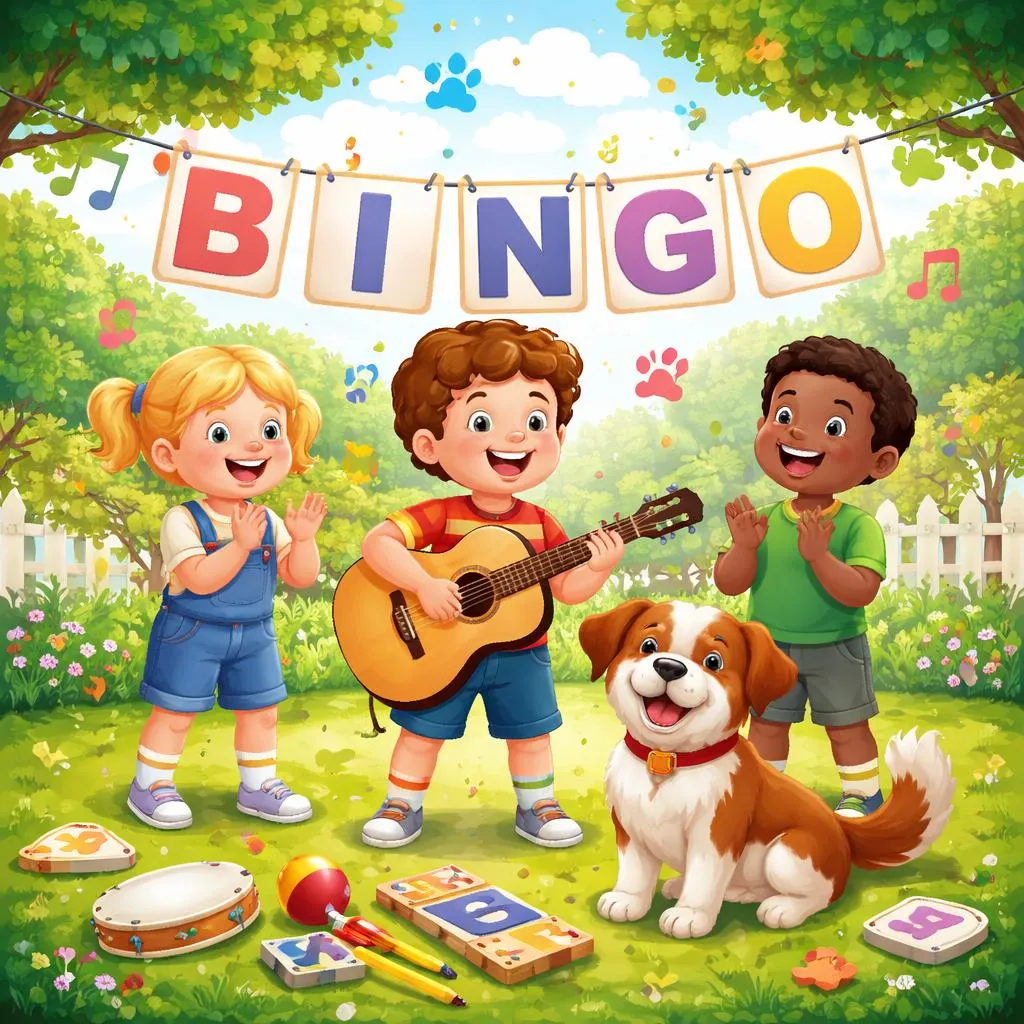
Let's clap our hands and learn a classic today. The Bingo lyrics song is a timeless folk tune and clapping game that tells a cheerful story about a farmer's dog. Its magic lies not in a complex plot, but in its brilliant, cumulative structure. Each verse systematically replaces one letter of the dog's name with a clap.
This interactive design makes the Bingo lyrics song a powerhouse for early learning. It turns spelling practice into a joyful, physical activity. Children practice letter recognition, sequencing, and rhythm all at once. It’s a call-and-response adventure that builds anticipation and group participation, making it a favorite in classrooms and homes worldwide.
The lyrics of nursery rhymes
The Bingo lyrics song follows a clear and predictable pattern, which is key to its educational value. The song establishes its story in the opening verse: "There was a farmer had a dog, and Bingo was his name-o. B-I-N-G-O, B-I-N-G-O, B-I-N-G-O, and Bingo was his name-o!"
The pattern then shifts. The next verse replaces the first letter 'B' with a clap: "(Clap)-I-N-G-O..." The following verse uses two claps for 'B' and 'I': "(Clap)-(Clap)-N-G-O..." This continues until all five letters are replaced by claps. The consistent rhythm and repetition in the Bingo lyrics song make it incredibly easy to follow and deeply satisfying to sing.
Vocabulary learning
While centered on spelling, the Bingo lyrics song introduces a set of useful, high-frequency vocabulary. The core nouns are farmer, dog, name. Learners also master the letter names B, I, N, G, O as distinct vocabulary items, which is a foundational pre-reading skill.
The song reinforces common verbs in the simple past tense, such as was and had. The repetitive framework ensures these words become deeply familiar. Furthermore, the action of clapping becomes an associated verb, connecting language to movement. This concise vocabulary set is practiced so frequently it builds a solid base for constructing simple sentences.
Phonics points
This song is an excellent tool for building phonemic awareness. The primary focus is on letter names versus their sounds, a crucial distinction for early readers. Chanting "B-I-N-G-O" reinforces the alphabetic names in a fixed sequence.
We can also highlight the initial consonant sound /b/, as heard in Bingo. The consistent "-o" ending in "Bingo" and "name-o" provides a stable rhyming sound throughout. For extended practice, children can identify the first sound in their own names and compare it to /b/. The rhythmic clapping physically segments the word into its five distinct phonemic parts, reinforcing the concept that words are made of individual units.
Grammar patterns
The Bingo lyrics song beautifully models a fundamental grammar structure: the simple past tense narrative. The entire song is a mini-story told in the past, using the classic folk structure: "There was a... who had a...". This exposes learners to a common narrative phrasing.
It also reinforces the possessive pronoun "his" in the phrase "his name-o." The consistent subject-verb-complement order in the lyric "Bingo was his name" provides a clear, repetitive model for building simple, declarative English sentences. This grammatical framework is absorbed naturally and musically, without explicit instruction.
Learning activities
The core activity is, of course, singing with coordinated clapping. This develops auditory processing, motor skills, and rhythmic precision. To increase engagement, vary the actions: stomp feet, tap shoulders, or use rhythm sticks on the "clap" beats.
A fantastic creative extension is "Adapt the Song." Once the original is mastered, use the same tune for other five-letter words. This could be a child's name ("S-A-R-A-H"), a pet's name, or another animal ("K-I-T-T-Y"). This activity practices flexible thinking, spelling, and applies the song's grammatical structure to new vocabulary, deepening comprehension.
Printable materials
Printable resources can bridge the auditory song with visual learning. A "Bingo Spelling Wheel" is highly effective. Create a circular dial with a window that reveals one letter at a time from the sequence B-I-N-G-O. Children turn the wheel to "hide" letters, visually mimicking the song's progression.
A "Clapping Sequence Chart" is another great tool. This sheet has six columns for each verse. Each column displays the five letters, with progressively more replaced by a clap symbol (👏). Learners can point to the chart as they sing, creating a strong visual-auditory link that supports memory, sequencing, and the concept of subtraction.
Educational games
Transform the song into lively play. Try "Musical Spelling Chairs." Place five chairs in a row, each with a letter card: B, I, N, G, O. Six children walk around as you sing. Pause the music suddenly. Everyone finds a chair. The child without a chair must identify a letter on a chair or say its sound. This adds excitement and letter review.
For a hands-on spelling game, organize "Letter Build & Remove." Use magnetic letters or printed cards. As you sing each verse, children physically place the letters B-I-N-G-O in order. On the clapping verses, they remove the corresponding letter. This tactile activity directly connects the auditory pattern of the Bingo lyrics song to concrete word building and deconstruction.
The enduring power of the Bingo lyrics song lies in its elegant fusion of music, movement, and literacy. It demonstrates that foundational skills like spelling and grammar can be practiced through joy and play. The song doesn't just teach letters; it teaches patterns, prediction, and participation. It turns a learning moment into a shared, energetic experience that children want to repeat. In doing so, it builds not just literacy skills, but also confidence and a positive association with language learning that lasts far beyond the final clap.