
What is this topic about?
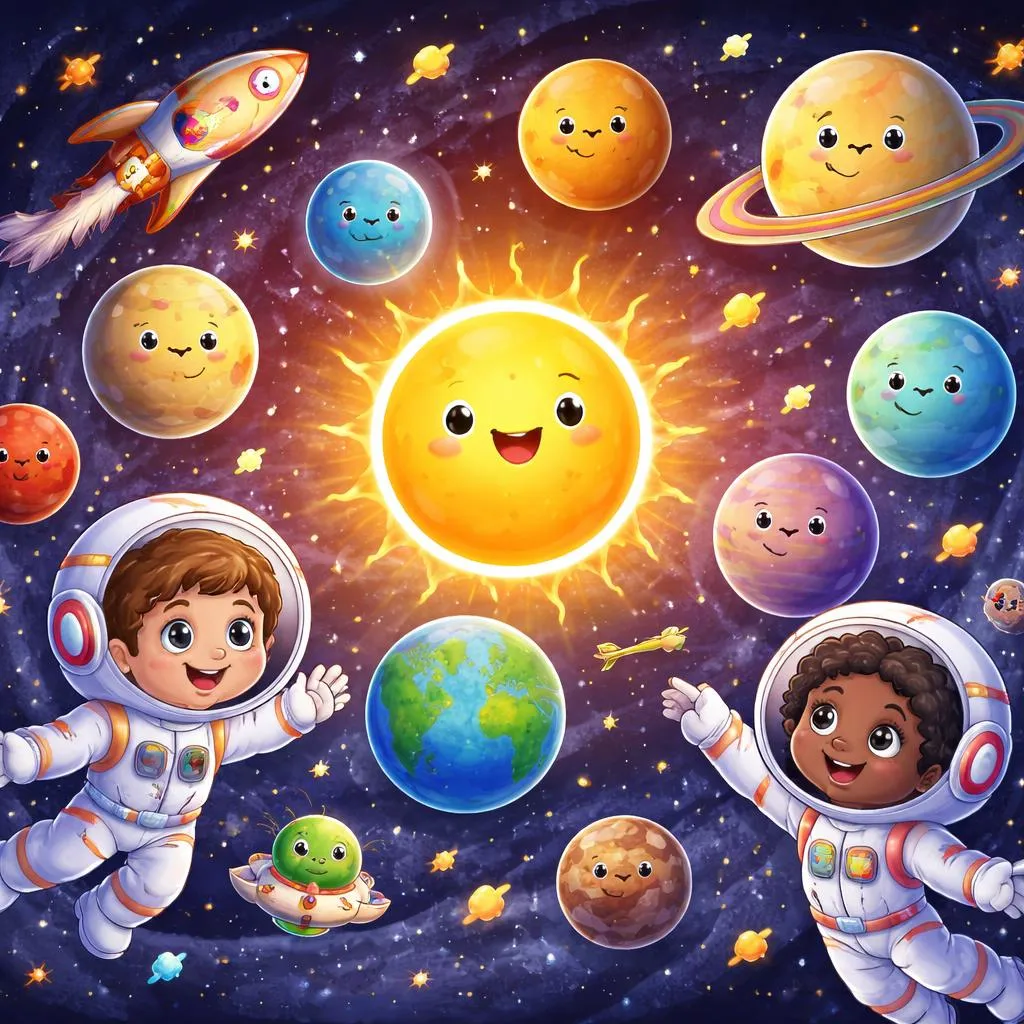
Let's go on an incredible journey today—a journey through our solar system. Learning the names of planets is about much more than memorizing a list. It's an adventure into science, mythology, and the vastness of space. It connects us to the universe right from our classroom or home.
When we study the names of planets, we learn about our cosmic neighborhood. We discover which planets are rocky like Earth and which are giant balls of gas. We learn about their order from the Sun. This topic sparks wonder, builds advanced vocabulary, and answers a fundamental human question: "What's out there?" It's a perfect blend of language learning and scientific discovery.
Meaning and explanation
Why do we teach the names of planets? These names are proper nouns, each holding history and meaning. Most are named after Roman gods and goddesses. For example, Mars is the god of war, and Venus is the goddess of love. Knowing these names gives children a key to understanding not just science, but also stories from ancient cultures.
Learning the names of planets also introduces key scientific concepts. We learn that planets orbit a star, our Sun. We learn about size, distance, and basic composition. This builds a framework for understanding Earth's place in the universe. It encourages observation, curiosity, and the use of specific, descriptive language to talk about faraway worlds.
Categories or lists
We can organize the names of planets in a few helpful ways. The most common way is by their order from the Sun. This gives us a memorable sequence: Mercury, Venus, Earth, Mars, Jupiter, Saturn, Uranus, Neptune. A classic mnemonic is "My Very Educated Mother Just Served Us Noodles."
We can also categorize them by type. The four planets closest to the Sun—Mercury, Venus, Earth, Mars—are the Terrestrial Planets (rocky). The next four—Jupiter, Saturn, Uranus, Neptune—are the Gas Giants (or, separating Uranus and Neptune as Ice Giants). Another fun list is by special features: the planet with rings (Saturn), the red planet (Mars), the largest planet (Jupiter), the blue planet (Earth and Neptune). Sorting helps manage the information.
Daily life examples
We encounter the names of planets in many everyday places. The most direct example is looking at the night sky. We might point out "Look, that bright 'star' is actually Jupiter!" or talk about the "Evening Star," which is the planet Venus.
We see planets in books, documentaries, and museum exhibits. In movies and cartoons, characters often travel to Mars or Saturn. News reports discuss missions like the Mars Rover. Even the days of the week are named after celestial bodies, some of which are planets (e.g., Saturday for Saturn). Connecting these names to real-world references makes the vocabulary meaningful and exciting.
Printable flashcards
Printable flashcards are stellar tools for learning the names of planets. Create a set where one side shows a clear, colorful image of the planet (using NASA photos or accurate illustrations). The other side should have the planet's name in large print and one key fact.
For example, the Mars card's back could say: "Mars: The Red Planet. It has two moons." The Jupiter card could say: "Jupiter: The Largest Planet. It has a giant storm called the Great Red Spot." Use these cards for ordering games, matching facts, or simple "Guess the Planet" quizzes. Visual aids are crucial for remembering these distant objects.
Learning activities and games
Learning comes alive with interactive activities. A fantastic hands-on project is "Create a Solar System Model." Use different-sized balls (a pea for Mercury, a grape for Earth, a large beach ball for Jupiter). Arrange them in order along a measured string in a hallway or playground to show relative distance. As you place each ball, say its name and a feature.
Another engaging activity is "Planet Profile Posters." Assign or let children choose a planet. They research (with help) and create a poster with its name, picture, position, size, and two cool facts. They then present their "planet report" to the class. This builds research, creativity, and presentation skills using the target vocabulary.
For a physical game, play "Gravity-Free Planet Tag." Designate areas of the playground as different planets. One child is the "Sun" in the center. When the Sun calls out a planet's name, like "VENUS!", all children must run to the Venus zone. The last one to arrive becomes the new Sun. This connects the names to movement and quick recall.
A simple yet effective tabletop game is "Planet Memory Match." Create two sets of cards: one with planet names and one with planet pictures or key facts. Turn all cards face down. Players take turns flipping two cards at a time, trying to find a name-and-picture pair. This reinforces recognition and matching.
What is the rhyme?
Many children learn the order of the planets through a song or chant. A popular one is a simple rhyme set to a tune like "Twinkle, Twinkle, Little Star" or "She'll Be Coming 'Round the Mountain." The lyrics are the mnemonic put to music: "Mercury, Venus, Earth, and Mars, Jupiter, Saturn are among the stars. Uranus, Neptune, that makes eight, orbiting the Sun, they are great!"
Singing the names of planets adds rhythm and melody, which dramatically aids memorization. It turns a list into a musical sequence that's easy to recall. The song provides a auditory framework that children can "play" in their minds long after the lesson.
Vocabulary learning
This topic introduces powerful, specific vocabulary. First, the core proper nouns: Mercury, Venus, Earth, Mars, Jupiter, Saturn, Uranus, Neptune. We also learn related space terms: Sun, solar system, orbit, moon, rings, atmosphere, gas giant, terrestrial, asteroid belt.
The activity encourages descriptive adjectives: rocky, gaseous, giant, cold, hot, red, ringed, distant. Using these words in context—"Jupiter is a gas giant"—builds a rich, scientific vocabulary that goes far beyond everyday language and encourages precise description.
Phonics points
The names of planets offer interesting phonics challenges. Many names contain multi-syllabic structures perfect for clapping: Mer-cu-ry (3), Ve-nus (2), Ju-pi-ter (3), Sat-urn (2), U-ra-nus (3), Nep-tune (2). This builds phonological awareness.
We can focus on vowel sounds and unusual consonant blends. The long /ū/ sound in Uranus, the soft /j/ sound in Jupiter, the /th/ digraph in Earth, and the /pt/ blend in Neptune are all great for practice. The names themselves become a fun exercise in decoding longer, more complex words.
Grammar patterns
Working with planet names reinforces key grammar. All planet names are proper nouns and must always be capitalized. This is a clear, non-negotiable rule we can practice repeatedly. We also use the verb "to be" for description: "Mars is red." "Jupiter is large."
We practice prepositions of place when discussing order: "Earth is between Venus and Mars." "Neptune is farthest from the Sun." We also use possessive forms: "Earth's moon," "Saturn's rings." These grammatical structures are practiced in a highly engaging context.
Printable materials
Create a "Solar System Passport." This is a printable booklet with a page for each planet. Each page has a space to write the planet's name, draw it, and record one fact (e.g., "Number from Sun: 4"). As children "visit" each planet through activities or videos, they fill out their passport. This creates a personal record of their learning journey.
A "Planet Adjective Match" worksheet is also useful. List the planets on one side. On the other, in a jumbled order, list descriptive phrases: "the red planet," "has beautiful rings," "we live here," "the largest." Children draw lines to connect each planet to its best-known description.
The journey through the names of planets is more than a vocabulary lesson. It is an exercise in scale, wonder, and systematic thinking. By using songs, models, games, and creative projects, we make these distant worlds feel real and exciting. This approach builds not only language skills but also a foundational curiosity about science and our place in the cosmos. The spark of interest ignited by learning these eight names can light a lifetime of exploration.