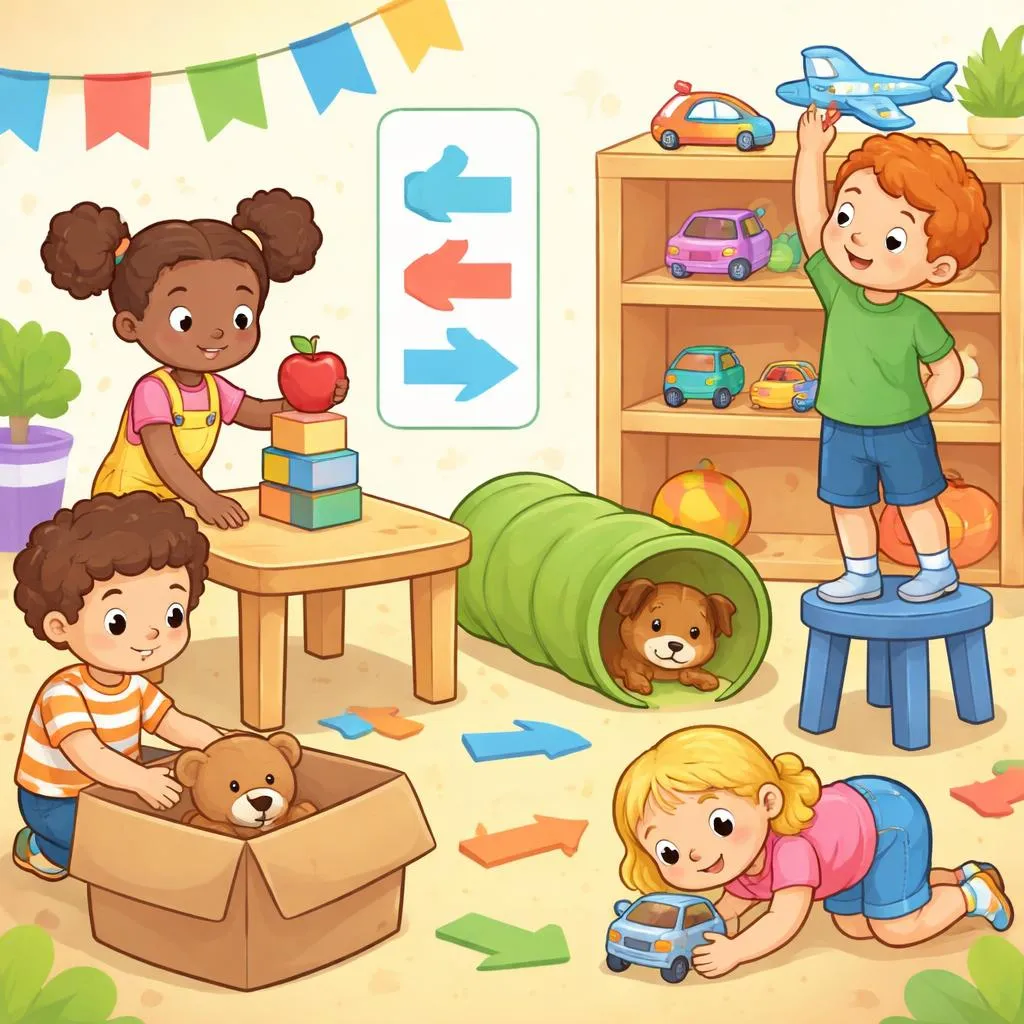

Hello, playful teachers and energetic young learners! Today we explore words that tell us where things are. They tell us about location and position. Words like in, on, under, behind, and next to. These are called prepositions. Learning them can be tricky. But preposition games make it fun and active. Children learn best when they move and play. Games help them understand location words naturally. Let us discover exciting games together. Let us learn where the ball is, where the bear is, and where we are.
What Are Prepositions? Prepositions are words that show the relationship between things. They often tell us where something is. They can also tell us when something happens. The most common prepositions are about location.
Think about a pencil. Where can it be? It can be on the desk. It can be in the drawer. It can be under the book. It can be behind the computer. Each of these little words changes where we imagine the pencil.
Prepositions are essential for clear communication. Without them, sentences would be confusing. "The cat is the box" does not make sense. "The cat is in the box" gives a clear picture. Children need to learn these words to describe their world accurately.
Meaning and Explanation of Common Prepositions Let us explore the most common prepositions children need to learn.
In means inside something. The toy is in the box. The fish swims in the water. The pencil is in the case.
On means touching the top surface. The book is on the table. The picture is on the wall. The cat sleeps on the bed.
Under means below something. The shoes are under the bed. The treasure is under the ground. The dog hides under the chair.
Behind means at the back of something. The sun is behind the cloud. The child stands behind the door. The car is behind the truck.
In front of means before something facing it. The teacher stands in front of the class. The bicycle is in front of the house.
Next to means beside or adjacent. The library is next to the school. The cup is next to the plate.
Between means in the middle of two things. The ball is between the two chairs. The sandwich is between the two slices of bread.
Above means higher than. The airplane flies above the clouds. The picture hangs above the sofa.
Below means lower than. The fish swim below the surface. The basement is below the first floor.
Categories or Lists of Preposition Games Here are preposition games organized by type and energy level.
Movement Games: These games get children moving around the room.
Simon Says with Prepositions: Play Simon Says using prepositional phrases. "Simon says put your hand on your head." "Simon says stand behind your chair." "Simon says put your pencil under your book." This builds listening and following directions.
Preposition Obstacle Course: Set up an obstacle course with instructions using prepositions. "Go under the table." "Climb over the pillow." "Walk around the chair." "Go through the hoop." Children follow the course while saying the prepositions.
Where Is the Bear?: Hide a stuffed animal in different places around the room. Children close their eyes while you hide it. Then they search and describe where they find it. "The bear is under the desk!" "The bear is behind the curtain!"
Action Games: These games combine prepositions with physical actions.
Preposition Dance: Play music and call out preposition instructions. "Put your hands above your head!" "Put your arms behind your back!" "Put your fingers between your palms!" Children dance and follow along.
Follow the Leader with Prepositions: The leader moves around the room and describes their actions. "I am going under the table." "I am standing next to the window." Followers copy and repeat the phrases.
Balloon Fun: Give each child a balloon. Call out instructions. "Put the balloon above your head!" "Put the balloon between your knees!" "Hold the balloon behind your back!" This works on coordination and prepositions.
Quiet Games: These games work well for calmer moments.
Preposition Bingo: Create bingo cards with pictures showing different positions. A cat in a box. A dog under a table. A bird above a tree. Call out the prepositional phrases. Children cover the matching picture.
Draw the Preposition: Give children paper and crayons. Describe a scene using prepositions. "Draw a tree in the middle. Draw a bird above the tree. Draw a flower next to the tree. Draw a worm under the ground." Children draw what they hear.
Preposition Memory: Create pairs of cards. One card has a picture showing a position. The matching card has the words. "The cat is under the chair." Children flip and match.
Daily Life Examples of Prepositions Prepositions appear everywhere in daily conversation. Pointing them out helps children learn naturally.
At breakfast, use prepositions. "The milk is in the refrigerator." "Put your plate on the table." "The spoon is next to the bowl." This constant modeling builds understanding.
During play, describe what children are doing. "You are hiding behind the couch." "The ball is under the chair." "Come sit beside me." Children hear prepositions in context.
At cleanup time, give directions with prepositions. "Put the blocks in the box." "Place the books on the shelf." "Put the crayons next to the paper." This connects prepositions to actions.
During story time, point out prepositions in books. "Look, the mouse is under the mushroom." "The bird is above the tree." Pictures make the meaning clear.
Printable Flashcards for Prepositions Flashcards help children learn prepositions visually. They provide clear images with words.
Position Flashcards: Create cards showing a simple object in different positions. A ball in a box, on a box, under a box, behind a box, next to a box. Each card has the preposition word.
Animal Position Flashcards: Use animals children love. A cat on a chair, a dog under a table, a bird above a tree. These are more engaging for young learners.
Preposition Word Cards: Create cards with just the preposition words. In, on, under, behind, next to, between, above, below. Children match them to the picture cards.
Sentence Flashcards: Create cards with full sentences and pictures. "The cat is under the chair." Children read or repeat the sentence.
Learning Activities or Games for Prepositions Games make learning prepositions active and fun.
Preposition Scavenger Hunt: Give children a list of preposition tasks. "Find something under a chair." "Find something behind a door." "Find something between two books." Children search and report back.
Preposition Simon Says: This classic game works perfectly for prepositions. "Simon says put your hand on your head." "Simon says stand behind your chair." "Simon says put your pencil under your book." Children who move without "Simon says" are out.
Where's the Toy?: Place a small toy in different positions around a box or chair. Ask children to describe where it is. "The toy is on the box." "Now it is under the box." "Now it is behind the box." This builds observation and language.
Prevention Drawing Dictation: Describe a scene using prepositions. Children draw what you describe. "Draw a house in the middle. Draw a tree next to the house. Draw a bird above the tree. Draw a flower in front of the house." Compare drawings at the end.
Printable Materials for Prepositions Printable resources support preposition learning. They provide structure for activities.
Preposition Posters: Create posters showing each preposition with a clear picture. Display them around the room for reference.
Preposition Coloring Pages: Create coloring pages showing positional scenes. A cat under a chair. A bird above a tree. Children color and describe what they see.
Preposition Mini-Book: Create a small booklet with a page for each preposition. Children draw the picture and trace or write the word.
Preposition Matching Worksheets: Create pages where children match the picture to the correct preposition word. Draw a line from the cat under the chair to the word "under."
Educational Games for Prepositions Games extend preposition learning in joyful ways.
Preposition Charades: Act out a preposition without speaking. Stand under an imaginary umbrella. Hide behind an imaginary door. Others guess the preposition being acted out.
Preposition I Spy: Play I Spy using prepositions. "I spy something on the shelf." "I spy something under the table." "I spy something next to the door." Children guess what you see.
Preposition Cube: Create a cube with different prepositions on each side. Children roll the cube and then put a small toy in that position relative to something. "Under!" They put the toy under the chair.
Preposition Hop: Place hoops or mats around the room. Call out preposition instructions. "Jump in the hoop!" "Stand next to the hoop!" "Put your hand above the hoop!" This combines gross motor skills with language.
Preposition Story Building: Start a story that uses prepositions. "Once upon a time, a little mouse lived under the floor." Children continue the story, trying to include prepositions. "One day, he climbed up the wall and hid behind a picture." This builds narrative skills and preposition use.
Through preposition games, children learn location words naturally. They move their bodies and use their imaginations. They see, hear, and act out the meanings of these important words. Games make learning joyful and memorable. Children remember "under" because they crawled under a table. They remember "behind" because they hid behind a door. The words become part of their active vocabulary through play.