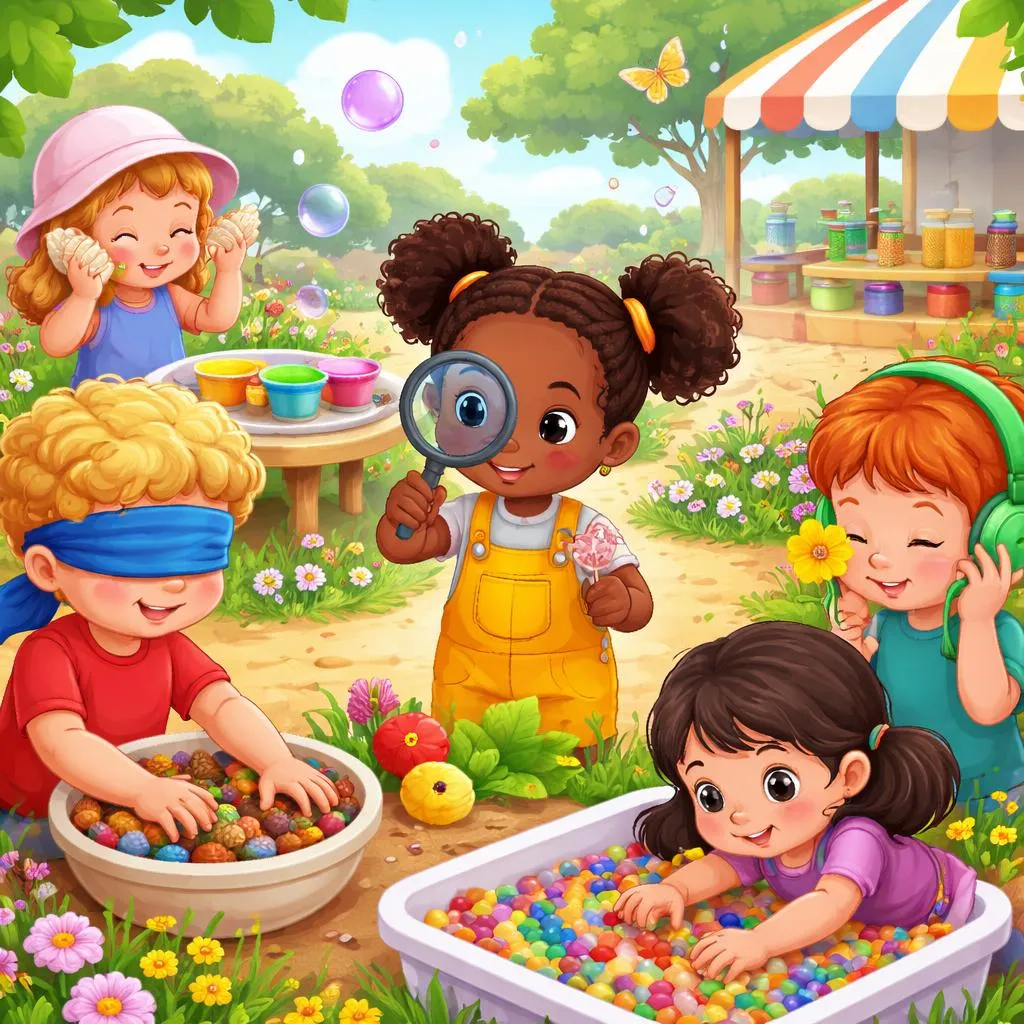

Young children learn about the world through their senses. Every day, they see, hear, touch, taste, and smell new things. Planned sensory activities help them focus on these experiences and build vocabulary. Today, we are going to explore engaging senses activities for preschoolers that will delight young learners and build important observation skills.
What Are Senses Activities? Senses activities are planned experiences that help children focus on one or more of the five senses. These activities encourage children to notice details they might otherwise miss. They build vocabulary for describing sensory experiences.
Senses activities can focus on one sense at a time. A listening walk helps children focus on hearing. A tasting party helps them focus on taste. Or activities can combine multiple senses. Playing with sensory bins engages touch, sight, and sometimes smell.
These activities build important skills. Observation, description, comparison, and classification all develop through sensory play. Children learn to notice and talk about what they experience.
Meaning and Explanation of the Five Senses Before starting activities, children need to understand what the senses are and why they matter.
Sight uses our eyes. We see colors, shapes, sizes, and movement. Our eyes help us find things, read books, and see faces.
Hearing uses our ears. We hear sounds, music, voices, and noises. Our ears help us listen to stories and enjoy songs.
Touch uses our skin. We feel textures, temperatures, and pressure. Our skin tells us if something is soft or hard, hot or cold.
Taste uses our tongue. We taste sweet, sour, salty, bitter, and savory flavors. Our tongue helps us enjoy food.
Smell uses our nose. We smell flowers, food, and other scents. Our nose helps us enjoy pleasant smells and warns us of dangers.
We can explain that our senses are like special tools our bodies have. Each tool gives us different information about the world.
Categories or Lists of Senses Activities Here are activities for each sense that work well with preschoolers.
Sight Activities: Color mixing with paint or colored water. Looking through magnifying glasses at leaves, rocks, and fabric. Playing I Spy with colors and shapes. Exploring a light table with translucent objects. Watching shadow puppets on the wall. Making binoculars from paper tubes and going on a sight walk. Looking at optical illusions.
Hearing Activities: Listening to sounds in nature during a quiet walk. Playing musical instruments and comparing sounds. Making shakers with different materials inside. Playing sound guessing games with eyes closed. Reading books with sound effects. Exploring loud and soft, high and low sounds. Making a rain stick.
Touch Activities: Sensory bins with rice, beans, sand, or water. Feeling different textures like fur, sandpaper, silk, and bubble wrap. Playing with play dough, clay, and slime. Exploring temperature with warm and cool items. Creating a texture board with different materials glued on. Having a feely bag where children reach in and guess objects. Walking barefoot on different textures.
Taste Activities: Tasting parties with different flavors. Sweet apple slices, salty pretzels, sour lemon, bitter dark chocolate. Blind taste tests where children guess what they are eating. Cooking simple recipes together. Exploring how temperature affects taste with warm and cold foods. Always check for allergies first.
Smell Activities: Smelling jars with different scents. Cotton balls with extracts, spices, flowers, lemon peels. Identifying smells blindfolded. Making scented play dough with different extracts. Exploring smells in nature during a walk. Matching smells to pictures. Discussing favorite and least favorite smells.
Daily Life Examples of Using Senses Throughout the day, point out sensory experiences to children.
During breakfast, talk about what children sense. "The toast smells warm. The orange juice tastes sweet. The cereal goes crunch."
During outdoor play, notice all the senses. "Look at the blue sky. Feel the warm sun. Hear the birds singing. Smell the grass."
During art, observe sensory details. "The paint feels cool and smooth. Look how the colors mix. Hear the brush on the paper."
During music, focus on hearing. "This song is fast. This song is slow. Shake the bells softly."
These natural observations make sensory awareness part of every day.
Printable Flashcards for Senses Activities Flashcards help children learn the names of the senses and the body parts associated with them.
Create cards for each sense:
Sight with a picture of eyes
Hearing with a picture of ears
Touch with a picture of a hand
Taste with a picture of a mouth and tongue
Smell with a picture of a nose
Create matching cards that show things we experience with each sense. A rainbow for sight. A bell for hearing. A soft blanket for touch. An ice cream cone for taste. A flower for smell.
Children match the sense to the object. This builds understanding of which sense we use for different experiences.
Learning Activities or Games for Senses Games make learning about senses active and engaging. Here are activities that work well in the classroom.
Sensory Stations: Set up five stations around the room, one for each sense. At the sight station, provide magnifying glasses and interesting things to look at. At the hearing station, provide instruments and sound-making objects. Children rotate through the stations in small groups.
Mystery Box: Place an object in a box with a hole for reaching in. Children reach in without looking and feel the object. They describe what they feel. Is it soft or hard? Smooth or rough? They guess what it might be.
Sound Guessing Game: Make sounds behind a screen or with eyes closed. Ring a bell, crinkle paper, pour water, shake keys. Children guess what is making each sound.
Smell Jars: Place different scented items in opaque containers with holes in the lid. Cotton balls with extracts, spices, flowers, lemon peels. Children smell and guess each scent.
Taste Testing: Provide small samples of foods with different tastes. Sweet apple slices, salty pretzels, sour lemon, bitter dark chocolate. Children describe each taste. Always check for allergies first.
Texture Walk: Create a path with different textures to walk on barefoot. Carpet squares, bubble wrap, smooth stones, soft fabric, cool tile. Children feel each texture with their feet.
I Spy with My Little Eye: Play I Spy using sight. "I spy something red. I spy something round." Children use their eyes to find the object.
Feely Bag: Place several small objects in a bag. Children reach in, feel one object, and describe it before pulling it out. This builds descriptive language.
Senses Books for Preschoolers Picture books reinforce sensory concepts. Here are some favorites.
"My Five Senses" by Aliki is a classic introduction. It shows how children use their senses throughout the day.
"Brown Bear, Brown Bear, What Do You See?" by Bill Martin Jr. focuses on sight.
"Polar Bear, Polar Bear, What Do You Hear?" by Bill Martin Jr. focuses on hearing.
"You Can't Taste a Pickle With Your Ear" by Harriet Ziefert explores all the senses.
"The Listening Walk" by Paul Showers describes all the sounds heard on a walk.
While reading, pause and talk about which senses the characters are using.
Senses Songs Music helps children remember sense concepts. Here are some simple songs to sing.
Five Senses Song (to the tune of "Where Is Thumbkin?"):
Five senses, five senses, We have them, we have them. Seeing, hearing, touching, Tasting and smelling. There are five, there are five.
My Eyes Can See (to the tune of "Row, Row, Row Your Boat"):
My eyes can see the sun, My ears can hear a drum, My hands can touch and feel, My tongue can taste a meal. My nose can smell a rose, That's how my body knows!
Sing these songs during circle time to reinforce the sense names.
Senses Science Explorations Simple experiments help children understand how their senses work.
Sight Exploration: Use magnifying glasses to look at small things closely. Compare how things look up close and far away. Explore color mixing.
Hearing Exploration: Make simple shakers with different materials inside. Rice, beans, sand, bells. Compare the sounds. Explore loud and soft.
Touch Exploration: Explore temperature by feeling warm and cool items. Compare textures. Make handprints in play dough.
Taste Exploration: Discover that we taste different flavors on different parts of our tongue. Try tasting with your nose plugged.
Smell Exploration: Explore how smell affects taste. Try eating something while holding your nose. Does it taste the same?
Creating a Senses Museum A wonderful culminating activity is creating a classroom "Senses Museum." Children help collect items for each sense.
For sight, they bring interesting things to look at. A kaleidoscope, a prism, colorful pictures.
For hearing, they bring things that make sounds. Bells, whistles, shakers, music boxes.
For touch, they bring different textures. A soft scarf, a rough sponge, a smooth stone, a bumpy ball.
For taste, they bring pictures of foods with different flavors. Sweet, sour, salty, bitter.
For smell, they bring safe scented items. A flower, a lemon, a cinnamon stick, a vanilla bean.
Display everything in labeled areas. Invite another class to visit. Children explain each exhibit.
Sensory Processing and Individual Differences Children experience senses differently. Some children are very sensitive to certain sensations. Others seek out intense sensory input.
Create activities that are inviting for all children. Offer choices. Some children may not want to taste or touch certain things. Never force participation.
Observe how children respond. Some may cover their ears at loud sounds. Some may avoid sticky textures. Adjust activities accordingly.
Create a sensory-friendly environment. Quiet spaces for children who need a break. A variety of textures and materials.
Connecting Senses to Seasons Sensory activities can connect to seasons throughout the year.
In fall, explore smells of cinnamon and pumpkin. Feel dried leaves. Taste apple cider. Hear leaves crunch. See colors changing.
In winter, feel cold snow. Smell peppermint. Taste warm cocoa. Hear winter songs. See twinkling lights.
In spring, smell flowers. Feel soft new leaves. Hear birds singing. Taste fresh fruits. See new growth.
In summer, feel warm sun. Taste cold watermelon. Hear insects. Smell cut grass. See bright colors.
These connections make sensory learning timely and meaningful.
As we explore senses activities for preschoolers, we open doors to deeper understanding of themselves and their world. Children learn to notice details they might have missed. They build vocabulary for describing experiences. They develop scientific observation skills. Through sight, hearing, touch, taste, and smell, children discover the wonder of being alive.