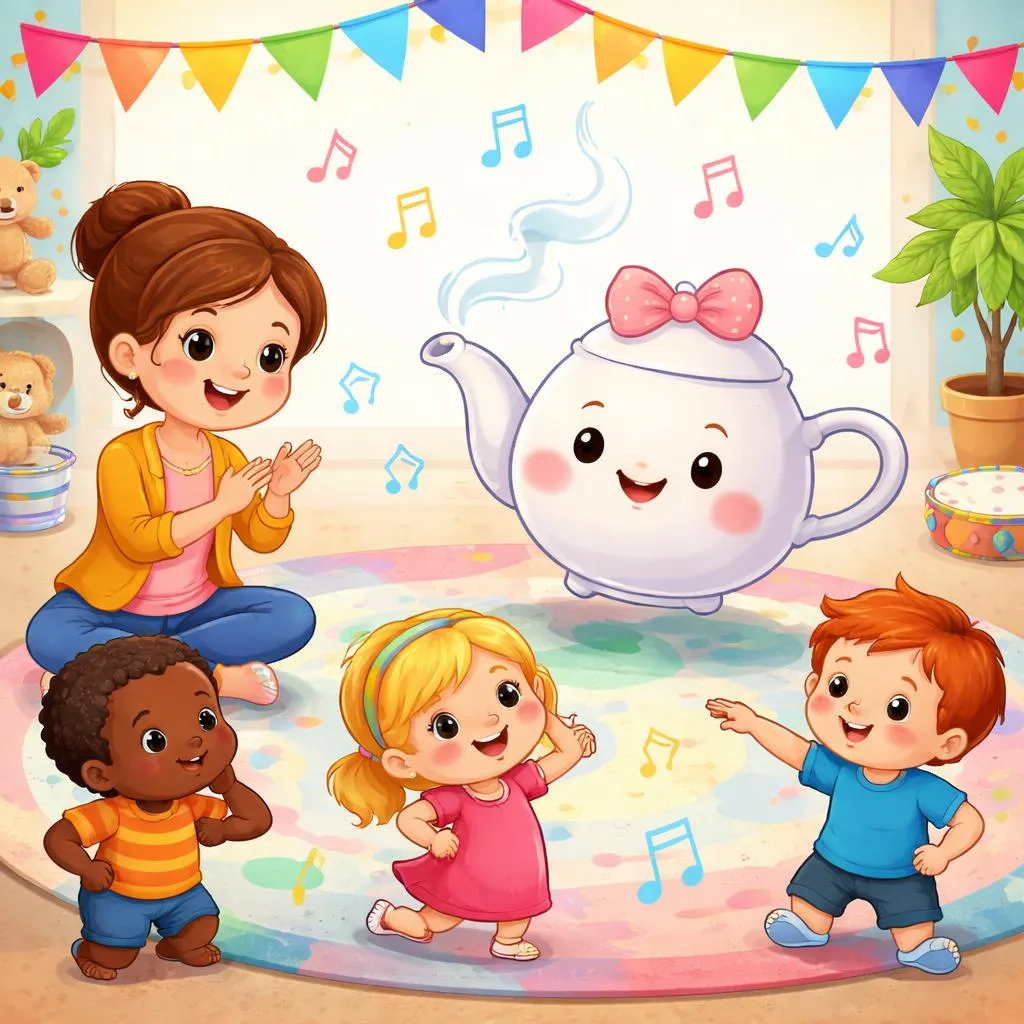

The "I'm a Little Teapot" song has delighted children for generations. Its simple melody and charming actions make it a classroom favorite. Today, we are going to explore the little teapot song words and discover how this classic rhyme can teach language, movement, and imagination to young learners.
What Is the Little Teapot Song? The "I'm a Little Teapot" song is a classic American nursery rhyme. It was written in 1939 by George Harold Sanders and Clarence Z. Kelley. The song was created to teach a dance routine to children. It became instantly popular and has remained a staple ever since.
The song personifies a teapot. The teapot sings about its own body parts. It has a handle on one side and a spout on the other. When it gets excited, it shouts and tips over to pour out the tea. Children love acting out these movements.
The song is perfect for young learners. It has a simple, memorable tune. The words are easy to understand. The actions are clear and fun. It combines music, movement, and imagination in one delightful package.
The Lyrics of Little Teapot Let us look closely at the little teapot song words. Here is the standard version we sing in most classrooms:
I'm a little teapot, short and stout, Here is my handle, here is my spout. When I get all steamed up, hear me shout, "Tip me over and pour me out!"
I'm a very special pot, it's true, Here's an example of what I can do. I can turn my handle into a spout, "Tip me over and pour me out!"
Some versions include additional verses. The second verse above is less common but adds variety. The core verse is what most children know and love.
The words are simple but rich with meaning. They introduce body parts, actions, and even a bit of science about steam. Children learn all this while having fun.
Vocabulary Learning from the Song The little teapot song words introduce several important vocabulary words. Let us look at what children can learn.
Body Part Words: Handle and spout are the key body parts in this song. Children learn that a teapot has a handle for holding and a spout for pouring. They connect these to their own bodies as they act out the song.
Descriptive Words: Short and stout describe the teapot's shape. Short means not tall. Stout means wide or sturdy. Children learn to describe physical characteristics.
Action Words: Steamed up, shout, tip over, and pour out describe what the teapot does. Children learn about what happens when water boils. They learn words for actions and sounds.
Emotion Words: The teapot gets "all steamed up" which means excited or angry. This introduces the idea that emotions can be like physical states. Children learn to connect feelings to words.
Phonics Points in the Song We can use this song to practice specific sounds. The repetition helps children hear and produce these sounds correctly.
The short /i/ sound appears in "little" and "tip." This is a common vowel sound in English. Children practice it naturally through the song.
The /sp/ blend appears in "spout" and "special." Children practice putting the /s/ and /p/ sounds together smoothly. This builds blending skills.
The /sh/ sound appears in "shout" and "short." This is a digraph where two letters make one sound. Children practice making the sound with rounded lips.
The /ou/ sound appears in "shout" and "out." This is a diphthong where the vowel sound changes. Children hear this pattern repeated throughout the song.
Grammar Patterns in the Lyrics The song contains several grammar patterns that children absorb naturally.
First Person Pronouns: "I'm" appears throughout the song. This is a contraction of "I am." Children learn to talk about themselves using first person. They practice the contraction naturally.
Present Tense: "Here is my handle" uses the present tense. Children learn to describe things that are true now. This is the most basic and important tense for young learners.
Imperative Form: "Tip me over" is a command. Children learn this form through the song. They understand that someone is telling the teapot what to do.
Prepositional Phrases: "Into a spout" uses the preposition "into." Children learn about transformation and change through this phrase.
Learning Activities with the Song The song can be the center of many engaging activities. Here are some ways to extend the learning.
Teapot Craft: Create simple teapot crafts with paper bags or paper plates. Children decorate their teapots. They add a handle on one side and a spout on the other. Then they use their teapots while singing the song.
Tea Party Role Play: Set up a pretend tea party. Use a real or pretend teapot. Children practice pouring tea for each other. They use polite language like "Would you like some tea?" This builds social skills along with vocabulary.
Teapot Drawing: Children draw pictures of teapots. They label the handle and spout. They can draw steam coming out. They can draw themselves as teapots. This connects art to the song.
Science Connection: Talk about what makes a teapot "steamed up." Water boils and turns to steam. Steam is hot and pushes out of the spout. This introduces basic science concepts in a simple way.
Printable Materials for Little Teapot Printable resources can enhance the learning experience. Here are some materials to create.
Lyrics Poster: Create a colorful poster with the little teapot song words. Add pictures next to key words. A teapot shape next to "teapot." A handle next to "handle." A spout next to "spout." Display this during song time.
Teapot Coloring Page: Create a coloring page showing a teapot. Children color it and add details. They can draw steam coming out. They can add a handle and spout if the picture needs them.
Teapot Puppet Template: Create a template for a teapot puppet. Children cut out the shape and attach a craft stick. They can hold up their puppet while singing. This adds a visual element to the performance.
Sequence Cards: Create cards showing the sequence of the song. First, the teapot stands still. Second, it shows handle and spout. Third, it gets steamed up. Fourth, it tips over. Children put the cards in order while singing.
Educational Games with Little Teapot Games make the song even more engaging. Here are some games to try.
Teapot Freeze Dance: Play the song. Children dance like teapots. When the music stops, they freeze in a teapot pose. One hand on hip for the handle, the other arm curved for the spout. This builds listening and creativity.
Teapot Says: Play a version of Simon Says using teapot actions. "Teapot says show your handle. Teapot says tip over. Teapot says get steamed up." This builds listening and following directions.
Pass the Teapot: Sit in a circle with a small teapot or a teapot picture. Pass it around while singing. When the song stops, the child holding the teapot must name one thing about teapots. What is it for? What parts does it have?
Teapot Hide and Seek: Hide a small teapot or teapot picture somewhere in the room. Children search for it while singing the song. When someone finds it, they hide it for the next round.
The Actions of the Song The actions are what make this song special. Children love acting out the teapot.
For "I'm a little teapot, short and stout," children stand with feet apart, looking round and sturdy.
For "Here is my handle," they put one hand on their hip, making a handle shape.
For "Here is my spout," they extend the other arm out to the side, curved like a spout.
For "When I get all steamed up, hear me shout," they wiggle and look excited.
For "Tip me over and pour me out," they lean to the side toward the spout arm, as if pouring.
These actions build coordination and body awareness. They also make the words memorable through physical connection.
Connecting to Tea Time Culture The song provides an opportunity to talk about tea and tea time. This builds cultural knowledge along with language.
We can talk about where tea comes from. Tea leaves grow on plants in warm countries. People dry the leaves and put them in hot water to make tea.
We can talk about different kinds of tea. Black tea, green tea, herbal tea. Some people drink tea with milk and sugar. Some drink it plain.
We can talk about tea time traditions. In some countries, people have afternoon tea with small sandwiches and cakes. This is a special social time.
If possible, have a real tea time in class. Use herbal tea that is safe for children. Practice polite conversation while drinking. This makes the song come alive.
Creating New Verses Children love creating new verses for familiar songs. This builds creativity and language skills.
We can change the teapot to other objects. "I'm a little coffee pot, short and stout." "I'm a little kettle, hear me shout."
We can change the actions. "I'm a little robot, beep and boop." "I'm a little frog, jump and leap."
We can change the descriptions. "I'm a little teapot, blue and bright." "I'm a little teapot, shiny new."
Writing new verses together builds confidence. Children see that they can create with language. Their verses become class favorites.
As we explore the little teapot song words with young children, we see the power of simple songs. These few lines, sung with enthusiasm and actions, teach vocabulary, grammar, and phonics. They build coordination and imagination. They connect children to culture and creativity. The little teapot, short and stout, has been teaching children for generations. It will continue to delight and educate for generations to come.