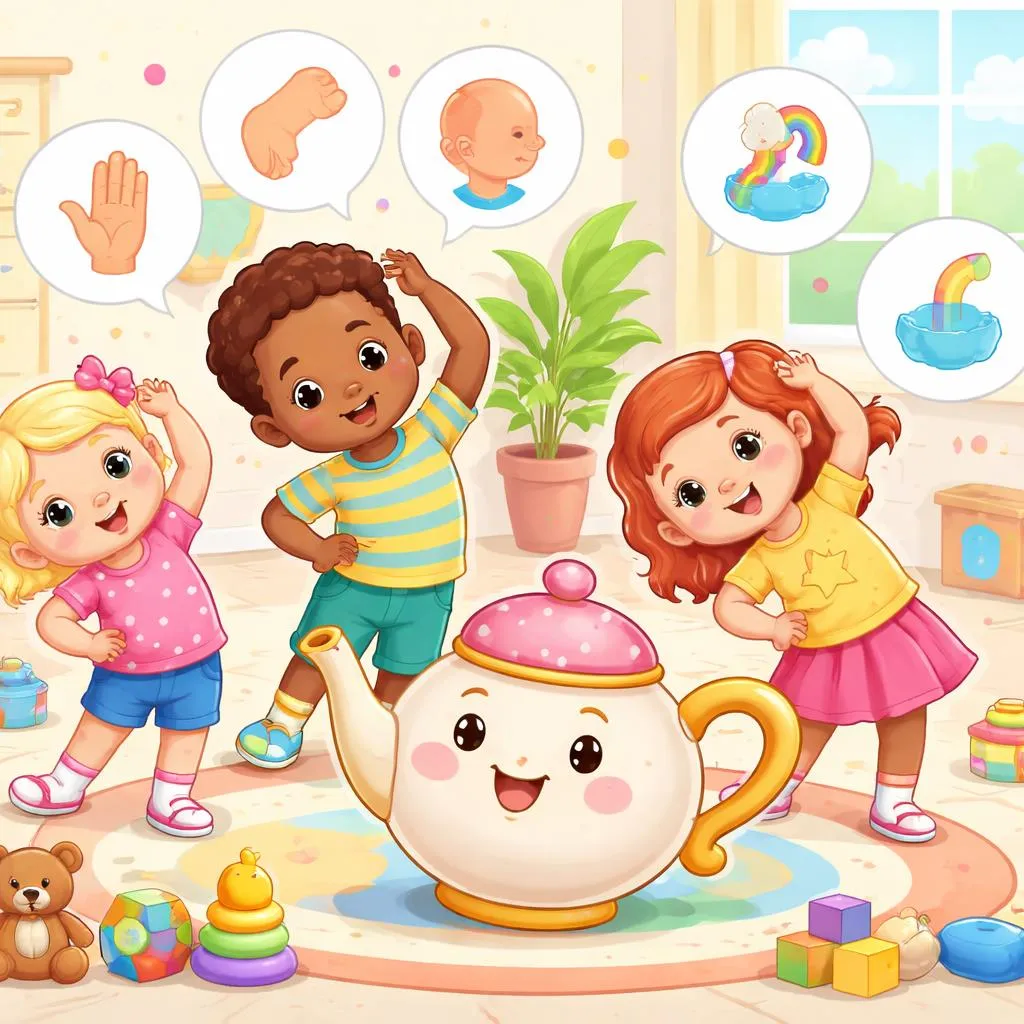

Hello, wonderful educators and parents! Today, we will explore one of the most iconic and physically engaging children’s rhymes. We are going to look closely at the words to I'm a Little Teapot. This classic action song does far more than entertain. It provides a perfect framework for teaching body parts, action verbs, and spatial awareness. Knowing the precise words to I'm a Little Teapot allows us to maximize its educational value. Let's pour into how this simple song can brew up a rich language learning experience.
What is the rhyme? "I'm a Little Teapot" is a popular children's action song and nursery rhyme. It originated in the United States in the 1930s as a dance for children. The rhyme is unique because it pairs specific lyrics with mimetic gestures. Children use their bodies to become the teapot, its handle, and its spout. This kinesthetic connection is its greatest teaching strength. The song transforms abstract words into concrete, physical shapes. This makes it an unforgettable tool for vocabulary retention and motor skill development.
The lyrics of nursery rhymes Let's establish the complete and standard version of the words to I'm a Little Teapot. Using consistent lyrics helps in teaching the coordinated movements. Here are the full, traditional lyrics:
I'm a little teapot, short and stout. Here is my handle, here is my spout. When I get all steamed up, hear me shout: "Tip me over and pour me out!"
Some versions include a second verse for the other side:
I'm a very special pot, it is true. Here is my handle, here is my spout. When I get all steamed up, hear me shout: "Tip me over and pour me out!"
Teaching these clear words to I'm a Little Teapot gives learners a solid base for action and language.
Vocabulary learning This rhyme introduces excellent descriptive and positional vocabulary. Key adjectives include "little," "short," and "stout." We can demonstrate these concepts visually and physically. The nouns are central to the song: "teapot," "handle," "spout," "steam." We directly link "handle" to one arm on the hip and "spout" to the other arm extended.
The song is also rich in action verbs: "get," "hear," "shout," "tip," "pour." We act these out dramatically. The phrase "steamed up" can introduce a fun idiom for feeling excited or angry. By anchoring each word in an action, the words to I'm a Little Teapot create deep, multisensory memory links for new language.
Phonics points The words to I'm a Little Teapot offer great opportunities for sound play. The rhyme heavily features the /ɒ/ sound in "pot," "stout," and "shout." We can emphasize this vowel sound as we sing. The /aʊ/ diphthong in "spout" and "out" is another clear example to highlight.
Alliteration and consonant sounds are also present. The repeated /t/ in "teapot," "tip," and "out" creates a crisp, rhythmic effect. The /st/ blend in "stout" is a useful consonant cluster to practice. Singing slowly allows us to isolate and repeat these sounds, turning a song into a subtle phonics lesson.
Grammar patterns The rhyme showcases the first-person perspective beautifully. The pronoun "I'm" (I am) and the possessive "my" are used throughout. This reinforces how to talk about oneself and one's body. The sentence "Here is my..." is a fundamental structure for identifying objects and ownership.
We also see the imperative mood in the command, "Tip me over and pour me out!" This is a natural way to learn polite command forms. The future implication in "When I get all steamed up, hear me shout" introduces a conditional cause-and-effect structure in a very simple, actionable way.
Learning activities The primary activity is, of course, the coordinated action performance. Practice the stance without singing first. One hand on the hip creates the "handle." The other arm curved out creates the "spout." Bend sideways on "Tip me over." This links the words to I'm a Little Teapot directly to motor planning and listening comprehension.
A "Teapot Design" craft activity extends the learning. Provide a simple teapot outline on paper. Learners can color it and label the parts: "handle," "spout," "lid." They can then write or trace the key words to I'm a Little Teapot around their drawing. This connects art, writing, and vocabulary.
Printable materials A "Sequence the Song" worksheet is very effective. Provide four pictures: 1) A whole teapot, 2) A hand on a hip (handle), 3) A steaming teapot, 4) A pouring teapot. Learners cut and paste them in the order the song describes. This builds narrative sequencing skills.
Create a "Word and Action Match" sheet. List the key verbs from the song: tip, pour, shout. Next to each, provide three simple pictures showing different actions. Learners draw a line from the word to the correct picture that matches the action in the words to I'm a Little Teapot. This reinforces verb meaning.
Educational games "Teapot Statues" is a fun twist on freeze dance. Play the song. Everyone dances like a teapot. Pause the music randomly. Call out a command based on the lyrics: "Show me your spout!" or "Get all steamed up!" Learners must freeze in that exact pose. This tests vocabulary recall and listening skills.
For a group game, try "Pass the Teapot." Sit in a circle. Pass a toy teapot around while singing. When the song reaches the word "shout," the person holding the teapot must shout, "Tip me over!" This game builds anticipation, reinforces keyword recognition, and keeps everyone engaged in the rhythm of the words to I'm a Little Teapot.
The magic of this rhyme lies in its perfect fusion of word and movement. When learners embody the words to I'm a Little Teapot, they are not just memorizing—they are living the language. This embodied learning makes vocabulary personal, physical, and permanent. Seeing a child confidently shape their body into a spout and shout the words is a sign of holistic language acquisition. So, encourage the dramatic play, celebrate the stout little teapots, and enjoy the process of pouring language skills into young minds through music and motion.